The T-Shaped Model for Immersive Learning at iLRN events
A design framework for iLRN conferences and events as immersive experiences
Codex Header
Codex Shelf / Book / Page (suggested):
-
Shelf: Annual Conference Series
-
Book: About the Annual iLRN Conference
-
Page: The T-Shaped Model for Immersive Learning at iLRN events
Maintainer: iLRN Executive Team (CEO office)
Primary Use: Conference and event design, program planning, experience curation, sponsor/partner alignment
Status: Active framework (living document)
Last Updated: 2026-02-04
Keywords / Tags: t-shaped model conference experience design hybrid Milgram continuum XR modalities place-based learning local host integration knowledge tree innovation garden futures lighthouse iLEAD
One-Sentence Abstract:
The iLRN T-Shaped Model is a practical design framework for conferences and events that (1) ensures modal breadth across the reality–virtuality continuum and (2) achieves contextual depth through authentic engagement with local place, culture, people, and relationships—while remaining aligned with iLRN’s ecosystem triad: the Knowledge Tree, Innovation Garden (iLEAD), and Futures Lighthouse.
Designing immersive learning scope & depth for our iLRN annual Conference
iLRN conferences are not simply venues for presenting work; they are themselves designed immersive experiences. This helps our emerging field share common experiences with immersive learning experiences and host dialogue within and about them. The T-Shaped Model is intended to prevent two common failure modes:
-
Modality narrowness: a conference becomes “VR-only,” “talks-only,” or “Zoom-only,” inadvertently shrinking the field’s perceived scope and excluding participants with different access realities. We emphasize the variation.
-
Placelessness: a conference can be physically hosted in a city (or “online”) yet feel interchangeable—missing the social, cultural, ecological, and relational specificity that makes immersive learning meaningful and ethical.
The T shape expresses a balanced commitment:
-
Horizontal: a curated spectrum of immersive modalities and participation formats.
-
Vertical: a deep dive into the host context—its local expertise, communities, ecosystems, histories, and lived realities.
The T-Shaped Model at a glance
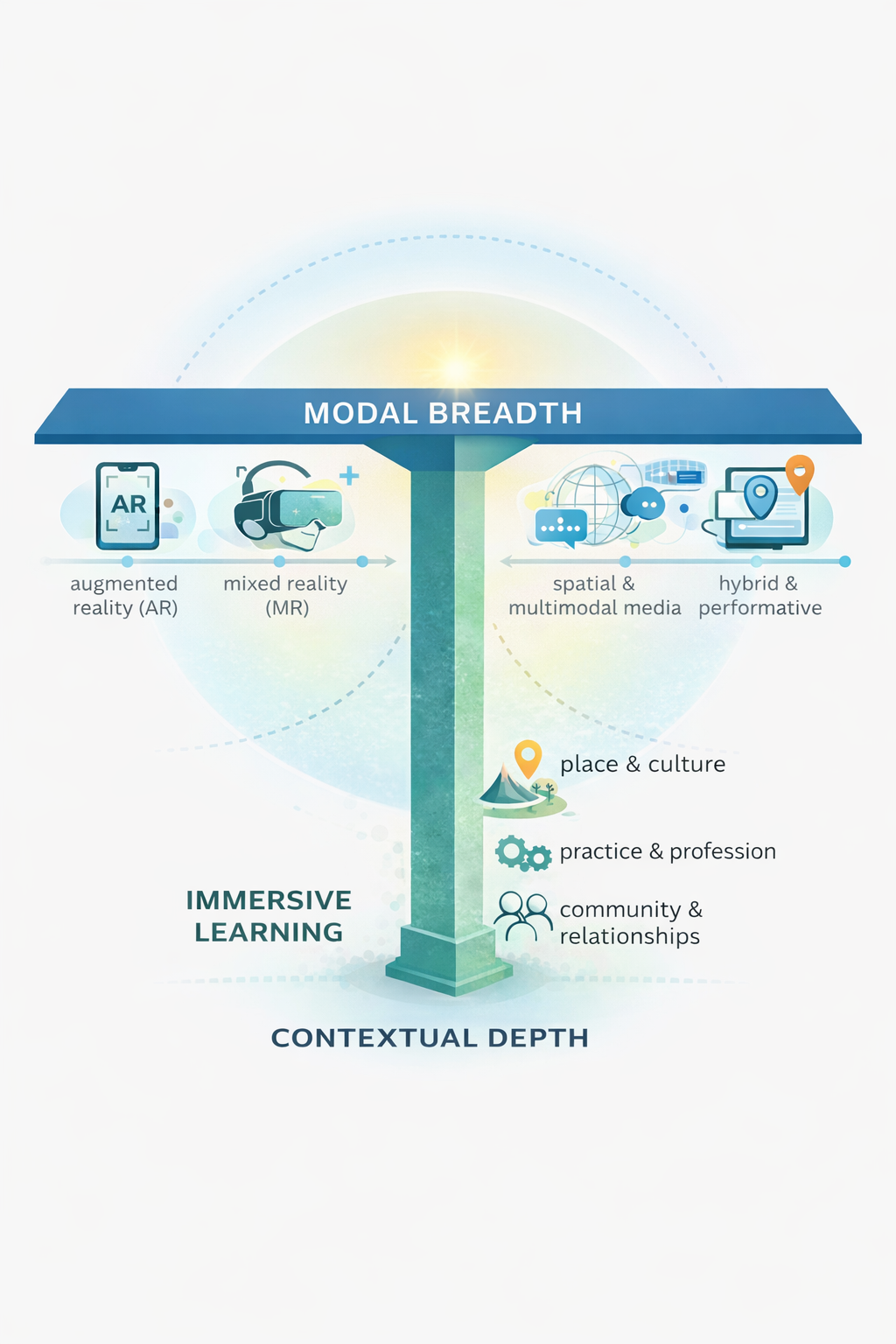
-
Horizontal = Modal Breadth (Milgram Reality–Virtuality Continuum): design the program so participants experience a range from AR → MR → VR, plus non-XR situated modalities, to represent the breadth of immersive learning practice and research.
-
Vertical = Contextual Depth (Local Host Realm): design intentional immersion into the location, culture, people, and relationships of the host context, creating authentic situated learning and community continuity.
(Note: This legend is intentionally operational; it is meant to guide planning decisions, not merely label concepts.)
Horizontal Dimension: Modal Breadth
Goal: Build an intentionally varied program across modalities so participants encounter the range of immersive learning—technically, pedagogically, and artistically.
Anchor concept: Milgram’s Reality–Virtuality Continuum (often referenced informally as “Milgram’s Spectrum”) spanning:
-
Physical/real environments and field experiences
-
Augmented Reality (AR)
-
Mixed Reality (MR) / Augmented Virtuality
-
Virtual Reality (VR)
-
Fully virtual environments and simulations
What “breadth” looks like at iLRN:
-
Sessions that cover multiple “levels” of immersion, from low-tech situated activities to high-end XR
-
Multiple participation pathways (in-person, online, hybrid synchronous, hybrid asynchronous)
-
A balanced mix of research, practice (iLEAD: Immersive Learning, Education, Arts, and Design), and futures/strategy programming
Vertical Dimension: Contextual Depth
Goal: Create meaningful immersion in the local host realm—not as tourism, but as situated learning, relationship-building, and ethical engagement.
Depth emphasizes:
-
Place and ecology (land, water, climate, built environment, local challenges)
-
Culture and history (including contested narratives, heritage, and living traditions)
-
People and relationships (local universities, schools, communities of practice, artists, industry, civic partners)
-
Stewardship and reciprocity (what iLRN gives back; what continues after we leave)
Mapping the T-Shape onto iLRN’s Ecosystem Triad
The T-Shaped Model does not collapse iLRN’s ecosystem into a single metaphor. It functions as an integrating lens that helps each ecosystem component contribute coherently to conference design.
Knowledge Tree — Evidence, theory, disciplines, and scholarly rigor
Primary contribution to the T:
-
Ensures the horizontal breadth reflects the full field (computer science, learning sciences, game studies/UX, and the branch houses) rather than a single technical trend.
-
Anchors the conference in publishable scholarship, methods, and peer-reviewed quality.
T-Shape implication: The Knowledge Tree helps prevent “modality breadth” from becoming a random assortment; it becomes a curated representation of disciplinary scope and quality.
Innovation Garden (iLEAD) — Practice, demonstration, arts, and design craft
Primary contribution to the T:
-
Makes “breadth” tangible through hands-on demos, studios, exhibits, performances, design showcases, and applied workshops.
-
Supports industry/product demos when they are structured as learning-oriented demonstrations (with clear educational value, transparency, and appropriate governance boundaries).
T-Shape implication: The Innovation Garden ensures participants can experience immersive learning, not only hear about it.
Futures Lantern — Scanning, scenarios, anticipatory governance
Primary contribution to the T:
-
Frames breadth and depth against emerging trajectories: AI, XR infrastructure, access, ethics, regulation, workforce shifts, global patterns.
-
Helps the vertical “local immersion” connect to planetary-scale challenges and long-range responsibilities.
T-Shape implication: The Immersive Futures' Lantern prevents the conference from being only retrospective (what we did) by sustaining forward motion (what we should prepare for).
How to use the T-Shaped Model in conference planning
1) Program architecture (committee-level)
Use the T as a planning rubric during program assembly:
-
Breadth checks (horizontal):
-
Do we have meaningful representation across AR/MR/VR and non-XR immersive modalities?
-
Do we have diversity across research, education practice, arts, and design craft (iLEAD)?
-
Do we have multiple access pathways (hybrid realities, time zones, asynchronous options)?
-
-
Depth checks (vertical):
-
What program elements could only happen here (or with this host community)?
-
Where do local partners lead, not merely appear?
-
What is the reciprocity plan—what remains valuable to the host community after iLRN?
-
2) Session and experience design (track-level)
Encourage each track/house to contribute both:
-
a modal offering (showcase something on the continuum) and
-
a place-rooted offering (a hosted experience, guided walk, local case study, community panel, site-based design challenge).
3) Participant experience journey (attendee-level)
Design “journeys” so attendees naturally traverse the T:
-
A participant can sample modalities across the week (horizontal)
-
And still “go deep” in at least one local immersion thread (vertical)
This is especially important in hybrid formats, where online attendees can otherwise become second-class participants.
Seasonal timeline fit (iLRN year begins September 1)
The T-Shaped Model is particularly useful as a seasonal rhythm rather than a one-time plan.
Pre-Season (build-up to September 1)
Objective: Establish the conditions for breadth and depth.
-
Identify local host partners, cultural advisors, and place-based anchors early
-
Run “modal breadth” audits on proposed program content
-
Establish hybrid access principles and minimum experience standards
In-Season (September 1 through the conference cycle)
Objective: Operationalize the T in committee timelines.
-
Each committee maintains a visible “T checklist” in their workflow
-
Program curation ensures breadth; local chair and partners drive depth
-
iLEAD programming is treated as a core pillar, not an add-on
-
Futures programming remains threaded throughout, not siloed
Post-Season (after the conference)
Objective: Harvest learning and steward continuity.
-
Publish reflective artifacts mapped to the T
-
Document host reciprocity outcomes
-
Convert “depth experiences” into reusable patterns and playbooks in the Codex
-
Feed futures insights into the next cycle’s scanning and workshop cards
Quality standards and governance signals
To keep the T-Shape from becoming aspirational branding, iLRN uses it as a governable design constraint:
-
Minimum breadth standard: conferences should intentionally represent multiple points along the reality–virtuality continuum and multiple participation modes.
-
Minimum depth standard: conferences should include hosted experiences that engage local context in ways that are authentic, ethical, and co-led with local partners.
-
Documentation standard: each conference should produce at least one Codex entry that:
-
maps experiences onto the T, and
-
records what worked, what failed, and what should be revised.
-
Tensions, risks, and constructive dissent
Opinion (explicit): The T-Shaped Model will only improve iLRN’s quality if you treat it as a constraint that forces trade-offs, not as a slogan that increases scope.
Key tensions to watch:
-
Breadth vs. coherence: More modalities can dilute narrative unity. Without curation, “breadth” becomes a buffet rather than a designed experience.
-
Depth vs. tokenism: “Local culture” can become performative if it is inserted late or framed as entertainment rather than co-led, reciprocal engagement.
-
Hybrid inequity: Breadth can unintentionally privilege those with high-end hardware and travel budgets unless access pathways are deliberately designed.
-
Operational load: Depth requires real relationship work; it cannot be produced by scheduling alone. If under-resourced, it collapses into generic social events.
-
Governance clarity: iLEAD product demonstrations, sponsor involvement, and experiential showcases require explicit boundaries so the conference remains educational, transparent, and values-aligned.
Practical checklist (paste into committee docs)
Breadth (Horizontal)
-
Program includes experiences spanning multiple points on the Milgram continuum
-
Clear representation of iLEAD practice: Education, Arts, Design
-
Multiple participation formats supported (in-person, online, hybrid)
-
Hardware access realities considered (loaners, low-tech alternatives, recordings, asynchronous options)
Depth (Vertical)
-
At least one signature experience co-led with local partners
-
Local context is present in more than one moment (threaded, not isolated)
-
Reciprocity plan documented (what iLRN contributes back)
-
Ethical considerations reviewed (representation, consent, cultural protocols)
Ecosystem coherence
-
Knowledge Tree: scholarship and disciplinary coverage are visible
-
Innovation Garden: hands-on experiences and showcases are core
-
Futures Lighthouse: anticipatory threads are integrated across the program
Suggested citation
Immersive Learning Research Network (iLRN). (2026). The iLRN T-Shaped Model for Immersive Learning: A design framework for conferences and events as immersive experiences. iLRN Codex.
Related Codex pages (recommended links)
-
Designing Immersive Convenings at iLRN (parent page)
-
iLRN Ecosystem Triad: Knowledge Tree, Innovation Garden (iLEAD), Futures Lighthouse
-
Hybrid Stack Rollout Plan (Seasonal timeline integration)
-
iLEAD scope and governance boundaries (including product demonstrations)
-
Conference experience standards (minimum viable immersion for hybrid equity)
Codex colophon
This Codex page is a living artifact maintained by iLRN. It is intended for operational use in planning and governance. Revisions should preserve a changelog, note the rationale for changes, and record any downstream impacts on conference policy, review processes, and participant experience standards.