Category 2: 2026 Future Technology Possibility
Future Technology Possibility Cards describe technologies plausible within a ten-to-twenty year horizon with significant implications for immersive learning. These cards are explicitly probabilistic — they describe what might be, not what will be. Each card carries a Circle of Scholars Part I snapshot and a community evidence Part II in which plausibility assessments, weak signals, and horizon challenges are welcomed.
- old template...Flow Machines: Adaptive XR via Biometrics
- FT: Agentic AI
- FT: Surveillance-by-Design XR
- FT: Flow Machines and Adaptive XR
- FT: Invisible Computing
- FT: Conversational Presence
- FT: Expanding XR Attack Surface
- FT: Democratized World-Building
- FT: Real Time Generative 3D
- FT: Wearables Everywhere
- FT: Reality Governance
- FT: Open XR Futures
- FT: MultiModal Intelligence
- FT: AI without AGI
- FT: Horizon Scanning as Infrastructure
- FT: Swarm Intelligence
old template...Flow Machines: Adaptive XR via Biometrics
Flow Machines: Adaptive XR via Biometrics
Workshop Synthesis
Circle of Scholars Activity
Facilitated by Fridolin Wild
January 14, 2026
Technology Possibility — Circle of Scholars
-
Immersive Learning Research Network (iLRN)
-
Immersive Futures Guild
-
One Sentence Abstract
This Codex entry documents a shared articulation and ongoing tensions emerging from an iLRN Circle of Scholars workshop exploring biometric sensing and adaptive XR as a technological possibility for maintaining learner flow through closed-loop, real-time pedagogical control systems.
Suggested Citation
Immersive Learning Research Network (iLRN). (2026). Flow machines: Adaptive XR via biometrics—Technology possibility—Circle of Scholars workshop synthesis. Immersive Futures Guild, iLRN Codex. https://codex.immersivelrn.org/link/459
Part I — Shared Articulation (Workshop Synthesis)
Context
This card emerged from the Circle of Scholars 2026 workshop as an exploration of a specific technology possibility: the use of real-time biometric sensing (e.g., heart rate variability, galvanic skin response, eye tracking, EEG proxies) to dynamically adapt immersive learning environments.
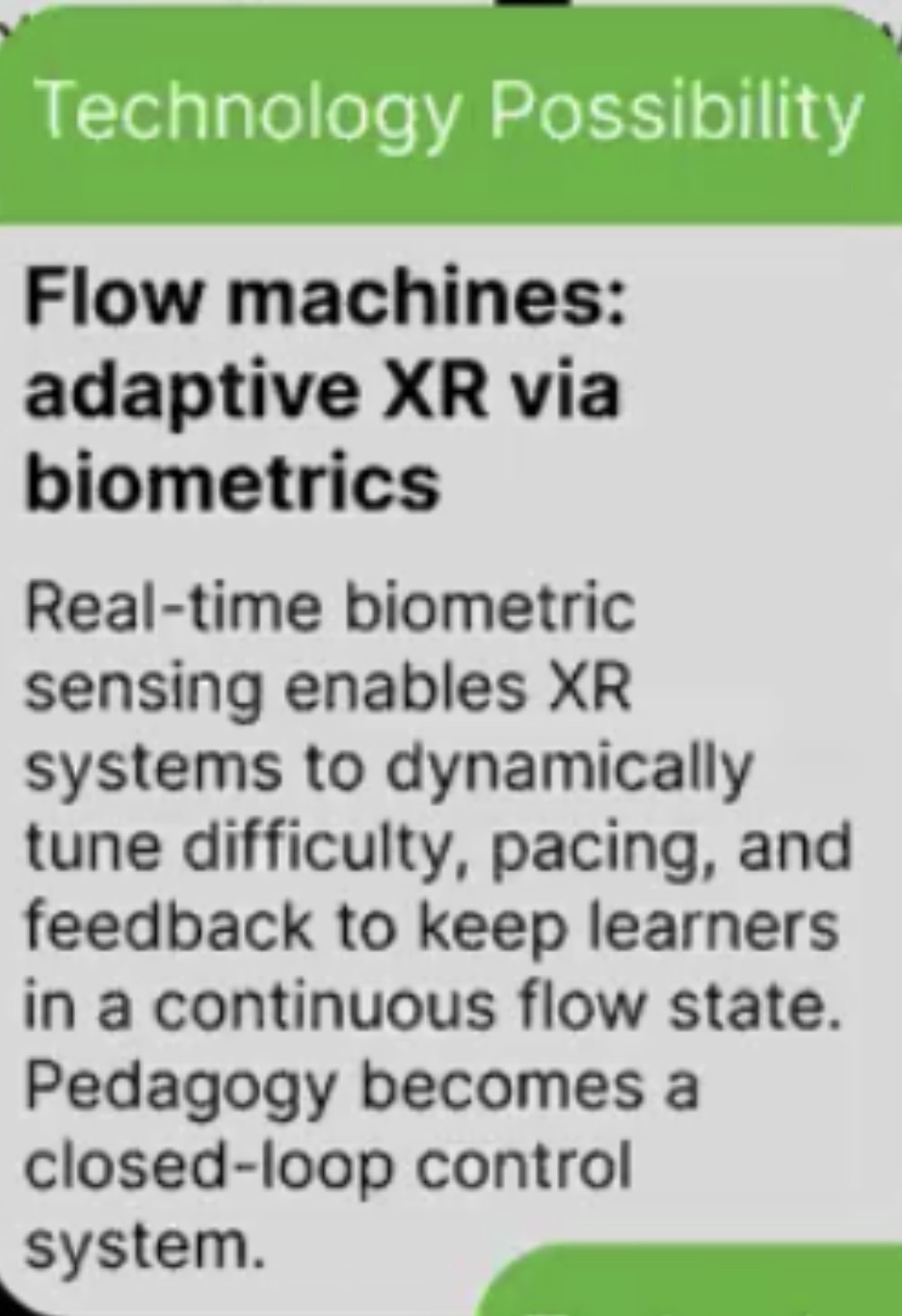
Participants examined the idea that XR systems could sense learner state continuously and adjust difficulty, pacing, modality, and feedback to sustain engagement—framing pedagogy as a closed-loop control system rather than a fixed instructional sequence.
The discussion treated this not as an inevitability, but as a design frontier with profound implications for agency, ethics, evidence, and governance.
Core Claim
Biometric-adaptive XR systems make it technically feasible for pedagogy to operate as a real-time feedback loop—continuously sensing learner state and tuning experience parameters to maintain flow—but this capability fundamentally reshapes assumptions about agency, consent, and instructional responsibility.
Key Dimensions Identified
The workshop surfaced four interrelated dimensions of this technology possibility:
1. Flow as a Controllable Variable
Flow was discussed not as a mystical state, but as a measurable proxy constructed from physiological and behavioral signals.
Key considerations included:
-
Operationalizing “flow” through indirect indicators rather than self-report alone
-
The risk of collapsing complex cognitive-emotional states into optimization targets
-
Whether maintaining flow should always be the goal, versus productive struggle or discomfort
2. Pedagogy as Closed-Loop Control
Participants explored the shift from open-loop instructional design to adaptive systems that respond continuously to learner state.
This reframing raised questions about:
-
Who defines the target state of the learner
-
How control parameters are set, tuned, and validated
-
The difference between responsiveness and manipulation
-
Transparency of adaptation logic to learners and educators
3. Biometric Data as Pedagogical Substrate
Biometric signals were treated not merely as analytics, but as instructional inputs.
Discussion emphasized:
-
Data quality, noise, and contextual ambiguity
-
The danger of over-interpreting physiological signals
-
Issues of data ownership, storage, and secondary use
-
Cultural and individual variability in biometric expression
4. Automation, Agency, and Trust
Adaptive XR systems introduce new asymmetries between system intelligence and learner awareness.
Key concerns included:
-
Learner consent in continuously adaptive environments
-
The erosion or augmentation of learner self-regulation
-
Educator trust in algorithmic pedagogical decisions
-
Long-term dependence on optimization systems
Why This Matters for Immersive Learning
Participants emphasized that biometric-adaptive XR systems:
-
Shift instructional authority from static design to dynamic systems
-
Blur boundaries between assessment, feedback, and intervention
-
Introduce ethical stakes at the level of moment-to-moment experience
-
Demand new validation methods beyond learning outcomes alone
As immersive learning systems become more responsive and autonomous, the locus of pedagogical responsibility moves from content to control logic.
Part II — Tensions, Open Questions, and Ongoing Dialogue
(This section remains intentionally open and revisitable.)
Unresolved Tensions Identified
The workshop did not resolve several core tensions:
Flow optimization vs. learner autonomy
When does adaptive support become behavioral steering?
Responsiveness vs. opacity
How much should learners know about how systems are adapting them?
Personalization vs. normalization
Do adaptive systems privilege certain physiological norms over others?
Efficiency vs. educational friction
What kinds of struggle or discomfort are pedagogically necessary—and should not be optimized away?
Points of Debate
Participants raised questions requiring further inquiry:
-
Can flow be a legitimate instructional objective across all learning domains?
-
What constitutes evidence that biometric adaptation improves learning rather than engagement alone?
-
How should disagreement between learner self-perception and system inference be handled?
-
Who is accountable when adaptive systems fail or cause harm?
Relationship to the iLRN Ways of Knowing Map
This card intersects with all three iLRN Ways of Knowing:
Tree (Knowledge / Evidence):
Learning sciences, control theory, affective computing, human-AI interaction, psychophysiology
Garden (Practice):
Adaptive XR design, biometric sensing pipelines, instructor dashboards, ethical design patterns
Lantern (Futures):
Automated pedagogy, attention economies, governance of adaptive learning systems
The card functions as a technology possibility, not a recommended practice or settled theory.
Invitation for Continued Contribution
Members of iLRN are invited to:
-
Contribute empirical studies or prototypes involving biometric-adaptive XR
-
Surface ethical failures or unintended consequences
-
Propose alternative metaphors to “closed-loop control”
-
Develop evaluation methods that move beyond engagement metrics
To contest, contribute, or extend this discussion,
please complete the Technology Possibility contribution form for Vision 2035: Flow Machines — Adaptive XR via Biometrics.
Disagreement is expected. Documentation is encouraged.
Examples, critiques, implementations, and methodological proposals related to this card may be added here through documented community contribution.
Working Status
This card reflects the current synthesis of the Circle of Scholars workshop.
It is a living artifact and may evolve as further dialogue, evidence, and practice emerge.
Codex Colophon
This page is part of the iLRN Codex, a living knowledge base supporting scholarly dialogue, practice-based inquiry, and futures-oriented exploration in immersive learning.
Guild: Immersive Futures
Activity: Circle of Scholars
Artifact Type: Technology Possibility Card
Methodological Context: Design-Based Research (DBR)
Ways of Knowing: Tree · Garden · Lantern
This artifact records a time-stamped synthesis, not a final position.
Disagreement is expected. Documentation is encouraged.
Versioning & Status
-
Initial synthesis: January 2026
-
Status: Living document
-
Revision policy: Updated through documented community contributions and facilitated dialogue
Permanent link:
https://codex.immersivelrn.org/link/459
FT: Agentic AI
|
PART I — FORESIGHT SNAPSHOT | FT: Agentic AI | Fixed Time-Stamped Synthesis |
2026 FT: Agentic AI
|
Card Type |
Future Technology Possibility |
|
Series |
Immersive Futures Guild — Vision 2035 |
|
Layer |
1 — Atomic Foresight Object |
|
Status |
Active |
|
Confidence |
Medium |
|
Workshop |
Circle of Scholars — January 2026 |
|
Facilitator |
Circle of Scholars Workshop Team |
|
Tags |
agentic-AI | autonomy | pedagogy | layer1 | ft |
|
Tally.so Form |
https://tally.so/r/ilrn-if-ft-agentai-2026 |
Agentic AI systems capable of planning multi-step actions, pursuing goals across time, and operating with minimal human oversight are moving from laboratory research into deployed applications. In immersive learning, agentic AI raises questions about who controls the trajectory of a learning experience, how agency is shared between learner, educator, and system, and what happens when learning agents pursue optimization targets that do not align with human educational values.
Key Drivers / Contributing Conditions:
-
AI capability scaling enabling multi-step goal pursuit
-
Commercial deployment of agentic systems in consumer and enterprise contexts
-
Research on AI-assisted learning path generation and adaptive scaffolding
Tensions Carried Forward to Part II:
-
Who is accountable when an agentic AI system makes a pedagogically harmful decision?
-
Can learner agency be preserved in an environment where AI agents are continuously optimizing?
Linked Scenarios / Strands: SC: Responsible AI | SCENARIO: Open Human Agency | STRAND: Human-Centered AI + XR
Ways of Knowing: Tree · Garden · Lantern
|
PART II — COMMUNITY EVIDENCE & DIALOGUE TRACK | FT: Agentic AI | H2 2026 — Living |
|
T |
COMMUNITY CONTRIBUTION FORM — FT: Agentic AI Submit case examples, methodological challenges, cultural perspectives, and proposed evidence criteria via: https://tally.so/r/ilrn-if-ft-agentai-2026 |
|
Part II — Scope and Instructions |
|
This section collects community responses, case examples, and challenges to the Part I foresight snapshot above. |
|
It opens July 1, 2026 and undergoes synthesis review in September 2026, November 2026, and January 2027. |
|
Contributions are submitted via the Tally.so form above and appear in the registers below after editorial review. |
|
The Part I text is not modified in response to Part II contributions; it is versioned at the Annual Handoff review. |
|
Contribution categories: Case Example | Methodological Challenge | Cultural/Community Perspective | Proposed Evidence Criterion |
|
Ways of Knowing accepted: Tree (evidence) | Garden (practice) | Lantern (futures) |
Tensions Open for Community Response:
-
Who is accountable when an agentic AI system makes a pedagogically harmful decision?
-
Can learner agency be preserved in an environment where AI agents are continuously optimizing?
|
Contributor / Date |
Category |
Way of Knowing |
Contribution Summary |
|---|---|---|---|
|
[ Awaiting contributions — form opens July 1, 2026 ] |
FT: Surveillance-by-Design XR
|
PART I — FORESIGHT SNAPSHOT | FT: Surveillance-by-Design XR | Fixed Time-Stamped Synthesis |
2026 FT: Surveillance-by-Design XR
|
Card Type |
Future Technology Possibility |
|
Series |
Immersive Futures Guild — Vision 2035 |
|
Layer |
1 — Atomic Foresight Object |
|
Status |
Active |
|
Confidence |
Medium |
|
Workshop |
Circle of Scholars — January 2026 |
|
Facilitator |
Circle of Scholars Workshop Team |
|
Tags |
surveillance | biometrics | privacy | layer1 | ft |
|
Tally.so Form |
https://tally.so/r/ilrn-if-ft-survxr-2026 |
As XR hardware becomes more capable of continuous biometric sensing, platforms and institutions face design choices about whether to build surveillance capacity into immersive learning systems by default. Surveillance-by-design refers to architectures that treat learner behavioral and biometric data as a core product feature rather than an opt-in capability. This card tracks the development trajectory of these architectures and the regulatory and community resistance to them.
Key Drivers / Contributing Conditions:
-
Biometric hardware normalization in consumer headsets
-
Commercial incentives for behavioral data monetization
-
Weak regulatory frameworks for educational biometric data
Tensions Carried Forward to Part II:
-
Where is the boundary between adaptive personalization and surveillance in immersive systems?
-
Can surveillance-by-design be governed by consent frameworks when it is built into the hardware?
Linked Scenarios / Strands: SC: Ethics Privacy & Bodily Autonomy | SCENARIO: Extractive Surveillance | STRAND: Ethical Multimodal Analytics
Ways of Knowing: Tree · Garden · Lantern
|
PART II — COMMUNITY EVIDENCE & DIALOGUE TRACK | FT: Surveillance-by-Design XR | H2 2026 — Living |
|
T |
COMMUNITY CONTRIBUTION FORM — FT: Surveillance-by-Design XR Submit case examples, methodological challenges, cultural perspectives, and proposed evidence criteria via: https://tally.so/r/ilrn-if-ft-survxr-2026 |
|
Part II — Scope and Instructions |
|
This section collects community responses, case examples, and challenges to the Part I foresight snapshot above. |
|
It opens July 1, 2026 and undergoes synthesis review in September 2026, November 2026, and January 2027. |
|
Contributions are submitted via the Tally.so form above and appear in the registers below after editorial review. |
|
The Part I text is not modified in response to Part II contributions; it is versioned at the Annual Handoff review. |
|
Contribution categories: Case Example | Methodological Challenge | Cultural/Community Perspective | Proposed Evidence Criterion |
|
Ways of Knowing accepted: Tree (evidence) | Garden (practice) | Lantern (futures) |
Tensions Open for Community Response:
-
Where is the boundary between adaptive personalization and surveillance in immersive systems?
-
Can surveillance-by-design be governed by consent frameworks when it is built into the hardware?
|
Contributor / Date |
Category |
Way of Knowing |
Contribution Summary |
|---|---|---|---|
|
[ Awaiting contributions — form opens July 1, 2026 ] |
FT: Flow Machines and Adaptive XR
|
PART I — FORESIGHT SNAPSHOT | FT: Flow Machines & Adaptive XR | Fixed Time-Stamped Synthesis |
2026 FT: Flow Machines & Adaptive XR
|
Card Type |
Future Technology Possibility |
|
Series |
Immersive Futures Guild — Vision 2035 |
|
Layer |
1 — Atomic Foresight Object |
|
Status |
Active |
|
Confidence |
Medium |
|
Workshop |
Circle of Scholars — January 2026 |
|
Facilitator |
Circle of Scholars Workshop Team |
|
Tags |
adaptive-XR | flow | personalization | layer1 | ft |
|
Tally.so Form |
https://tally.so/r/ilrn-if-ft-flow-2026 |
Adaptive XR systems using real-time multimodal data about learner state — attention, arousal, cognitive load, emotional valence — to adjust the immersive environment dynamically are in active development. At their best, these systems support flow states and optimize learning conditions for individual learners. At their worst, they become manipulative engagement engines that optimize for behavioral compliance rather than genuine learning.
Key Drivers / Contributing Conditions:
-
Multimodal sensing maturation in XR hardware
-
Research on flow states and cognitive load in immersive contexts
-
Commercial demand for engagement optimization in EdTech
Tensions Carried Forward to Part II:
-
How can the design boundary between flow support and behavioral manipulation be operationalized?
-
Can adaptive systems be transparent enough to preserve learner autonomy?
Linked Scenarios / Strands: SC: Digital Wellbeing | SCENARIO: Creative Immersion | STRAND: Embodied Cognition & Learning
Ways of Knowing: Tree · Garden · Lantern
|
PART II — COMMUNITY EVIDENCE & DIALOGUE TRACK | FT: Flow Machines & Adaptive XR | H2 2026 — Living |
|
T |
COMMUNITY CONTRIBUTION FORM — FT: Flow Machines & Adaptive XR Submit case examples, methodological challenges, cultural perspectives, and proposed evidence criteria via: https://tally.so/r/ilrn-if-ft-flow-2026 |
|
Part II — Scope and Instructions |
|
This section collects community responses, case examples, and challenges to the Part I foresight snapshot above. |
|
It opens July 1, 2026 and undergoes synthesis review in September 2026, November 2026, and January 2027. |
|
Contributions are submitted via the Tally.so form above and appear in the registers below after editorial review. |
|
The Part I text is not modified in response to Part II contributions; it is versioned at the Annual Handoff review. |
|
Contribution categories: Case Example | Methodological Challenge | Cultural/Community Perspective | Proposed Evidence Criterion |
|
Ways of Knowing accepted: Tree (evidence) | Garden (practice) | Lantern (futures) |
Tensions Open for Community Response:
-
How can the design boundary between flow support and behavioral manipulation be operationalized?
-
Can adaptive systems be transparent enough to preserve learner autonomy?
|
Contributor / Date |
Category |
Way of Knowing |
Contribution Summary |
|---|---|---|---|
|
[ Awaiting contributions — form opens July 1, 2026 ] |
FT: Invisible Computing
|
PART I — FORESIGHT SNAPSHOT | FT: Invisible Computing | Fixed Time-Stamped Synthesis |
2026 FT: Invisible Computing
|
Card Type |
Future Technology Possibility |
|
Series |
Immersive Futures Guild — Vision 2035 |
|
Layer |
1 — Atomic Foresight Object |
|
Status |
Active |
|
Confidence |
Medium |
|
Workshop |
Circle of Scholars — January 2026 |
|
Facilitator |
Circle of Scholars Workshop Team |
|
Tags |
invisible-computing | ambient | ubiquitous | layer1 | ft |
|
Tally.so Form |
https://tally.so/r/ilrn-if-ft-invis-2026 |
The trajectory of computing toward ambient, embedded, and wearable forms means that the interface boundaries of immersive learning are dissolving. Future learners may not distinguish between digital and physical learning environments because the distinction has become architectural rather than experiential. This card examines the implications of invisible computing for learning design, assessment, ethics, and consent.
Key Drivers / Contributing Conditions:
-
Smart environment infrastructure maturation
-
Miniaturization of sensing and display hardware
-
Ambient AI processing capability growth
Tensions Carried Forward to Part II:
-
How should consent operate in learning environments where the digital interface is invisible?
-
What does learner control mean when the immersive system is ambient and continuous?
Linked Scenarios / Strands: STRAND: Ambient & Invisible XR Infrastructure | FT: Wearables Everywhere
Ways of Knowing: Tree · Garden · Lantern
|
PART II — COMMUNITY EVIDENCE & DIALOGUE TRACK | FT: Invisible Computing | H2 2026 — Living |
|
T |
COMMUNITY CONTRIBUTION FORM — FT: Invisible Computing Submit case examples, methodological challenges, cultural perspectives, and proposed evidence criteria via: https://tally.so/r/ilrn-if-ft-invis-2026 |
|
Part II — Scope and Instructions |
|
This section collects community responses, case examples, and challenges to the Part I foresight snapshot above. |
|
It opens July 1, 2026 and undergoes synthesis review in September 2026, November 2026, and January 2027. |
|
Contributions are submitted via the Tally.so form above and appear in the registers below after editorial review. |
|
The Part I text is not modified in response to Part II contributions; it is versioned at the Annual Handoff review. |
|
Contribution categories: Case Example | Methodological Challenge | Cultural/Community Perspective | Proposed Evidence Criterion |
|
Ways of Knowing accepted: Tree (evidence) | Garden (practice) | Lantern (futures) |
Tensions Open for Community Response:
-
How should consent operate in learning environments where the digital interface is invisible?
-
What does learner control mean when the immersive system is ambient and continuous?
|
Contributor / Date |
Category |
Way of Knowing |
Contribution Summary |
|---|---|---|---|
|
[ Awaiting contributions — form opens July 1, 2026 ] |
FT: Conversational Presence
|
PART I — FORESIGHT SNAPSHOT | FT: Conversational Presence | Fixed Time-Stamped Synthesis |
2026 FT: Conversational Presence
|
Card Type |
Future Technology Possibility |
|
Series |
Immersive Futures Guild — Vision 2035 |
|
Layer |
1 — Atomic Foresight Object |
|
Status |
Active |
|
Confidence |
Medium |
|
Workshop |
Circle of Scholars — January 2026 |
|
Facilitator |
Circle of Scholars Workshop Team |
|
Tags |
conversational-AI | social-presence | LLM | layer1 | ft |
|
Tally.so Form |
https://tally.so/r/ilrn-if-ft-convpres-2026 |
Large language model and multimodal AI systems are creating a new category of social presence in immersive environments — AI agents that sustain extended, contextually coherent, emotionally responsive conversation. In learning contexts this raises questions about the nature of teacher-learner relationships, parasocial dynamics, and the appropriate scope of AI as a social partner in education.
Key Drivers / Contributing Conditions:
-
LLM capability scaling for contextual coherence
-
Multimodal AI enabling voice, expression, and gesture integration
-
Demand for 24/7 tutoring presence at scale
Tensions Carried Forward to Part II:
-
When does a conversational AI agent constitute an adequate substitute for a human educator?
-
How should parasocial attachment to AI tutors be understood and governed in educational contexts?
Linked Scenarios / Strands: STRAND: Social & Co-Regulated XR Learning | SCENARIO: Creative Immersion
Ways of Knowing: Tree · Garden · Lantern
|
PART II — COMMUNITY EVIDENCE & DIALOGUE TRACK | FT: Conversational Presence | H2 2026 — Living |
|
T |
COMMUNITY CONTRIBUTION FORM — FT: Conversational Presence Submit case examples, methodological challenges, cultural perspectives, and proposed evidence criteria via: https://tally.so/r/ilrn-if-ft-convpres-2026 |
|
Part II — Scope and Instructions |
|
This section collects community responses, case examples, and challenges to the Part I foresight snapshot above. |
|
It opens July 1, 2026 and undergoes synthesis review in September 2026, November 2026, and January 2027. |
|
Contributions are submitted via the Tally.so form above and appear in the registers below after editorial review. |
|
The Part I text is not modified in response to Part II contributions; it is versioned at the Annual Handoff review. |
|
Contribution categories: Case Example | Methodological Challenge | Cultural/Community Perspective | Proposed Evidence Criterion |
|
Ways of Knowing accepted: Tree (evidence) | Garden (practice) | Lantern (futures) |
Tensions Open for Community Response:
-
When does a conversational AI agent constitute an adequate substitute for a human educator?
-
How should parasocial attachment to AI tutors be understood and governed in educational contexts?
|
Contributor / Date |
Category |
Way of Knowing |
Contribution Summary |
|---|---|---|---|
|
[ Awaiting contributions — form opens July 1, 2026 ] |
FT: Expanding XR Attack Surface
|
PART I — FORESIGHT SNAPSHOT | FT: Expanding XR Attack Surface | Fixed Time-Stamped Synthesis |
2026 FT: Expanding XR Attack Surface
|
Card Type |
Future Technology Possibility |
|
Series |
Immersive Futures Guild — Vision 2035 |
|
Layer |
1 — Atomic Foresight Object |
|
Status |
Active |
|
Confidence |
Medium |
|
Workshop |
Circle of Scholars — January 2026 |
|
Facilitator |
Circle of Scholars Workshop Team |
|
Tags |
cybersecurity | attack-surface | privacy | layer1 | ft |
|
Tally.so Form |
https://tally.so/r/ilrn-if-ft-xratk-2026 |
As immersive environments become more interconnected and data-rich, they become larger and more consequential targets for malicious actors. The XR attack surface includes hardware vulnerabilities, platform data breaches, identity spoofing in social VR, manipulation of environmental stimuli to induce disorientation or harmful responses, and exfiltration of biometric and behavioral data.
Key Drivers / Contributing Conditions:
-
Increasing value of biometric data to malicious actors
-
Complexity of multi-platform XR environments creating security gaps
-
Limited security culture in EdTech development pipelines
Tensions Carried Forward to Part II:
-
How should security threat modeling be integrated into pedagogical design processes?
-
What liability frameworks apply when an educational XR platform is exploited to harm learners?
Linked Scenarios / Strands: SC: Ethics Privacy & Bodily Autonomy | SCENARIO: Extractive Surveillance
Ways of Knowing: Tree · Garden · Lantern
|
PART II — COMMUNITY EVIDENCE & DIALOGUE TRACK | FT: Expanding XR Attack Surface | H2 2026 — Living |
|
T |
COMMUNITY CONTRIBUTION FORM — FT: Expanding XR Attack Surface Submit case examples, methodological challenges, cultural perspectives, and proposed evidence criteria via: https://tally.so/r/ilrn-if-ft-xratk-2026 |
|
Part II — Scope and Instructions |
|
This section collects community responses, case examples, and challenges to the Part I foresight snapshot above. |
|
It opens July 1, 2026 and undergoes synthesis review in September 2026, November 2026, and January 2027. |
|
Contributions are submitted via the Tally.so form above and appear in the registers below after editorial review. |
|
The Part I text is not modified in response to Part II contributions; it is versioned at the Annual Handoff review. |
|
Contribution categories: Case Example | Methodological Challenge | Cultural/Community Perspective | Proposed Evidence Criterion |
|
Ways of Knowing accepted: Tree (evidence) | Garden (practice) | Lantern (futures) |
Tensions Open for Community Response:
-
How should security threat modeling be integrated into pedagogical design processes?
-
What liability frameworks apply when an educational XR platform is exploited to harm learners?
|
Contributor / Date |
Category |
Way of Knowing |
Contribution Summary |
|---|---|---|---|
|
[ Awaiting contributions — form opens July 1, 2026 ] |
FT: Democratized World-Building
|
PART I — FORESIGHT SNAPSHOT | FT: Democratized World-Building | Fixed Time-Stamped Synthesis |
2026 FT: Democratized World-Building
|
Card Type |
Future Technology Possibility |
|
Series |
Immersive Futures Guild — Vision 2035 |
|
Layer |
1 — Atomic Foresight Object |
|
Status |
Active |
|
Confidence |
Medium |
|
Workshop |
Circle of Scholars — January 2026 |
|
Facilitator |
Circle of Scholars Workshop Team |
|
Tags |
world-building | generative-AI | democratization | layer1 | ft |
|
Tally.so Form |
https://tally.so/r/ilrn-if-ft-worldbuild-2026 |
Generative AI tools are dramatically lowering the technical barriers to creating interactive 3D environments, narrative simulations, and immersive scenarios. This democratization has significant implications for who can create immersive learning experiences — shifting capacity from specialized development studios to individual educators, students, and community members — and for the equity, quality, and safety of the resulting ecosystem.
Key Drivers / Contributing Conditions:
-
Generative 3D AI capability scaling
-
No-code and low-code immersive platform development
-
Declining cost of real-time rendering infrastructure
Tensions Carried Forward to Part II:
-
Does democratized world-building enable community empowerment or accelerate the production of culturally harmful or pedagogically poor immersive content?
Linked Scenarios / Strands: STRAND: Learners as World-Builders | SCENARIO: Global Co-Creation
Ways of Knowing: Tree · Garden · Lantern
|
PART II — COMMUNITY EVIDENCE & DIALOGUE TRACK | FT: Democratized World-Building | H2 2026 — Living |
|
T |
COMMUNITY CONTRIBUTION FORM — FT: Democratized World-Building Submit case examples, methodological challenges, cultural perspectives, and proposed evidence criteria via: https://tally.so/r/ilrn-if-ft-worldbuild-2026 |
|
Part II — Scope and Instructions |
|
This section collects community responses, case examples, and challenges to the Part I foresight snapshot above. |
|
It opens July 1, 2026 and undergoes synthesis review in September 2026, November 2026, and January 2027. |
|
Contributions are submitted via the Tally.so form above and appear in the registers below after editorial review. |
|
The Part I text is not modified in response to Part II contributions; it is versioned at the Annual Handoff review. |
|
Contribution categories: Case Example | Methodological Challenge | Cultural/Community Perspective | Proposed Evidence Criterion |
|
Ways of Knowing accepted: Tree (evidence) | Garden (practice) | Lantern (futures) |
Tensions Open for Community Response:
-
Does democratized world-building enable community empowerment or accelerate the production of culturally harmful or pedagogically poor immersive content?
|
Contributor / Date |
Category |
Way of Knowing |
Contribution Summary |
|---|---|---|---|
|
[ Awaiting contributions — form opens July 1, 2026 ] |
FT: Real Time Generative 3D
|
PART I — FORESIGHT SNAPSHOT | FT: Real-Time Generative 3D | Fixed Time-Stamped Synthesis |
2026 FT: Real-Time Generative 3D
|
Card Type |
Future Technology Possibility |
|
Series |
Immersive Futures Guild — Vision 2035 |
|
Layer |
1 — Atomic Foresight Object |
|
Status |
Active |
|
Confidence |
Medium |
|
Workshop |
Circle of Scholars — January 2026 |
|
Facilitator |
Circle of Scholars Workshop Team |
|
Tags |
generative-3D | AI | content-creation | layer1 | ft |
|
Tally.so Form |
https://tally.so/r/ilrn-if-ft-gen3d-2026 |
The capability for AI systems to generate photorealistic or stylized 3D environments and objects in real time — rather than through pre-authored asset pipelines — is developing rapidly. This has direct implications for immersive learning content creation economies, the viability of adaptive environments that respond to learner choices, and the provenance and authenticity of educational immersive content.
Key Drivers / Contributing Conditions:
-
Neural rendering research maturation
-
GPU and NPU capability scaling
-
Commercial investment in real-time 3D generation
Tensions Carried Forward to Part II:
-
How should provenance be tracked for AI-generated immersive educational content?
-
Does real-time generation enable meaningful personalization or merely infinite variation without pedagogical purpose?
Linked Scenarios / Strands: FT: Democratized World-Building | SCENARIO: Creative Immersion
Ways of Knowing: Tree · Garden · Lantern
|
PART II — COMMUNITY EVIDENCE & DIALOGUE TRACK | FT: Real-Time Generative 3D | H2 2026 — Living |
|
T |
COMMUNITY CONTRIBUTION FORM — FT: Real-Time Generative 3D Submit case examples, methodological challenges, cultural perspectives, and proposed evidence criteria via: https://tally.so/r/ilrn-if-ft-gen3d-2026 |
|
Part II — Scope and Instructions |
|
This section collects community responses, case examples, and challenges to the Part I foresight snapshot above. |
|
It opens July 1, 2026 and undergoes synthesis review in September 2026, November 2026, and January 2027. |
|
Contributions are submitted via the Tally.so form above and appear in the registers below after editorial review. |
|
The Part I text is not modified in response to Part II contributions; it is versioned at the Annual Handoff review. |
|
Contribution categories: Case Example | Methodological Challenge | Cultural/Community Perspective | Proposed Evidence Criterion |
|
Ways of Knowing accepted: Tree (evidence) | Garden (practice) | Lantern (futures) |
Tensions Open for Community Response:
-
How should provenance be tracked for AI-generated immersive educational content?
-
Does real-time generation enable meaningful personalization or merely infinite variation without pedagogical purpose?
|
Contributor / Date |
Category |
Way of Knowing |
Contribution Summary |
|---|---|---|---|
|
[ Awaiting contributions — form opens July 1, 2026 ] |
FT: Wearables Everywhere
|
PART I — FORESIGHT SNAPSHOT | FT: Wearables Everywhere | Fixed Time-Stamped Synthesis |
FT: Wearables Everywhere
|
Card Type |
Future Technology Possibility |
|
Series |
Immersive Futures Guild — Vision 2035 |
|
Layer |
1 — Atomic Foresight Object |
|
Status |
Active |
|
Confidence |
Medium |
|
Workshop |
Circle of Scholars — January 2026 |
|
Facilitator |
Circle of Scholars Workshop Team |
|
Tags |
wearables | haptics | biosensors | layer1 | ft |
|
Tally.so Form |
https://tally.so/r/ilrn-if-ft-wear-2026 |
The proliferation of wearable computing — headsets, smart glasses, haptic devices, biosensors, and spatial audio systems — is creating a diverse hardware ecosystem for immersive learning. Future learners may engage with immersive content through a wide variety of form factors, not all of which share the same interaction paradigms, accessibility properties, or data collection capabilities.
Key Drivers / Contributing Conditions:
-
Consumer wearables market maturation
-
Haptic technology miniaturization
-
Spatial audio normalization in consumer devices
Tensions Carried Forward to Part II:
-
How should learning design account for a fragmented and heterogeneous wearable ecosystem?
-
Which wearable form factors enable genuinely immersive learning versus merely mobile content delivery?
Linked Scenarios / Strands: SC: Accessibility | STRAND: Ambient & Invisible XR Infrastructure
Ways of Knowing: Tree · Garden · Lantern
|
PART II — COMMUNITY EVIDENCE & DIALOGUE TRACK | FT: Wearables Everywhere | H2 2026 — Living |
|
T |
COMMUNITY CONTRIBUTION FORM — FT: Wearables Everywhere Submit case examples, methodological challenges, cultural perspectives, and proposed evidence criteria via: https://tally.so/r/ilrn-if-ft-wear-2026 |
|
Part II — Scope and Instructions |
|
This section collects community responses, case examples, and challenges to the Part I foresight snapshot above. |
|
It opens July 1, 2026 and undergoes synthesis review in September 2026, November 2026, and January 2027. |
|
Contributions are submitted via the Tally.so form above and appear in the registers below after editorial review. |
|
The Part I text is not modified in response to Part II contributions; it is versioned at the Annual Handoff review. |
|
Contribution categories: Case Example | Methodological Challenge | Cultural/Community Perspective | Proposed Evidence Criterion |
|
Ways of Knowing accepted: Tree (evidence) | Garden (practice) | Lantern (futures) |
Tensions Open for Community Response:
-
How should learning design account for a fragmented and heterogeneous wearable ecosystem?
-
Which wearable form factors enable genuinely immersive learning versus merely mobile content delivery?
|
Contributor / Date |
Category |
Way of Knowing |
Contribution Summary |
|---|---|---|---|
|
[ Awaiting contributions — form opens July 1, 2026 ] |
FT: Reality Governance
|
PART I — FORESIGHT SNAPSHOT | FT: Reality Governance | Fixed Time-Stamped Synthesis |
2026 FT: Reality Governance
|
Card Type |
Future Technology Possibility |
|
Series |
Immersive Futures Guild — Vision 2035 |
|
Layer |
1 — Atomic Foresight Object |
|
Status |
Active |
|
Confidence |
Medium |
|
Workshop |
Circle of Scholars — January 2026 |
|
Facilitator |
Circle of Scholars Workshop Team |
|
Tags |
governance | regulation | policy | layer1 | ft |
|
Tally.so Form |
https://tally.so/r/ilrn-if-ft-realgov-2026 |
As immersive technologies become capable of mediating substantial portions of human experience — work, education, social interaction, civic life — questions of governance move from technical and corporate domains into policy and democratic processes. Reality governance refers to the emerging field of policy, regulation, and institutional frameworks that govern who controls immersive environments, what occurs within them, and who bears accountability for harms.
Key Drivers / Contributing Conditions:
-
Metaverse platform governance debates
-
Regulatory extension into virtual spaces
-
Democratic legitimacy questions about corporate control of social environments
Tensions Carried Forward to Part II:
-
Who has legitimate authority to govern persistent immersive educational environments?
-
How should democratic accountability be extended to AI-mediated immersive spaces?
Linked Scenarios / Strands: SC: Responsible AI | SCENARIO: Open Human Agency
Ways of Knowing: Tree · Garden · Lantern
|
PART II — COMMUNITY EVIDENCE & DIALOGUE TRACK | FT: Reality Governance | H2 2026 — Living |
|
T |
COMMUNITY CONTRIBUTION FORM — FT: Reality Governance Submit case examples, methodological challenges, cultural perspectives, and proposed evidence criteria via: https://tally.so/r/ilrn-if-ft-realgov-2026 |
|
Part II — Scope and Instructions |
|
This section collects community responses, case examples, and challenges to the Part I foresight snapshot above. |
|
It opens July 1, 2026 and undergoes synthesis review in September 2026, November 2026, and January 2027. |
|
Contributions are submitted via the Tally.so form above and appear in the registers below after editorial review. |
|
The Part I text is not modified in response to Part II contributions; it is versioned at the Annual Handoff review. |
|
Contribution categories: Case Example | Methodological Challenge | Cultural/Community Perspective | Proposed Evidence Criterion |
|
Ways of Knowing accepted: Tree (evidence) | Garden (practice) | Lantern (futures) |
Tensions Open for Community Response:
-
Who has legitimate authority to govern persistent immersive educational environments?
-
How should democratic accountability be extended to AI-mediated immersive spaces?
|
Contributor / Date |
Category |
Way of Knowing |
Contribution Summary |
|---|---|---|---|
|
[ Awaiting contributions — form opens July 1, 2026 ] |
FT: Open XR Futures
|
PART I — FORESIGHT SNAPSHOT | FT: Open XR Futures | Fixed Time-Stamped Synthesis |
2026 FT: Open XR Futures
|
Card Type |
Future Technology Possibility |
|
Series |
Immersive Futures Guild — Vision 2035 |
|
Layer |
1 — Atomic Foresight Object |
|
Status |
Active |
|
Confidence |
Medium |
|
Workshop |
Circle of Scholars — January 2026 |
|
Facilitator |
Circle of Scholars Workshop Team |
|
Tags |
open-XR | interoperability | standards | layer1 | ft |
|
Tally.so Form |
https://tally.so/r/ilrn-if-ft-openxr-2026 |
The trajectory of XR platforms is contested between proprietary, closed ecosystems controlled by large technology corporations and open, interoperable standards developed through community and standards-body governance. The outcome of this contest has significant implications for who can build immersive learning experiences, on what terms, with what portability, and with what accountability to learner communities.
Key Drivers / Contributing Conditions:
-
OpenXR standards development
-
WebXR maturation and browser-native XR
-
Open-source XR platform community growth
Tensions Carried Forward to Part II:
-
Can open XR platforms achieve sufficient quality and accessibility to compete with proprietary alternatives?
-
How should educational institutions navigate the risk of platform lock-in versus the constraint of open platform capability limitations?
Linked Scenarios / Strands: SCENARIO: Open Human Agency | SC: Equity
Ways of Knowing: Tree · Garden · Lantern
|
PART II — COMMUNITY EVIDENCE & DIALOGUE TRACK | FT: Open XR Futures | H2 2026 — Living |
|
T |
COMMUNITY CONTRIBUTION FORM — FT: Open XR Futures Submit case examples, methodological challenges, cultural perspectives, and proposed evidence criteria via: https://tally.so/r/ilrn-if-ft-openxr-2026 |
|
Part II — Scope and Instructions |
|
This section collects community responses, case examples, and challenges to the Part I foresight snapshot above. |
|
It opens July 1, 2026 and undergoes synthesis review in September 2026, November 2026, and January 2027. |
|
Contributions are submitted via the Tally.so form above and appear in the registers below after editorial review. |
|
The Part I text is not modified in response to Part II contributions; it is versioned at the Annual Handoff review. |
|
Contribution categories: Case Example | Methodological Challenge | Cultural/Community Perspective | Proposed Evidence Criterion |
|
Ways of Knowing accepted: Tree (evidence) | Garden (practice) | Lantern (futures) |
Tensions Open for Community Response:
-
Can open XR platforms achieve sufficient quality and accessibility to compete with proprietary alternatives?
-
How should educational institutions navigate the risk of platform lock-in versus the constraint of open platform capability limitations?
|
Contributor / Date |
Category |
Way of Knowing |
Contribution Summary |
|---|---|---|---|
|
[ Awaiting contributions — form opens July 1, 2026 ] |
FT: MultiModal Intelligence
|
PART I — FORESIGHT SNAPSHOT | FT: Multimodal Intelligence | Fixed Time-Stamped Synthesis |
2026 FT: Multimodal Intelligence
|
Card Type |
Future Technology Possibility |
|
Series |
Immersive Futures Guild — Vision 2035 |
|
Layer |
1 — Atomic Foresight Object |
|
Status |
Active |
|
Confidence |
Medium |
|
Workshop |
Circle of Scholars — January 2026 |
|
Facilitator |
Circle of Scholars Workshop Team |
|
Tags |
multimodal-AI | intelligence | sensing | layer1 | ft |
|
Tally.so Form |
https://tally.so/r/ilrn-if-ft-multimod-2026 |
AI systems capable of processing and generating across text, image, audio, video, and 3D modalities simultaneously are creating new possibilities for immersive learning design. Multimodal intelligence enables richer, more contextually responsive learning environments, but also introduces compounded risks of bias, consent violation, and the inappropriate collapse of distinctions between different types of learner expression.
Key Drivers / Contributing Conditions:
-
Multimodal foundation model capability scaling
-
Real-time multimodal processing hardware development
-
Research on multimodal learning analytics
Tensions Carried Forward to Part II:
-
How should the ethical governance of multimodal data differ from unimodal data governance?
-
Does multimodal AI enable deeper understanding of learning or merely more comprehensive surveillance?
Linked Scenarios / Strands: STRAND: Ethical Multimodal Analytics | STRAND: Human-Centered AI + XR
Ways of Knowing: Tree · Garden · Lantern
|
PART II — COMMUNITY EVIDENCE & DIALOGUE TRACK | FT: Multimodal Intelligence | H2 2026 — Living |
|
T |
COMMUNITY CONTRIBUTION FORM — FT: Multimodal Intelligence Submit case examples, methodological challenges, cultural perspectives, and proposed evidence criteria via: https://tally.so/r/ilrn-if-ft-multimod-2026 |
|
Part II — Scope and Instructions |
|
This section collects community responses, case examples, and challenges to the Part I foresight snapshot above. |
|
It opens July 1, 2026 and undergoes synthesis review in September 2026, November 2026, and January 2027. |
|
Contributions are submitted via the Tally.so form above and appear in the registers below after editorial review. |
|
The Part I text is not modified in response to Part II contributions; it is versioned at the Annual Handoff review. |
|
Contribution categories: Case Example | Methodological Challenge | Cultural/Community Perspective | Proposed Evidence Criterion |
|
Ways of Knowing accepted: Tree (evidence) | Garden (practice) | Lantern (futures) |
Tensions Open for Community Response:
-
How should the ethical governance of multimodal data differ from unimodal data governance?
-
Does multimodal AI enable deeper understanding of learning or merely more comprehensive surveillance?
|
Contributor / Date |
Category |
Way of Knowing |
Contribution Summary |
|---|---|---|---|
|
[ Awaiting contributions — form opens July 1, 2026 ] |
FT: AI without AGI
|
PART I — FORESIGHT SNAPSHOT | FT: AI without AGI | Fixed Time-Stamped Synthesis |
2026 FT: AI without AGI
|
Card Type |
Future Technology Possibility |
|
Series |
Immersive Futures Guild — Vision 2035 |
|
Layer |
1 — Atomic Foresight Object |
|
Status |
Active |
|
Confidence |
Medium |
|
Workshop |
Circle of Scholars — January 2026 |
|
Facilitator |
Circle of Scholars Workshop Team |
|
Tags |
narrow-AI | AI-capabilities | design | layer1 | ft |
|
Tally.so Form |
https://tally.so/r/ilrn-if-ft-ainoagi-2026 |
Narrow AI systems — highly capable at specific tasks but without general intelligence — are already reshaping immersive learning design. This card addresses the practical implications of systems that are powerful but bounded: capable at content generation, adaptive feedback, and learning analytics, while remaining limited in contextual judgment, ethical reasoning, and genuine pedagogical understanding. The mismatch between AI capability perception and AI capability reality is itself a design and governance challenge.
Key Drivers / Contributing Conditions:
-
AI marketing overstating generalization capability
-
Demonstrated brittleness of AI systems outside training distribution
-
Educator overreliance on AI recommendations without critical evaluation
Tensions Carried Forward to Part II:
-
How should educators calibrate their reliance on AI systems whose limitations are systematically underrepresented in marketing?
Linked Scenarios / Strands: SCENARIO: Pragmatic Normalization | STRAND: Human-Centered AI + XR
Ways of Knowing: Tree · Garden · Lantern
|
PART II — COMMUNITY EVIDENCE & DIALOGUE TRACK | FT: AI without AGI | H2 2026 — Living |
|
T |
COMMUNITY CONTRIBUTION FORM — FT: AI without AGI Submit case examples, methodological challenges, cultural perspectives, and proposed evidence criteria via: https://tally.so/r/ilrn-if-ft-ainoagi-2026 |
|
Part II — Scope and Instructions |
|
This section collects community responses, case examples, and challenges to the Part I foresight snapshot above. |
|
It opens July 1, 2026 and undergoes synthesis review in September 2026, November 2026, and January 2027. |
|
Contributions are submitted via the Tally.so form above and appear in the registers below after editorial review. |
|
The Part I text is not modified in response to Part II contributions; it is versioned at the Annual Handoff review. |
|
Contribution categories: Case Example | Methodological Challenge | Cultural/Community Perspective | Proposed Evidence Criterion |
|
Ways of Knowing accepted: Tree (evidence) | Garden (practice) | Lantern (futures) |
Tensions Open for Community Response:
-
How should educators calibrate their reliance on AI systems whose limitations are systematically underrepresented in marketing?
|
Contributor / Date |
Category |
Way of Knowing |
Contribution Summary |
|---|---|---|---|
|
[ Awaiting contributions — form opens July 1, 2026 ] |
FT: Horizon Scanning as Infrastructure
|
PART I — FORESIGHT SNAPSHOT | FT: Horizon Scanning as Infrastructure | Fixed Time-Stamped Synthesis |
2026 FT: Horizon Scanning as Infrastructure
|
Card Type |
Future Technology Possibility |
|
Series |
Immersive Futures Guild — Vision 2035 |
|
Layer |
1 — Atomic Foresight Object |
|
Status |
Active |
|
Confidence |
Medium |
|
Workshop |
Circle of Scholars — January 2026 |
|
Facilitator |
Circle of Scholars Workshop Team |
|
Tags |
horizon-scanning | foresight | infrastructure | layer1 | ft |
|
Tally.so Form |
https://tally.so/r/ilrn-if-ft-horizscan-2026 |
Systematic horizon scanning — the ongoing monitoring of weak signals, emerging technologies, and shifting social conditions — is increasingly recognized as an organizational capability requiring permanent infrastructure rather than periodic exercises. For iLRN's Immersive Futures Guild, this means treating the Codex itself, the annual Circle of Scholars cycle, and the Tally.so community evidence system as components of continuous horizon scanning infrastructure.
Key Drivers / Contributing Conditions:
-
Organizational foresight research demonstrating superiority of continuous versus episodic scanning
-
Community-distributed signal detection outperforming centralized expert monitoring
-
Codex as living infrastructure enabling signal accumulation across cycles
Tensions Carried Forward to Part II:
-
How should weak signals be evaluated before they have sufficient evidence for a Part I card?
-
What is the threshold for including a signal in the horizon scanning register versus dismissing it as noise?
Linked Scenarios / Strands: SCENARIO: Open Human Agency | Immersive Futures Guild infrastructure
Ways of Knowing: Tree · Garden · Lantern
|
PART II — COMMUNITY EVIDENCE & DIALOGUE TRACK | FT: Horizon Scanning as Infrastructure | H2 2026 — Living |
|
T |
COMMUNITY CONTRIBUTION FORM — FT: Horizon Scanning as Infrastructure Submit case examples, methodological challenges, cultural perspectives, and proposed evidence criteria via: https://tally.so/r/ilrn-if-ft-horizscan-2026 |
|
Part II — Scope and Instructions |
|
This section collects community responses, case examples, and challenges to the Part I foresight snapshot above. |
|
It opens July 1, 2026 and undergoes synthesis review in September 2026, November 2026, and January 2027. |
|
Contributions are submitted via the Tally.so form above and appear in the registers below after editorial review. |
|
The Part I text is not modified in response to Part II contributions; it is versioned at the Annual Handoff review. |
|
Contribution categories: Case Example | Methodological Challenge | Cultural/Community Perspective | Proposed Evidence Criterion |
|
Ways of Knowing accepted: Tree (evidence) | Garden (practice) | Lantern (futures) |
Tensions Open for Community Response:
-
How should weak signals be evaluated before they have sufficient evidence for a Part I card?
-
What is the threshold for including a signal in the horizon scanning register versus dismissing it as noise?
|
Contributor / Date |
Category |
Way of Knowing |
Contribution Summary |
|---|---|---|---|
|
[ Awaiting contributions — form opens July 1, 2026 ] |
FT: Swarm Intelligence
|
PART I — FORESIGHT SNAPSHOT | FT: Swarm Intelligence | Fixed Time-Stamped Synthesis |
2026 FT: Swarm Intelligence
|
Card Type |
Future Technology Possibility |
|
Series |
Immersive Futures Guild — Vision 2035 |
|
Layer |
1 — Atomic Foresight Object |
|
Status |
Active |
|
Confidence |
Medium |
|
Workshop |
Circle of Scholars — January 2026 |
|
Facilitator |
Circle of Scholars Workshop Team |
|
Tags |
swarm | distributed | collaboration | layer1 | ft |
|
Tally.so Form |
https://tally.so/r/ilrn-if-ft-swarm-2026 |
Swarm intelligence approaches — distributed, decentralized problem-solving by large numbers of loosely coupled agents — are finding applications in collaborative learning environment design, crowd-sourced knowledge construction, and the management of large-scale virtual educational communities. This card examines the pedagogical and organizational implications of swarm approaches for immersive learning at scale.
Key Drivers / Contributing Conditions:
-
Swarm algorithm application to collaborative knowledge systems
-
Large-scale social VR community self-organization research
-
Distributed AI processing in edge computing environments
Tensions Carried Forward to Part II:
-
How should individual learning accountability be maintained in swarm-organized learning systems?
-
Can swarm dynamics in immersive environments be governed to prevent harmful emergent behaviors?
Linked Scenarios / Strands: STRAND: Social & Co-Regulated XR Learning | SCENARIO: Global Co-Creation
Ways of Knowing: Tree · Garden · Lantern
|
PART II — COMMUNITY EVIDENCE & DIALOGUE TRACK | FT: Swarm Intelligence | H2 2026 — Living |
|
T |
COMMUNITY CONTRIBUTION FORM — FT: Swarm Intelligence Submit case examples, methodological challenges, cultural perspectives, and proposed evidence criteria via: https://tally.so/r/ilrn-if-ft-swarm-2026 |
|
Part II — Scope and Instructions |
|
This section collects community responses, case examples, and challenges to the Part I foresight snapshot above. |
|
It opens July 1, 2026 and undergoes synthesis review in September 2026, November 2026, and January 2027. |
|
Contributions are submitted via the Tally.so form above and appear in the registers below after editorial review. |
|
The Part I text is not modified in response to Part II contributions; it is versioned at the Annual Handoff review. |
|
Contribution categories: Case Example | Methodological Challenge | Cultural/Community Perspective | Proposed Evidence Criterion |
|
Ways of Knowing accepted: Tree (evidence) | Garden (practice) | Lantern (futures) |
Tensions Open for Community Response:
-
How should individual learning accountability be maintained in swarm-organized learning systems?
-
Can swarm dynamics in immersive environments be governed to prevent harmful emergent behaviors?
|
Contributor / Date |
Category |
Way of Knowing |
Contribution Summary |
|---|---|---|---|
|
[ Awaiting contributions — form opens July 1, 2026 ] |