Immersive Futures project 2026
- About Fridolin Wild's "Vision 2035" Circle of Scholars' workshop
- Category 1: 2026 Social Challenges Cards
- SC: Sustainability
- SC: Digital Wellbeing
- SC: Equity
- SC: Care, Culture, & Community
- SC: Research Integrity Under Pressure
- SC: Global Inequality
- SC: Truth & Epistemic Trust
- SC: Responsible AI
- SC: Resilience
- SC: Employment Upheaval
- SC: Ethics, Privacy, & Bodily Autonomy
- SC: Accessibility
- Category 2: 2026 Future Technology Possibility
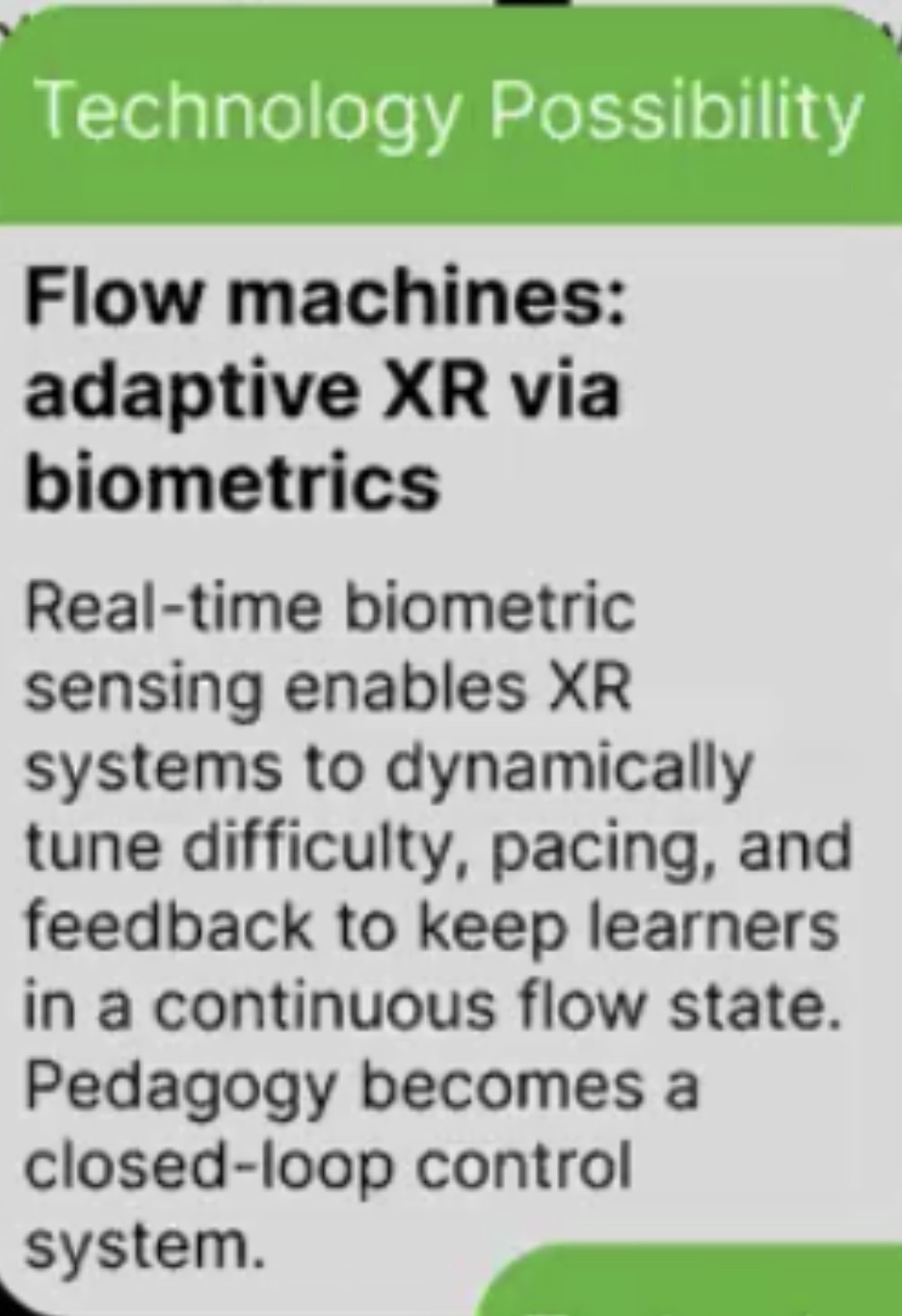
- old template...Flow Machines: Adaptive XR via Biometrics
- FT: Agentic AI
- FT: Surveillance-by-Design XR
- FT: Flow Machines and Adaptive XR
- FT: Invisible Computing
- FT: Conversational Presence
- FT: Expanding XR Attack Surface
- FT: Democratized World-Building
- FT: Real Time Generative 3D
- FT: Wearables Everywhere
- FT: Reality Governance
- FT: Open XR Futures
- FT: MultiModal Intelligence
- FT: AI without AGI
- FT: Horizon Scanning as Infrastructure
- FT: Swarm Intelligence
- Category 3: Historical Technology Shift cards
- HT: Generative AI Enters the World
- HT: AI inside Immersion
- HT: Natural Embodied Interaction
- HT: Spatial Platforms replace Flat Systems
- HT: Multimodal Learning Analytics
- HT: Mobile Fidelity at Scale
- HT: Post-hype Reality Check
- HT: Affordable XR goes Mainstream
- Category 4: Educational Transformation Cards
About Fridolin Wild's "Vision 2035" Circle of Scholars' workshop
Category 1: 2026 Social Challenges Cards
Societal Challenge Cards document broad social, economic, ecological, and political conditions that create the context within which immersive learning futures will unfold. Each card carries a Circle of Scholars Part I snapshot and a community evidence Part II. The card set reflects the Vision 2035 foresight horizon and is reviewed annually.
SC: Sustainability
|
PART I — FORESIGHT SNAPSHOT | SC: Sustainability | Fixed Time-Stamped Synthesis |
2026 SC: Sustainability
|
Card Type |
Societal Challenge |
|
Series |
Immersive Futures Guild — Vision 2035 |
|
Layer |
1 — Atomic Foresight Object |
|
Status |
Active |
|
Confidence |
Medium |
|
Workshop |
Circle of Scholars — January 2026 |
|
Facilitator |
Circle of Scholars Workshop Team |
|
Tags |
sustainability | ecology | infrastructure | layer1 | sc |
|
Tally.so Form |
https://tally.so/r/ilrn-if-sc-sustainability-2026 |
The convergence of ecological crisis with technology development creates both pressure and opportunity for immersive learning systems. Digital infrastructure carries environmental costs — data centers, device manufacturing, and energy consumption — that must be accounted for in the design of immersive learning ecosystems. Simultaneously, immersive technologies offer capabilities for environmental education, remote collaboration (reducing travel footprint), and simulation of ecological systems otherwise impossible to experience directly.
Key Drivers / Contributing Conditions:
-
Climate emergency acceleration and institutional net-zero commitments
-
Device lifecycle, e-waste, and hardware supply chain concerns
-
Energy costs of cloud-rendered and AI-assisted XR at scale
-
Growing learner and institutional demand for sustainability accounting in EdTech
Educational and Design Implications:
-
Carbon accounting requirements for virtual campuses and XR deployments
-
Pedagogical opportunities in immersive ecological and climate simulation
-
Design tension between digital access expansion and digital footprint reduction
Tensions Carried Forward to Part II:
-
Can immersive learning claim sustainability benefits without comprehensive lifecycle accounting?
-
How should institutions weigh digital footprint against travel-reduction benefits of virtual conferencing?
Linked Scenarios / Strands: See cross-links above
Ways of Knowing: Tree · Garden · Lantern
|
PART II — COMMUNITY EVIDENCE & DIALOGUE TRACK | SC: Sustainability | H2 2026 — Living |
|
T |
COMMUNITY CONTRIBUTION FORM — SC: Sustainability Submit case examples, methodological challenges, cultural perspectives, and proposed evidence criteria via: https://tally.so/r/ilrn-if-sc-sustainability-2026 |
|
Part II — Scope and Instructions |
|
This section collects community responses, case examples, and challenges to the Part I foresight snapshot above. |
|
It opens July 1, 2026 and undergoes synthesis review in September 2026, November 2026, and January 2027. |
|
Contributions are submitted via the Tally.so form above and appear in the registers below after editorial review. |
|
The Part I text is not modified in response to Part II contributions; it is versioned at the Annual Handoff review. |
|
Contribution categories: Case Example | Methodological Challenge | Cultural/Community Perspective | Proposed Evidence Criterion |
|
Ways of Knowing accepted: Tree (evidence) | Garden (practice) | Lantern (futures) |
Tensions Open for Community Response:
-
Can immersive learning claim sustainability benefits without comprehensive lifecycle accounting?
-
How should institutions weigh digital footprint against travel-reduction benefits of virtual conferencing?
|
Contributor / Date |
Category |
Way of Knowing |
Contribution Summary |
|---|---|---|---|
|
[ Awaiting contributions — form opens July 1, 2026 ] |
SC: Digital Wellbeing
|
PART I — FORESIGHT SNAPSHOT | SC: Digital Wellbeing | Fixed Time-Stamped Synthesis |
2026 SC: Digital Wellbeing
|
Card Type |
Societal Challenge |
|
Series |
Immersive Futures Guild — Vision 2035 |
|
Layer |
1 — Atomic Foresight Object |
|
Status |
Active |
|
Confidence |
Medium |
|
Workshop |
Circle of Scholars — January 2026 |
|
Facilitator |
Circle of Scholars Workshop Team |
|
Tags |
wellbeing | mental-health | design-ethics | layer1 | sc |
|
Tally.so Form |
https://tally.so/r/ilrn-if-sc-dw-2026 |
The proliferation of screen-mediated, immersive, and always-on digital environments raises significant questions about cognitive load, attention regulation, social development, and mental health — particularly for children, adolescents, and neurodivergent learners. Immersive learning systems must be designed with awareness of these dynamics rather than assuming that engagement metrics are equivalent to wellbeing indicators.
Key Drivers / Contributing Conditions:
-
Youth mental health research documenting screen-time effects
-
Attention economy critique applied to educational technology
-
Emerging evidence on XR-specific side effects including cybersickness and social isolation
-
Institutional and parental demand for digital wellness frameworks
Educational and Design Implications:
-
Design requirements for attention-safe and load-aware XR
-
Research needs in XR-specific wellbeing and recovery
-
Risk of engagement optimization displacing wellbeing considerations
Tensions Carried Forward to Part II:
-
Where is the design boundary between productive immersive challenge and harmful cognitive overload?
-
Can wellbeing be meaningfully measured in immersive learning contexts with current tools?
Linked Scenarios / Strands: See cross-links above
Ways of Knowing: Tree · Garden · Lantern
|
PART II — COMMUNITY EVIDENCE & DIALOGUE TRACK | SC: Digital Wellbeing | H2 2026 — Living |
|
T |
COMMUNITY CONTRIBUTION FORM — SC: Digital Wellbeing Submit case examples, methodological challenges, cultural perspectives, and proposed evidence criteria via: https://tally.so/r/ilrn-if-sc-dw-2026 |
|
Part II — Scope and Instructions |
|
This section collects community responses, case examples, and challenges to the Part I foresight snapshot above. |
|
It opens July 1, 2026 and undergoes synthesis review in September 2026, November 2026, and January 2027. |
|
Contributions are submitted via the Tally.so form above and appear in the registers below after editorial review. |
|
The Part I text is not modified in response to Part II contributions; it is versioned at the Annual Handoff review. |
|
Contribution categories: Case Example | Methodological Challenge | Cultural/Community Perspective | Proposed Evidence Criterion |
|
Ways of Knowing accepted: Tree (evidence) | Garden (practice) | Lantern (futures) |
Tensions Open for Community Response:
-
Where is the design boundary between productive immersive challenge and harmful cognitive overload?
-
Can wellbeing be meaningfully measured in immersive learning contexts with current tools?
|
Contributor / Date |
Category |
Way of Knowing |
Contribution Summary |
|---|---|---|---|
|
[ Awaiting contributions — form opens July 1, 2026 ] |
SC: Equity
|
PART I — FORESIGHT SNAPSHOT | SC: Equity | Fixed Time-Stamped Synthesis |
SC: Equity
|
Card Type |
Societal Challenge |
|
Series |
Immersive Futures Guild — Vision 2035 |
|
Layer |
1 — Atomic Foresight Object |
|
Status |
Active |
|
Confidence |
Medium |
|
Workshop |
Circle of Scholars — January 2026 |
|
Facilitator |
Circle of Scholars Workshop Team |
|
Tags |
equity | access | justice | layer1 | sc |
|
Tally.so Form |
https://tally.so/r/ilrn-if-sc-equity-2026 |
Access to immersive learning technologies is unevenly distributed across geographic, economic, racial, and linguistic lines. The benefits of XR, AI, and spatial computing are not automatically democratizing — without deliberate design and policy intervention, they risk reinforcing existing educational inequalities or creating new ones. Equity in the Guild Codex is treated as a structural condition, not a value to be balanced against other considerations.
Key Drivers / Contributing Conditions:
-
Hardware cost and availability disparities across regions and income groups
-
Bandwidth and infrastructure inequality in rural and Global South contexts
-
Cultural and linguistic content gaps in commercial XR platforms
-
Teacher capacity inequalities as an equity multiplier
Educational and Design Implications:
-
Mandatory equity impact assessment for Guild-affiliated immersive projects
-
Low-cost and offline-capable design as a first-class requirement
-
Geographic Chapters as organizational equity mechanism
Tensions Carried Forward to Part II:
-
How should iLRN weigh conference XR investments against equity implications for under-resourced members?
-
When does 'accessible design' satisfy equity requirements versus perpetuating a two-tier system?
Linked Scenarios / Strands: See cross-links above
Ways of Knowing: Tree · Garden · Lantern
|
PART II — COMMUNITY EVIDENCE & DIALOGUE TRACK | SC: Equity | H2 2026 — Living |
|
T |
COMMUNITY CONTRIBUTION FORM — SC: Equity Submit case examples, methodological challenges, cultural perspectives, and proposed evidence criteria via: https://tally.so/r/ilrn-if-sc-equity-2026 |
|
Part II — Scope and Instructions |
|
This section collects community responses, case examples, and challenges to the Part I foresight snapshot above. |
|
It opens July 1, 2026 and undergoes synthesis review in September 2026, November 2026, and January 2027. |
|
Contributions are submitted via the Tally.so form above and appear in the registers below after editorial review. |
|
The Part I text is not modified in response to Part II contributions; it is versioned at the Annual Handoff review. |
|
Contribution categories: Case Example | Methodological Challenge | Cultural/Community Perspective | Proposed Evidence Criterion |
|
Ways of Knowing accepted: Tree (evidence) | Garden (practice) | Lantern (futures) |
Tensions Open for Community Response:
-
How should iLRN weigh conference XR investments against equity implications for under-resourced members?
-
When does 'accessible design' satisfy equity requirements versus perpetuating a two-tier system?
|
Contributor / Date |
Category |
Way of Knowing |
Contribution Summary |
|---|---|---|---|
|
[ Awaiting contributions — form opens July 1, 2026 ] |
SC: Care, Culture, & Community
|
PART I — FORESIGHT SNAPSHOT | SC: Care, Culture, & Community | Fixed Time-Stamped Synthesis |
SC: Care, Culture, & Community
|
Card Type |
Societal Challenge |
|
Series |
Immersive Futures Guild — Vision 2035 |
|
Layer |
1 — Atomic Foresight Object |
|
Status |
Active |
|
Confidence |
Medium |
|
Workshop |
Circle of Scholars — January 14, 2026 |
|
Facilitator |
Fridolin Wild |
|
Tags |
care | culture | community | indigenous | layer1 | sc |
|
Tally.so Form |
https://tally.so/r/ilrn-if-sc-ccc-2026 |
Education is embedded in cultural and community contexts that resist reduction to scalable digital solutions. Immersive learning systems designed without attention to local culture, community relationships, and care infrastructures risk producing technically sophisticated but socially harmful interventions. This card documents the Circle of Scholars position — from the January 14, 2026 workshop facilitated by Fridolin Wild — that care, cultural grounding, and community stewardship are first-order design and governance requirements, not optional ethical additions. The care-as-attentional-responsibility framing developed in that workshop holds that immersive technologies shape how people attend to one another, how cultures are represented or transformed, and how communities are formed or fragmented.
Key Drivers / Contributing Conditions:
-
Communal learning traditions in non-Western and Indigenous contexts
-
Cultural protocol requirements for representation and knowledge sovereignty
-
Social isolation risks of individualized immersive experiences
-
Community governance gaps in persistent immersive environments
Educational and Design Implications:
-
Community co-design as a prerequisite rather than enhancement
-
Cultural competence requirements for avatar, environment, and narrative design
-
Stewardship models for immersive environments beyond single deployments
Tensions Carried Forward to Part II:
-
Can care be meaningfully designed into a system, or does it only emerge through sustained relational practice?
-
When does 'community engagement' become performative rather than substantive?
-
How should responsibility be allocated when emergent community use transforms designed intent?
Linked Scenarios / Strands: See cross-links above
Ways of Knowing: Tree · Garden · Lantern
|
PART II — COMMUNITY EVIDENCE & DIALOGUE TRACK | SC: Care, Culture, & Community | H2 2026 — Living |
|
T |
COMMUNITY CONTRIBUTION FORM — SC: Care, Culture, & Community Submit case examples, methodological challenges, cultural perspectives, and proposed evidence criteria via: https://tally.so/r/ilrn-if-sc-ccc-2026 |
|
Part II — Scope and Instructions |
|
This section collects community responses, case examples, and challenges to the Part I foresight snapshot above. |
|
It opens July 1, 2026 and undergoes synthesis review in September 2026, November 2026, and January 2027. |
|
Contributions are submitted via the Tally.so form above and appear in the registers below after editorial review. |
|
The Part I text is not modified in response to Part II contributions; it is versioned at the Annual Handoff review. |
|
Contribution categories: Case Example | Methodological Challenge | Cultural/Community Perspective | Proposed Evidence Criterion |
|
Ways of Knowing accepted: Tree (evidence) | Garden (practice) | Lantern (futures) |
Tensions Open for Community Response:
-
Can care be meaningfully designed into a system, or does it only emerge through sustained relational practice?
-
When does 'community engagement' become performative rather than substantive?
-
How should responsibility be allocated when emergent community use transforms designed intent?
|
Contributor / Date |
Category |
Way of Knowing |
Contribution Summary |
|---|---|---|---|
|
[ Awaiting contributions — form opens July 1, 2026 ] |
SC: Research Integrity Under Pressure
|
PART I — FORESIGHT SNAPSHOT | SC: Research Integrity Under Pressure | Fixed Time-Stamped Synthesis |
SC: Research Integrity Under Pressure
|
Card Type |
Societal Challenge |
|
Series |
Immersive Futures Guild — Vision 2035 |
|
Layer |
1 — Atomic Foresight Object |
|
Status |
Active |
|
Confidence |
Medium |
|
Workshop |
Circle of Scholars — January 2026 |
|
Facilitator |
Circle of Scholars Workshop Team |
|
Tags |
research-integrity | evidence | methodology | layer1 | sc |
|
Tally.so Form |
https://tally.so/r/ilrn-if-sc-ri-2026 |
The combination of commercial incentive, rapid technology cycles, and publication pressure creates conditions in which research quality in immersive learning is under significant and documented strain. Underpowered studies, outcome measure inconsistency, publication bias toward positive findings, and vendor-funded research all contribute to an evidence base that is thinner and more contested than is typically acknowledged in introductory claims. The iLRN Knowledge Tree is, in part, a direct infrastructure response to this challenge.
Key Drivers / Contributing Conditions:
-
Vendor-academic entanglement and conflict of interest normalization
-
Publication bias and replication crisis in educational technology research
-
Outcome measure fragmentation preventing cumulative synthesis
-
Pressure to demonstrate impact on short institutional timescales
Educational and Design Implications:
-
Pre-registration norms and conflict of interest disclosure standards
-
Investment in replication studies and null-result publication
-
Knowledge Tree methodology as corrective infrastructure for the field
Tensions Carried Forward to Part II:
-
How should practitioners use evidence when the evidence base is known to be unreliable?
-
What level of methodological scrutiny is appropriate before making design recommendations?
Linked Scenarios / Strands: See cross-links above
Ways of Knowing: Tree · Garden · Lantern
|
PART II — COMMUNITY EVIDENCE & DIALOGUE TRACK | SC: Research Integrity Under Pressure | H2 2026 — Living |
|
T |
COMMUNITY CONTRIBUTION FORM — SC: Research Integrity Under Pressure Submit case examples, methodological challenges, cultural perspectives, and proposed evidence criteria via: https://tally.so/r/ilrn-if-sc-ri-2026 |
|
Part II — Scope and Instructions |
|
This section collects community responses, case examples, and challenges to the Part I foresight snapshot above. |
|
It opens July 1, 2026 and undergoes synthesis review in September 2026, November 2026, and January 2027. |
|
Contributions are submitted via the Tally.so form above and appear in the registers below after editorial review. |
|
The Part I text is not modified in response to Part II contributions; it is versioned at the Annual Handoff review. |
|
Contribution categories: Case Example | Methodological Challenge | Cultural/Community Perspective | Proposed Evidence Criterion |
|
Ways of Knowing accepted: Tree (evidence) | Garden (practice) | Lantern (futures) |
Tensions Open for Community Response:
-
How should practitioners use evidence when the evidence base is known to be unreliable?
-
What level of methodological scrutiny is appropriate before making design recommendations?
|
Contributor / Date |
Category |
Way of Knowing |
Contribution Summary |
|---|---|---|---|
|
[ Awaiting contributions — form opens July 1, 2026 ] |
SC: Global Inequality
|
PART I — FORESIGHT SNAPSHOT | SC: Global Inequality | Fixed Time-Stamped Synthesis |
2026 SC: Global Inequality
|
Card Type |
Societal Challenge |
|
Series |
Immersive Futures Guild — Vision 2035 |
|
Layer |
1 — Atomic Foresight Object |
|
Status |
Active |
|
Confidence |
Medium |
|
Workshop |
Circle of Scholars — January 2026 |
|
Facilitator |
Circle of Scholars Workshop Team |
|
Tags |
global-inequality | geopolitics | access | layer1 | sc |
|
Tally.so Form |
https://tally.so/r/ilrn-if-sc-gi-2026 |
The geopolitical distribution of XR and AI research capacity, infrastructure investment, technology manufacturing, and platform governance is heavily concentrated in a small number of countries and regions. This creates structural inequalities in who shapes immersive learning futures — whose pedagogical traditions are encoded into global platforms, whose researchers can access cutting-edge tools, and whose communities bear the costs of extractive technology deployment without capturing equivalent benefits.
Key Drivers / Contributing Conditions:
-
Technology manufacturing concentration in a small number of economies
-
Research funding inequality across regions
-
English-language and Western epistemological dominance in XR content and research
-
Global South infrastructure deficits compounded by climate vulnerability
Educational and Design Implications:
-
iLRN Geographic Chapters as structural equity mechanism
-
Multilingual and multicultural Codex contribution as a governance requirement
-
Research partnership models that transfer capacity rather than extract data
Tensions Carried Forward to Part II:
-
How can a global foresight program avoid reproducing the inequalities it documents?
-
When do 'global standards' impose uniformity that erases legitimate local variation?
Linked Scenarios / Strands: See cross-links above
Ways of Knowing: Tree · Garden · Lantern
|
PART II — COMMUNITY EVIDENCE & DIALOGUE TRACK | SC: Global Inequality | H2 2026 — Living |
|
T |
COMMUNITY CONTRIBUTION FORM — SC: Global Inequality Submit case examples, methodological challenges, cultural perspectives, and proposed evidence criteria via: https://tally.so/r/ilrn-if-sc-gi-2026 |
|
Part II — Scope and Instructions |
|
This section collects community responses, case examples, and challenges to the Part I foresight snapshot above. |
|
It opens July 1, 2026 and undergoes synthesis review in September 2026, November 2026, and January 2027. |
|
Contributions are submitted via the Tally.so form above and appear in the registers below after editorial review. |
|
The Part I text is not modified in response to Part II contributions; it is versioned at the Annual Handoff review. |
|
Contribution categories: Case Example | Methodological Challenge | Cultural/Community Perspective | Proposed Evidence Criterion |
|
Ways of Knowing accepted: Tree (evidence) | Garden (practice) | Lantern (futures) |
Tensions Open for Community Response:
-
How can a global foresight program avoid reproducing the inequalities it documents?
-
When do 'global standards' impose uniformity that erases legitimate local variation?
|
Contributor / Date |
Category |
Way of Knowing |
Contribution Summary |
|---|---|---|---|
|
[ Awaiting contributions — form opens July 1, 2026 ] |
SC: Truth & Epistemic Trust
|
PART I — FORESIGHT SNAPSHOT | SC: Truth & Epistemic Trust | Fixed Time-Stamped Synthesis |
2026 SC: Truth & Epistemic Trust
|
Card Type |
Societal Challenge |
|
Series |
Immersive Futures Guild — Vision 2035 |
|
Layer |
1 — Atomic Foresight Object |
|
Status |
Active |
|
Confidence |
Medium |
|
Workshop |
Circle of Scholars — January 2026 |
|
Facilitator |
Circle of Scholars Workshop Team |
|
Tags |
epistemic-trust | misinformation | media-literacy | layer1 | sc |
|
Tally.so Form |
https://tally.so/r/ilrn-if-sc-etrust-2026 |
The rise of synthetic media, AI-generated content, and high-fidelity simulation creates new challenges for epistemic trust — the foundational social agreement that shared reality is knowable and communicable. For immersive learning, this raises questions about the boundaries between authentic experience and simulation, the pedagogical implications of photorealistic synthetic environments, and the social responsibilities of immersive content creators working in an era of widespread epistemic uncertainty.
Key Drivers / Contributing Conditions:
-
Synthetic media and deepfake technology at consumer scale
-
Platform misinformation dynamics affecting educational authority
-
Declining institutional trust in knowledge authorities
-
XR's capacity to create experiences that feel indistinguishable from authentic events
Educational and Design Implications:
-
Provenance standards for immersive educational content
-
Media literacy — including spatial and immersive media literacy — as a prerequisite
-
Research on epistemic effects of sustained engagement with high-fidelity simulation
Tensions Carried Forward to Part II:
-
How should immersive educators navigate the boundary between productive simulation and epistemically harmful fabrication?
-
Can provenance standards be technically enforced or do they require social and institutional mechanisms?
Linked Scenarios / Strands: See cross-links above
Ways of Knowing: Tree · Garden · Lantern
|
PART II — COMMUNITY EVIDENCE & DIALOGUE TRACK | SC: Truth & Epistemic Trust | H2 2026 — Living |
|
T |
COMMUNITY CONTRIBUTION FORM — SC: Truth & Epistemic Trust Submit case examples, methodological challenges, cultural perspectives, and proposed evidence criteria via: https://tally.so/r/ilrn-if-sc-etrust-2026 |
|
Part II — Scope and Instructions |
|
This section collects community responses, case examples, and challenges to the Part I foresight snapshot above. |
|
It opens July 1, 2026 and undergoes synthesis review in September 2026, November 2026, and January 2027. |
|
Contributions are submitted via the Tally.so form above and appear in the registers below after editorial review. |
|
The Part I text is not modified in response to Part II contributions; it is versioned at the Annual Handoff review. |
|
Contribution categories: Case Example | Methodological Challenge | Cultural/Community Perspective | Proposed Evidence Criterion |
|
Ways of Knowing accepted: Tree (evidence) | Garden (practice) | Lantern (futures) |
Tensions Open for Community Response:
-
How should immersive educators navigate the boundary between productive simulation and epistemically harmful fabrication?
-
Can provenance standards be technically enforced or do they require social and institutional mechanisms?
|
Contributor / Date |
Category |
Way of Knowing |
Contribution Summary |
|---|---|---|---|
|
[ Awaiting contributions — form opens July 1, 2026 ] |
SC: Responsible AI
|
PART I — FORESIGHT SNAPSHOT | SC: Responsible AI | Fixed Time-Stamped Synthesis |
2026 SC: Responsible AI
|
Card Type |
Societal Challenge |
|
Series |
Immersive Futures Guild — Vision 2035 |
|
Layer |
1 — Atomic Foresight Object |
|
Status |
Active |
|
Confidence |
Medium |
|
Workshop |
Circle of Scholars — January 2026 |
|
Facilitator |
Circle of Scholars Workshop Team |
|
Tags |
responsible-AI | bias | governance | transparency | layer1 | sc |
|
Tally.so Form |
https://tally.so/r/ilrn-if-sc-rai-2026 |
AI systems are rapidly becoming embedded in immersive learning environments as adaptive tutoring engines, content generators, assessment systems, virtual facilitators, and behavioral monitors. The responsible development and deployment of AI in these contexts requires explicit frameworks for bias, transparency, data governance, consent, and learner agency preservation. This card tracks the evolving regulatory landscape, risk frameworks, and design standards relevant to AI integration in immersive learning.
Key Drivers / Contributing Conditions:
-
AI capability acceleration outpacing governance framework development
-
Regulatory landscape development across EU, US, and other jurisdictions
-
Demonstrated bias in training data and AI output across cultural contexts
-
Black-box decision-making in adaptive systems resisting interpretability
Educational and Design Implications:
-
Explainability requirements for AI-driven adaptive XR systems
-
Learner data governance standards and consent protocols
-
Bias auditing as a deployment requirement for AI-assisted immersive learning
Tensions Carried Forward to Part II:
-
How can algorithmic transparency be operationalized in complex AI-XR systems?
-
Who bears accountability when an AI system causes harm to a learner in an immersive context?
Linked Scenarios / Strands: See cross-links above
Ways of Knowing: Tree · Garden · Lantern
|
PART II — COMMUNITY EVIDENCE & DIALOGUE TRACK | SC: Responsible AI | H2 2026 — Living |
|
T |
COMMUNITY CONTRIBUTION FORM — SC: Responsible AI Submit case examples, methodological challenges, cultural perspectives, and proposed evidence criteria via: https://tally.so/r/ilrn-if-sc-rai-2026 |
|
Part II — Scope and Instructions |
|
This section collects community responses, case examples, and challenges to the Part I foresight snapshot above. |
|
It opens July 1, 2026 and undergoes synthesis review in September 2026, November 2026, and January 2027. |
|
Contributions are submitted via the Tally.so form above and appear in the registers below after editorial review. |
|
The Part I text is not modified in response to Part II contributions; it is versioned at the Annual Handoff review. |
|
Contribution categories: Case Example | Methodological Challenge | Cultural/Community Perspective | Proposed Evidence Criterion |
|
Ways of Knowing accepted: Tree (evidence) | Garden (practice) | Lantern (futures) |
Tensions Open for Community Response:
-
How can algorithmic transparency be operationalized in complex AI-XR systems?
-
Who bears accountability when an AI system causes harm to a learner in an immersive context?
|
Contributor / Date |
Category |
Way of Knowing |
Contribution Summary |
|---|---|---|---|
|
[ Awaiting contributions — form opens July 1, 2026 ] |
SC: Resilience
|
PART I — FORESIGHT SNAPSHOT | SC: Resilience | Fixed Time-Stamped Synthesis |
2026 SC: Resilience
|
Card Type |
Societal Challenge |
|
Series |
Immersive Futures Guild — Vision 2035 |
|
Layer |
1 — Atomic Foresight Object |
|
Status |
Active |
|
Confidence |
Medium |
|
Workshop |
Circle of Scholars — January 2026 |
|
Facilitator |
Circle of Scholars Workshop Team |
|
Tags |
resilience | continuity | crisis | layer1 | sc |
|
Tally.so Form |
https://tally.so/r/ilrn-if-sc-resilience-2026 |
Educational systems globally face disruption from climate events, pandemics, geopolitical conflict, and economic instability. Immersive learning technologies present both opportunities and risks: opportunities to maintain learning continuity when physical infrastructure is unavailable, and risks of creating single points of failure when digital infrastructure itself is disrupted or when resilient design has been sacrificed for efficiency.
Key Drivers / Contributing Conditions:
-
COVID-19 legacy and ongoing epidemic risk
-
Climate-driven school and university disruption
-
Infrastructure fragility in conflict and crisis zones
-
Power and connectivity inequality intensified during disruption events
Educational and Design Implications:
-
Offline-capable and low-bandwidth immersive learning design
-
Redundant infrastructure planning for virtual campuses
-
Research on XR for crisis education and emergency learning continuity
Tensions Carried Forward to Part II:
-
How should iLRN balance digital-first immersive learning with the resilience requirements of offline access?
-
When does virtual continuity substitute adequately for physical presence and when does it fail?
Linked Scenarios / Strands: See cross-links above
Ways of Knowing: Tree · Garden · Lantern
|
PART II — COMMUNITY EVIDENCE & DIALOGUE TRACK | SC: Resilience | H2 2026 — Living |
|
T |
COMMUNITY CONTRIBUTION FORM — SC: Resilience Submit case examples, methodological challenges, cultural perspectives, and proposed evidence criteria via: https://tally.so/r/ilrn-if-sc-resilience-2026 |
|
Part II — Scope and Instructions |
|
This section collects community responses, case examples, and challenges to the Part I foresight snapshot above. |
|
It opens July 1, 2026 and undergoes synthesis review in September 2026, November 2026, and January 2027. |
|
Contributions are submitted via the Tally.so form above and appear in the registers below after editorial review. |
|
The Part I text is not modified in response to Part II contributions; it is versioned at the Annual Handoff review. |
|
Contribution categories: Case Example | Methodological Challenge | Cultural/Community Perspective | Proposed Evidence Criterion |
|
Ways of Knowing accepted: Tree (evidence) | Garden (practice) | Lantern (futures) |
Tensions Open for Community Response:
-
How should iLRN balance digital-first immersive learning with the resilience requirements of offline access?
-
When does virtual continuity substitute adequately for physical presence and when does it fail?
|
Contributor / Date |
Category |
Way of Knowing |
Contribution Summary |
|---|---|---|---|
|
[ Awaiting contributions — form opens July 1, 2026 ] |
SC: Employment Upheaval
|
PART I — FORESIGHT SNAPSHOT | SC: Employment Upheaval | Fixed Time-Stamped Synthesis |
2026 SC: Employment Upheaval
|
Card Type |
Societal Challenge |
|
Series |
Immersive Futures Guild — Vision 2035 |
|
Layer |
1 — Atomic Foresight Object |
|
Status |
Active |
|
Confidence |
Medium |
|
Workshop |
Circle of Scholars — January 2026 |
|
Facilitator |
Circle of Scholars Workshop Team |
|
Tags |
employment | reskilling | workforce | layer1 | sc |
|
Tally.so Form |
https://tally.so/r/ilrn-if-sc-employment-2026 |
AI and automation are restructuring labor markets in ways that have direct implications for education and training systems. Immersive learning technologies are simultaneously positioned as responses to reskilling demands — enabling rapid, high-fidelity vocational and professional training — and as potential contributors to job displacement in educational and training sectors. The research evidence on XR-based skill transfer to real workplace performance remains limited and contested.
Key Drivers / Contributing Conditions:
-
AI-driven job displacement projections across multiple sectors
-
Demand for rapid, scalable reskilling infrastructure
-
Vocational and professional training transformation needs
-
Growth of non-traditional career pathways and gig economy contexts
Educational and Design Implications:
-
Demand signal for immersive vocational and professional training investment
-
Research urgency for transfer studies connecting XR training to work performance
-
Policy coordination between EdTech systems and labor market institutions
Tensions Carried Forward to Part II:
-
Does immersive training address structural employment displacement or obscure its systemic causes?
-
Who should bear the cost of XR-based reskilling — individuals, employers, or public institutions?
Linked Scenarios / Strands: See cross-links above
Ways of Knowing: Tree · Garden · Lantern
|
PART II — COMMUNITY EVIDENCE & DIALOGUE TRACK | SC: Employment Upheaval | H2 2026 — Living |
|
T |
COMMUNITY CONTRIBUTION FORM — SC: Employment Upheaval Submit case examples, methodological challenges, cultural perspectives, and proposed evidence criteria via: https://tally.so/r/ilrn-if-sc-employment-2026 |
|
Part II — Scope and Instructions |
|
This section collects community responses, case examples, and challenges to the Part I foresight snapshot above. |
|
It opens July 1, 2026 and undergoes synthesis review in September 2026, November 2026, and January 2027. |
|
Contributions are submitted via the Tally.so form above and appear in the registers below after editorial review. |
|
The Part I text is not modified in response to Part II contributions; it is versioned at the Annual Handoff review. |
|
Contribution categories: Case Example | Methodological Challenge | Cultural/Community Perspective | Proposed Evidence Criterion |
|
Ways of Knowing accepted: Tree (evidence) | Garden (practice) | Lantern (futures) |
Tensions Open for Community Response:
-
Does immersive training address structural employment displacement or obscure its systemic causes?
-
Who should bear the cost of XR-based reskilling — individuals, employers, or public institutions?
|
Contributor / Date |
Category |
Way of Knowing |
Contribution Summary |
|---|---|---|---|
|
[ Awaiting contributions — form opens July 1, 2026 ] |
SC: Ethics, Privacy, & Bodily Autonomy
|
PART I — FORESIGHT SNAPSHOT | SC: Ethics, Privacy, & Bodily Autonomy | Fixed Time-Stamped Synthesis |
2026 SC: Ethics, Privacy, & Bodily Autonomy
|
Card Type |
Societal Challenge |
|
Series |
Immersive Futures Guild — Vision 2035 |
|
Layer |
1 — Atomic Foresight Object |
|
Status |
Active |
|
Confidence |
Medium |
|
Workshop |
Circle of Scholars — January 2026 |
|
Facilitator |
Circle of Scholars Workshop Team |
|
Tags |
privacy | ethics | biometrics | consent | layer1 | sc |
|
Tally.so Form |
https://tally.so/r/ilrn-if-sc-ep-2026 |
Immersive technologies — particularly those involving biometric sensing, eye-tracking, full-body motion capture, affect recognition, and persistent digital identity — collect data at a level of intimacy that exceeds prior educational technologies by a significant margin. This creates ethical and legal questions about consent, bodily autonomy, data sovereignty, and the limits of institutional surveillance in learning contexts that existing frameworks are not yet adequate to address.
Key Drivers / Contributing Conditions:
-
Biometric data collection normalized in consumer XR hardware
-
Eye-tracking and attention surveillance capacity built into standard headsets
-
Affect and emotion recognition entering educational deployment
-
Regulatory gaps in immersive educational data governance across jurisdictions
Educational and Design Implications:
-
Explicit consent frameworks for biometric educational data as a deployment prerequisite
-
Data minimization as a first-class design requirement, not a compliance afterthought
-
Research on learner awareness of and responses to immersive surveillance
Tensions Carried Forward to Part II:
-
Can biometric data collection be justified for educational purposes under any consent framework?
-
How should bodily autonomy be operationalized in mandatory educational contexts using immersive technology?
Linked Scenarios / Strands: See cross-links above
Ways of Knowing: Tree · Garden · Lantern
|
PART II — COMMUNITY EVIDENCE & DIALOGUE TRACK | SC: Ethics, Privacy, & Bodily Autonomy | H2 2026 — Living |
|
T |
COMMUNITY CONTRIBUTION FORM — SC: Ethics, Privacy, & Bodily Autonomy Submit case examples, methodological challenges, cultural perspectives, and proposed evidence criteria via: https://tally.so/r/ilrn-if-sc-ep-2026 |
|
Part II — Scope and Instructions |
|
This section collects community responses, case examples, and challenges to the Part I foresight snapshot above. |
|
It opens July 1, 2026 and undergoes synthesis review in September 2026, November 2026, and January 2027. |
|
Contributions are submitted via the Tally.so form above and appear in the registers below after editorial review. |
|
The Part I text is not modified in response to Part II contributions; it is versioned at the Annual Handoff review. |
|
Contribution categories: Case Example | Methodological Challenge | Cultural/Community Perspective | Proposed Evidence Criterion |
|
Ways of Knowing accepted: Tree (evidence) | Garden (practice) | Lantern (futures) |
Tensions Open for Community Response:
-
Can biometric data collection be justified for educational purposes under any consent framework?
-
How should bodily autonomy be operationalized in mandatory educational contexts using immersive technology?
|
Contributor / Date |
Category |
Way of Knowing |
Contribution Summary |
|---|---|---|---|
|
[ Awaiting contributions — form opens July 1, 2026 ] |
SC: Accessibility
|
PART I — FORESIGHT SNAPSHOT | SC: Accessibility | Fixed Time-Stamped Synthesis |
2026 SC: Accessibility
|
Card Type |
Societal Challenge |
|
Series |
Immersive Futures Guild — Vision 2035 |
|
Layer |
1 — Atomic Foresight Object |
|
Status |
Active |
|
Confidence |
Medium |
|
Workshop |
Circle of Scholars — January 2026 |
|
Facilitator |
Circle of Scholars Workshop Team |
|
Tags |
accessibility | UDL | disability | inclusion | layer1 | sc |
|
Tally.so Form |
https://tally.so/r/ilrn-if-sc-access-2026 |
Accessibility in immersive learning encompasses physical, cognitive, sensory, linguistic, and socioeconomic dimensions. Standard XR hardware and software has historically been developed without adequate attention to users with disabilities, older learners, or those with limited prior technology exposure. This card tracks the state of accessibility research, design standards, and policy requirements, and holds the position — emerging from Guild foresight work — that accessibility-first design is both a moral requirement and a market opportunity.
Key Drivers / Contributing Conditions:
-
Disability rights frameworks applied to digital and immersive education
-
Aging populations entering learning contexts with immersive technology
-
Universal Design for Learning (UDL) mandate and policy pressure
-
Hardware design exclusions for sensory and motor disabilities in mainstream headsets
Educational and Design Implications:
-
Accessibility auditing protocols as a required step in XR learning environment deployment
-
Co-design with disability communities as a governance requirement for iLRN-affiliated projects
-
Research on XR for learners with diverse abilities as a Guild foresight priority
Tensions Carried Forward to Part II:
-
How should the cost of accessibility retrofitting be allocated when it was not designed-in from the start?
-
Can universal design goals be reconciled with the specialized needs of specific disability communities?
Linked Scenarios / Strands: See cross-links above
Ways of Knowing: Tree · Garden · Lantern
|
PART II — COMMUNITY EVIDENCE & DIALOGUE TRACK | SC: Accessibility | H2 2026 — Living |
|
T |
COMMUNITY CONTRIBUTION FORM — SC: Accessibility Submit case examples, methodological challenges, cultural perspectives, and proposed evidence criteria via: https://tally.so/r/ilrn-if-sc-access-2026 |
|
Part II — Scope and Instructions |
|
This section collects community responses, case examples, and challenges to the Part I foresight snapshot above. |
|
It opens July 1, 2026 and undergoes synthesis review in September 2026, November 2026, and January 2027. |
|
Contributions are submitted via the Tally.so form above and appear in the registers below after editorial review. |
|
The Part I text is not modified in response to Part II contributions; it is versioned at the Annual Handoff review. |
|
Contribution categories: Case Example | Methodological Challenge | Cultural/Community Perspective | Proposed Evidence Criterion |
|
Ways of Knowing accepted: Tree (evidence) | Garden (practice) | Lantern (futures) |
Tensions Open for Community Response:
-
How should the cost of accessibility retrofitting be allocated when it was not designed-in from the start?
-
Can universal design goals be reconciled with the specialized needs of specific disability communities?
|
Contributor / Date |
Category |
Way of Knowing |
Contribution Summary |
|---|---|---|---|
|
[ Awaiting contributions — form opens July 1, 2026 ] |
Category 2: 2026 Future Technology Possibility
Future Technology Possibility Cards describe technologies plausible within a ten-to-twenty year horizon with significant implications for immersive learning. These cards are explicitly probabilistic — they describe what might be, not what will be. Each card carries a Circle of Scholars Part I snapshot and a community evidence Part II in which plausibility assessments, weak signals, and horizon challenges are welcomed.
old template...Flow Machines: Adaptive XR via Biometrics
Flow Machines: Adaptive XR via Biometrics
Workshop Synthesis
Circle of Scholars Activity
Facilitated by Fridolin Wild
January 14, 2026
Technology Possibility — Circle of Scholars
-
Immersive Learning Research Network (iLRN)
-
Immersive Futures Guild
-
One Sentence Abstract
This Codex entry documents a shared articulation and ongoing tensions emerging from an iLRN Circle of Scholars workshop exploring biometric sensing and adaptive XR as a technological possibility for maintaining learner flow through closed-loop, real-time pedagogical control systems.
Suggested Citation
Immersive Learning Research Network (iLRN). (2026). Flow machines: Adaptive XR via biometrics—Technology possibility—Circle of Scholars workshop synthesis. Immersive Futures Guild, iLRN Codex. https://codex.immersivelrn.org/link/459
Part I — Shared Articulation (Workshop Synthesis)
Context
This card emerged from the Circle of Scholars 2026 workshop as an exploration of a specific technology possibility: the use of real-time biometric sensing (e.g., heart rate variability, galvanic skin response, eye tracking, EEG proxies) to dynamically adapt immersive learning environments.
Participants examined the idea that XR systems could sense learner state continuously and adjust difficulty, pacing, modality, and feedback to sustain engagement—framing pedagogy as a closed-loop control system rather than a fixed instructional sequence.
The discussion treated this not as an inevitability, but as a design frontier with profound implications for agency, ethics, evidence, and governance.
Core Claim
Biometric-adaptive XR systems make it technically feasible for pedagogy to operate as a real-time feedback loop—continuously sensing learner state and tuning experience parameters to maintain flow—but this capability fundamentally reshapes assumptions about agency, consent, and instructional responsibility.
Key Dimensions Identified
The workshop surfaced four interrelated dimensions of this technology possibility:
1. Flow as a Controllable Variable
Flow was discussed not as a mystical state, but as a measurable proxy constructed from physiological and behavioral signals.
Key considerations included:
-
Operationalizing “flow” through indirect indicators rather than self-report alone
-
The risk of collapsing complex cognitive-emotional states into optimization targets
-
Whether maintaining flow should always be the goal, versus productive struggle or discomfort
2. Pedagogy as Closed-Loop Control
Participants explored the shift from open-loop instructional design to adaptive systems that respond continuously to learner state.
This reframing raised questions about:
-
Who defines the target state of the learner
-
How control parameters are set, tuned, and validated
-
The difference between responsiveness and manipulation
-
Transparency of adaptation logic to learners and educators
3. Biometric Data as Pedagogical Substrate
Biometric signals were treated not merely as analytics, but as instructional inputs.
Discussion emphasized:
-
Data quality, noise, and contextual ambiguity
-
The danger of over-interpreting physiological signals
-
Issues of data ownership, storage, and secondary use
-
Cultural and individual variability in biometric expression
4. Automation, Agency, and Trust
Adaptive XR systems introduce new asymmetries between system intelligence and learner awareness.
Key concerns included:
-
Learner consent in continuously adaptive environments
-
The erosion or augmentation of learner self-regulation
-
Educator trust in algorithmic pedagogical decisions
-
Long-term dependence on optimization systems
Why This Matters for Immersive Learning
Participants emphasized that biometric-adaptive XR systems:
-
Shift instructional authority from static design to dynamic systems
-
Blur boundaries between assessment, feedback, and intervention
-
Introduce ethical stakes at the level of moment-to-moment experience
-
Demand new validation methods beyond learning outcomes alone
As immersive learning systems become more responsive and autonomous, the locus of pedagogical responsibility moves from content to control logic.
Part II — Tensions, Open Questions, and Ongoing Dialogue
(This section remains intentionally open and revisitable.)
Unresolved Tensions Identified
The workshop did not resolve several core tensions:
Flow optimization vs. learner autonomy
When does adaptive support become behavioral steering?
Responsiveness vs. opacity
How much should learners know about how systems are adapting them?
Personalization vs. normalization
Do adaptive systems privilege certain physiological norms over others?
Efficiency vs. educational friction
What kinds of struggle or discomfort are pedagogically necessary—and should not be optimized away?
Points of Debate
Participants raised questions requiring further inquiry:
-
Can flow be a legitimate instructional objective across all learning domains?
-
What constitutes evidence that biometric adaptation improves learning rather than engagement alone?
-
How should disagreement between learner self-perception and system inference be handled?
-
Who is accountable when adaptive systems fail or cause harm?
Relationship to the iLRN Ways of Knowing Map
This card intersects with all three iLRN Ways of Knowing:
Tree (Knowledge / Evidence):
Learning sciences, control theory, affective computing, human-AI interaction, psychophysiology
Garden (Practice):
Adaptive XR design, biometric sensing pipelines, instructor dashboards, ethical design patterns
Lantern (Futures):
Automated pedagogy, attention economies, governance of adaptive learning systems
The card functions as a technology possibility, not a recommended practice or settled theory.
Invitation for Continued Contribution
Members of iLRN are invited to:
-
Contribute empirical studies or prototypes involving biometric-adaptive XR
-
Surface ethical failures or unintended consequences
-
Propose alternative metaphors to “closed-loop control”
-
Develop evaluation methods that move beyond engagement metrics
To contest, contribute, or extend this discussion,
please complete the Technology Possibility contribution form for Vision 2035: Flow Machines — Adaptive XR via Biometrics.
Disagreement is expected. Documentation is encouraged.
Examples, critiques, implementations, and methodological proposals related to this card may be added here through documented community contribution.
Working Status
This card reflects the current synthesis of the Circle of Scholars workshop.
It is a living artifact and may evolve as further dialogue, evidence, and practice emerge.
Codex Colophon
This page is part of the iLRN Codex, a living knowledge base supporting scholarly dialogue, practice-based inquiry, and futures-oriented exploration in immersive learning.
Guild: Immersive Futures
Activity: Circle of Scholars
Artifact Type: Technology Possibility Card
Methodological Context: Design-Based Research (DBR)
Ways of Knowing: Tree · Garden · Lantern
This artifact records a time-stamped synthesis, not a final position.
Disagreement is expected. Documentation is encouraged.
Versioning & Status
-
Initial synthesis: January 2026
-
Status: Living document
-
Revision policy: Updated through documented community contributions and facilitated dialogue
Permanent link:
https://codex.immersivelrn.org/link/459
FT: Agentic AI
|
PART I — FORESIGHT SNAPSHOT | FT: Agentic AI | Fixed Time-Stamped Synthesis |
2026 FT: Agentic AI
|
Card Type |
Future Technology Possibility |
|
Series |
Immersive Futures Guild — Vision 2035 |
|
Layer |
1 — Atomic Foresight Object |
|
Status |
Active |
|
Confidence |
Medium |
|
Workshop |
Circle of Scholars — January 2026 |
|
Facilitator |
Circle of Scholars Workshop Team |
|
Tags |
agentic-AI | autonomy | pedagogy | layer1 | ft |
|
Tally.so Form |
https://tally.so/r/ilrn-if-ft-agentai-2026 |
Agentic AI systems capable of planning multi-step actions, pursuing goals across time, and operating with minimal human oversight are moving from laboratory research into deployed applications. In immersive learning, agentic AI raises questions about who controls the trajectory of a learning experience, how agency is shared between learner, educator, and system, and what happens when learning agents pursue optimization targets that do not align with human educational values.
Key Drivers / Contributing Conditions:
-
AI capability scaling enabling multi-step goal pursuit
-
Commercial deployment of agentic systems in consumer and enterprise contexts
-
Research on AI-assisted learning path generation and adaptive scaffolding
Tensions Carried Forward to Part II:
-
Who is accountable when an agentic AI system makes a pedagogically harmful decision?
-
Can learner agency be preserved in an environment where AI agents are continuously optimizing?
Linked Scenarios / Strands: SC: Responsible AI | SCENARIO: Open Human Agency | STRAND: Human-Centered AI + XR
Ways of Knowing: Tree · Garden · Lantern
|
PART II — COMMUNITY EVIDENCE & DIALOGUE TRACK | FT: Agentic AI | H2 2026 — Living |
|
T |
COMMUNITY CONTRIBUTION FORM — FT: Agentic AI Submit case examples, methodological challenges, cultural perspectives, and proposed evidence criteria via: https://tally.so/r/ilrn-if-ft-agentai-2026 |
|
Part II — Scope and Instructions |
|
This section collects community responses, case examples, and challenges to the Part I foresight snapshot above. |
|
It opens July 1, 2026 and undergoes synthesis review in September 2026, November 2026, and January 2027. |
|
Contributions are submitted via the Tally.so form above and appear in the registers below after editorial review. |
|
The Part I text is not modified in response to Part II contributions; it is versioned at the Annual Handoff review. |
|
Contribution categories: Case Example | Methodological Challenge | Cultural/Community Perspective | Proposed Evidence Criterion |
|
Ways of Knowing accepted: Tree (evidence) | Garden (practice) | Lantern (futures) |
Tensions Open for Community Response:
-
Who is accountable when an agentic AI system makes a pedagogically harmful decision?
-
Can learner agency be preserved in an environment where AI agents are continuously optimizing?
|
Contributor / Date |
Category |
Way of Knowing |
Contribution Summary |
|---|---|---|---|
|
[ Awaiting contributions — form opens July 1, 2026 ] |
FT: Surveillance-by-Design XR
|
PART I — FORESIGHT SNAPSHOT | FT: Surveillance-by-Design XR | Fixed Time-Stamped Synthesis |
2026 FT: Surveillance-by-Design XR
|
Card Type |
Future Technology Possibility |
|
Series |
Immersive Futures Guild — Vision 2035 |
|
Layer |
1 — Atomic Foresight Object |
|
Status |
Active |
|
Confidence |
Medium |
|
Workshop |
Circle of Scholars — January 2026 |
|
Facilitator |
Circle of Scholars Workshop Team |
|
Tags |
surveillance | biometrics | privacy | layer1 | ft |
|
Tally.so Form |
https://tally.so/r/ilrn-if-ft-survxr-2026 |
As XR hardware becomes more capable of continuous biometric sensing, platforms and institutions face design choices about whether to build surveillance capacity into immersive learning systems by default. Surveillance-by-design refers to architectures that treat learner behavioral and biometric data as a core product feature rather than an opt-in capability. This card tracks the development trajectory of these architectures and the regulatory and community resistance to them.
Key Drivers / Contributing Conditions:
-
Biometric hardware normalization in consumer headsets
-
Commercial incentives for behavioral data monetization
-
Weak regulatory frameworks for educational biometric data
Tensions Carried Forward to Part II:
-
Where is the boundary between adaptive personalization and surveillance in immersive systems?
-
Can surveillance-by-design be governed by consent frameworks when it is built into the hardware?
Linked Scenarios / Strands: SC: Ethics Privacy & Bodily Autonomy | SCENARIO: Extractive Surveillance | STRAND: Ethical Multimodal Analytics
Ways of Knowing: Tree · Garden · Lantern
|
PART II — COMMUNITY EVIDENCE & DIALOGUE TRACK | FT: Surveillance-by-Design XR | H2 2026 — Living |
|
T |
COMMUNITY CONTRIBUTION FORM — FT: Surveillance-by-Design XR Submit case examples, methodological challenges, cultural perspectives, and proposed evidence criteria via: https://tally.so/r/ilrn-if-ft-survxr-2026 |
|
Part II — Scope and Instructions |
|
This section collects community responses, case examples, and challenges to the Part I foresight snapshot above. |
|
It opens July 1, 2026 and undergoes synthesis review in September 2026, November 2026, and January 2027. |
|
Contributions are submitted via the Tally.so form above and appear in the registers below after editorial review. |
|
The Part I text is not modified in response to Part II contributions; it is versioned at the Annual Handoff review. |
|
Contribution categories: Case Example | Methodological Challenge | Cultural/Community Perspective | Proposed Evidence Criterion |
|
Ways of Knowing accepted: Tree (evidence) | Garden (practice) | Lantern (futures) |
Tensions Open for Community Response:
-
Where is the boundary between adaptive personalization and surveillance in immersive systems?
-
Can surveillance-by-design be governed by consent frameworks when it is built into the hardware?
|
Contributor / Date |
Category |
Way of Knowing |
Contribution Summary |
|---|---|---|---|
|
[ Awaiting contributions — form opens July 1, 2026 ] |
FT: Flow Machines and Adaptive XR
|
PART I — FORESIGHT SNAPSHOT | FT: Flow Machines & Adaptive XR | Fixed Time-Stamped Synthesis |
2026 FT: Flow Machines & Adaptive XR
|
Card Type |
Future Technology Possibility |
|
Series |
Immersive Futures Guild — Vision 2035 |
|
Layer |
1 — Atomic Foresight Object |
|
Status |
Active |
|
Confidence |
Medium |
|
Workshop |
Circle of Scholars — January 2026 |
|
Facilitator |
Circle of Scholars Workshop Team |
|
Tags |
adaptive-XR | flow | personalization | layer1 | ft |
|
Tally.so Form |
https://tally.so/r/ilrn-if-ft-flow-2026 |
Adaptive XR systems using real-time multimodal data about learner state — attention, arousal, cognitive load, emotional valence — to adjust the immersive environment dynamically are in active development. At their best, these systems support flow states and optimize learning conditions for individual learners. At their worst, they become manipulative engagement engines that optimize for behavioral compliance rather than genuine learning.
Key Drivers / Contributing Conditions:
-
Multimodal sensing maturation in XR hardware
-
Research on flow states and cognitive load in immersive contexts
-
Commercial demand for engagement optimization in EdTech
Tensions Carried Forward to Part II:
-
How can the design boundary between flow support and behavioral manipulation be operationalized?
-
Can adaptive systems be transparent enough to preserve learner autonomy?
Linked Scenarios / Strands: SC: Digital Wellbeing | SCENARIO: Creative Immersion | STRAND: Embodied Cognition & Learning
Ways of Knowing: Tree · Garden · Lantern
|
PART II — COMMUNITY EVIDENCE & DIALOGUE TRACK | FT: Flow Machines & Adaptive XR | H2 2026 — Living |
|
T |
COMMUNITY CONTRIBUTION FORM — FT: Flow Machines & Adaptive XR Submit case examples, methodological challenges, cultural perspectives, and proposed evidence criteria via: https://tally.so/r/ilrn-if-ft-flow-2026 |
|
Part II — Scope and Instructions |
|
This section collects community responses, case examples, and challenges to the Part I foresight snapshot above. |
|
It opens July 1, 2026 and undergoes synthesis review in September 2026, November 2026, and January 2027. |
|
Contributions are submitted via the Tally.so form above and appear in the registers below after editorial review. |
|
The Part I text is not modified in response to Part II contributions; it is versioned at the Annual Handoff review. |
|
Contribution categories: Case Example | Methodological Challenge | Cultural/Community Perspective | Proposed Evidence Criterion |
|
Ways of Knowing accepted: Tree (evidence) | Garden (practice) | Lantern (futures) |
Tensions Open for Community Response:
-
How can the design boundary between flow support and behavioral manipulation be operationalized?
-
Can adaptive systems be transparent enough to preserve learner autonomy?
|
Contributor / Date |
Category |
Way of Knowing |
Contribution Summary |
|---|---|---|---|
|
[ Awaiting contributions — form opens July 1, 2026 ] |
FT: Invisible Computing
|
PART I — FORESIGHT SNAPSHOT | FT: Invisible Computing | Fixed Time-Stamped Synthesis |
2026 FT: Invisible Computing
|
Card Type |
Future Technology Possibility |
|
Series |
Immersive Futures Guild — Vision 2035 |
|
Layer |
1 — Atomic Foresight Object |
|
Status |
Active |
|
Confidence |
Medium |
|
Workshop |
Circle of Scholars — January 2026 |
|
Facilitator |
Circle of Scholars Workshop Team |
|
Tags |
invisible-computing | ambient | ubiquitous | layer1 | ft |
|
Tally.so Form |
https://tally.so/r/ilrn-if-ft-invis-2026 |
The trajectory of computing toward ambient, embedded, and wearable forms means that the interface boundaries of immersive learning are dissolving. Future learners may not distinguish between digital and physical learning environments because the distinction has become architectural rather than experiential. This card examines the implications of invisible computing for learning design, assessment, ethics, and consent.
Key Drivers / Contributing Conditions:
-
Smart environment infrastructure maturation
-
Miniaturization of sensing and display hardware
-
Ambient AI processing capability growth
Tensions Carried Forward to Part II:
-
How should consent operate in learning environments where the digital interface is invisible?
-
What does learner control mean when the immersive system is ambient and continuous?
Linked Scenarios / Strands: STRAND: Ambient & Invisible XR Infrastructure | FT: Wearables Everywhere
Ways of Knowing: Tree · Garden · Lantern
|
PART II — COMMUNITY EVIDENCE & DIALOGUE TRACK | FT: Invisible Computing | H2 2026 — Living |
|
T |
COMMUNITY CONTRIBUTION FORM — FT: Invisible Computing Submit case examples, methodological challenges, cultural perspectives, and proposed evidence criteria via: https://tally.so/r/ilrn-if-ft-invis-2026 |
|
Part II — Scope and Instructions |
|
This section collects community responses, case examples, and challenges to the Part I foresight snapshot above. |
|
It opens July 1, 2026 and undergoes synthesis review in September 2026, November 2026, and January 2027. |
|
Contributions are submitted via the Tally.so form above and appear in the registers below after editorial review. |
|
The Part I text is not modified in response to Part II contributions; it is versioned at the Annual Handoff review. |
|
Contribution categories: Case Example | Methodological Challenge | Cultural/Community Perspective | Proposed Evidence Criterion |
|
Ways of Knowing accepted: Tree (evidence) | Garden (practice) | Lantern (futures) |
Tensions Open for Community Response:
-
How should consent operate in learning environments where the digital interface is invisible?
-
What does learner control mean when the immersive system is ambient and continuous?
|
Contributor / Date |
Category |
Way of Knowing |
Contribution Summary |
|---|---|---|---|
|
[ Awaiting contributions — form opens July 1, 2026 ] |
FT: Conversational Presence
|
PART I — FORESIGHT SNAPSHOT | FT: Conversational Presence | Fixed Time-Stamped Synthesis |
2026 FT: Conversational Presence
|
Card Type |
Future Technology Possibility |
|
Series |
Immersive Futures Guild — Vision 2035 |
|
Layer |
1 — Atomic Foresight Object |
|
Status |
Active |
|
Confidence |
Medium |
|
Workshop |
Circle of Scholars — January 2026 |
|
Facilitator |
Circle of Scholars Workshop Team |
|
Tags |
conversational-AI | social-presence | LLM | layer1 | ft |
|
Tally.so Form |
https://tally.so/r/ilrn-if-ft-convpres-2026 |
Large language model and multimodal AI systems are creating a new category of social presence in immersive environments — AI agents that sustain extended, contextually coherent, emotionally responsive conversation. In learning contexts this raises questions about the nature of teacher-learner relationships, parasocial dynamics, and the appropriate scope of AI as a social partner in education.
Key Drivers / Contributing Conditions:
-
LLM capability scaling for contextual coherence
-
Multimodal AI enabling voice, expression, and gesture integration
-
Demand for 24/7 tutoring presence at scale
Tensions Carried Forward to Part II:
-
When does a conversational AI agent constitute an adequate substitute for a human educator?
-
How should parasocial attachment to AI tutors be understood and governed in educational contexts?
Linked Scenarios / Strands: STRAND: Social & Co-Regulated XR Learning | SCENARIO: Creative Immersion
Ways of Knowing: Tree · Garden · Lantern
|
PART II — COMMUNITY EVIDENCE & DIALOGUE TRACK | FT: Conversational Presence | H2 2026 — Living |
|
T |
COMMUNITY CONTRIBUTION FORM — FT: Conversational Presence Submit case examples, methodological challenges, cultural perspectives, and proposed evidence criteria via: https://tally.so/r/ilrn-if-ft-convpres-2026 |
|
Part II — Scope and Instructions |
|
This section collects community responses, case examples, and challenges to the Part I foresight snapshot above. |
|
It opens July 1, 2026 and undergoes synthesis review in September 2026, November 2026, and January 2027. |
|
Contributions are submitted via the Tally.so form above and appear in the registers below after editorial review. |
|
The Part I text is not modified in response to Part II contributions; it is versioned at the Annual Handoff review. |
|
Contribution categories: Case Example | Methodological Challenge | Cultural/Community Perspective | Proposed Evidence Criterion |
|
Ways of Knowing accepted: Tree (evidence) | Garden (practice) | Lantern (futures) |
Tensions Open for Community Response:
-
When does a conversational AI agent constitute an adequate substitute for a human educator?
-
How should parasocial attachment to AI tutors be understood and governed in educational contexts?
|
Contributor / Date |
Category |
Way of Knowing |
Contribution Summary |
|---|---|---|---|
|
[ Awaiting contributions — form opens July 1, 2026 ] |
FT: Expanding XR Attack Surface
|
PART I — FORESIGHT SNAPSHOT | FT: Expanding XR Attack Surface | Fixed Time-Stamped Synthesis |
2026 FT: Expanding XR Attack Surface
|
Card Type |
Future Technology Possibility |
|
Series |
Immersive Futures Guild — Vision 2035 |
|
Layer |
1 — Atomic Foresight Object |
|
Status |
Active |
|
Confidence |
Medium |
|
Workshop |
Circle of Scholars — January 2026 |
|
Facilitator |
Circle of Scholars Workshop Team |
|
Tags |
cybersecurity | attack-surface | privacy | layer1 | ft |
|
Tally.so Form |
https://tally.so/r/ilrn-if-ft-xratk-2026 |
As immersive environments become more interconnected and data-rich, they become larger and more consequential targets for malicious actors. The XR attack surface includes hardware vulnerabilities, platform data breaches, identity spoofing in social VR, manipulation of environmental stimuli to induce disorientation or harmful responses, and exfiltration of biometric and behavioral data.
Key Drivers / Contributing Conditions:
-
Increasing value of biometric data to malicious actors
-
Complexity of multi-platform XR environments creating security gaps
-
Limited security culture in EdTech development pipelines
Tensions Carried Forward to Part II:
-
How should security threat modeling be integrated into pedagogical design processes?
-
What liability frameworks apply when an educational XR platform is exploited to harm learners?
Linked Scenarios / Strands: SC: Ethics Privacy & Bodily Autonomy | SCENARIO: Extractive Surveillance
Ways of Knowing: Tree · Garden · Lantern
|
PART II — COMMUNITY EVIDENCE & DIALOGUE TRACK | FT: Expanding XR Attack Surface | H2 2026 — Living |
|
T |
COMMUNITY CONTRIBUTION FORM — FT: Expanding XR Attack Surface Submit case examples, methodological challenges, cultural perspectives, and proposed evidence criteria via: https://tally.so/r/ilrn-if-ft-xratk-2026 |
|
Part II — Scope and Instructions |
|
This section collects community responses, case examples, and challenges to the Part I foresight snapshot above. |
|
It opens July 1, 2026 and undergoes synthesis review in September 2026, November 2026, and January 2027. |
|
Contributions are submitted via the Tally.so form above and appear in the registers below after editorial review. |
|
The Part I text is not modified in response to Part II contributions; it is versioned at the Annual Handoff review. |
|
Contribution categories: Case Example | Methodological Challenge | Cultural/Community Perspective | Proposed Evidence Criterion |
|
Ways of Knowing accepted: Tree (evidence) | Garden (practice) | Lantern (futures) |
Tensions Open for Community Response:
-
How should security threat modeling be integrated into pedagogical design processes?
-
What liability frameworks apply when an educational XR platform is exploited to harm learners?
|
Contributor / Date |
Category |
Way of Knowing |
Contribution Summary |
|---|---|---|---|
|
[ Awaiting contributions — form opens July 1, 2026 ] |
FT: Democratized World-Building
|
PART I — FORESIGHT SNAPSHOT | FT: Democratized World-Building | Fixed Time-Stamped Synthesis |
2026 FT: Democratized World-Building
|
Card Type |
Future Technology Possibility |
|
Series |
Immersive Futures Guild — Vision 2035 |
|
Layer |
1 — Atomic Foresight Object |
|
Status |
Active |
|
Confidence |
Medium |
|
Workshop |
Circle of Scholars — January 2026 |
|
Facilitator |
Circle of Scholars Workshop Team |
|
Tags |
world-building | generative-AI | democratization | layer1 | ft |
|
Tally.so Form |
https://tally.so/r/ilrn-if-ft-worldbuild-2026 |
Generative AI tools are dramatically lowering the technical barriers to creating interactive 3D environments, narrative simulations, and immersive scenarios. This democratization has significant implications for who can create immersive learning experiences — shifting capacity from specialized development studios to individual educators, students, and community members — and for the equity, quality, and safety of the resulting ecosystem.
Key Drivers / Contributing Conditions:
-
Generative 3D AI capability scaling
-
No-code and low-code immersive platform development
-
Declining cost of real-time rendering infrastructure
Tensions Carried Forward to Part II:
-
Does democratized world-building enable community empowerment or accelerate the production of culturally harmful or pedagogically poor immersive content?
Linked Scenarios / Strands: STRAND: Learners as World-Builders | SCENARIO: Global Co-Creation
Ways of Knowing: Tree · Garden · Lantern
|
PART II — COMMUNITY EVIDENCE & DIALOGUE TRACK | FT: Democratized World-Building | H2 2026 — Living |
|
T |
COMMUNITY CONTRIBUTION FORM — FT: Democratized World-Building Submit case examples, methodological challenges, cultural perspectives, and proposed evidence criteria via: https://tally.so/r/ilrn-if-ft-worldbuild-2026 |
|
Part II — Scope and Instructions |
|
This section collects community responses, case examples, and challenges to the Part I foresight snapshot above. |
|
It opens July 1, 2026 and undergoes synthesis review in September 2026, November 2026, and January 2027. |
|
Contributions are submitted via the Tally.so form above and appear in the registers below after editorial review. |
|
The Part I text is not modified in response to Part II contributions; it is versioned at the Annual Handoff review. |
|
Contribution categories: Case Example | Methodological Challenge | Cultural/Community Perspective | Proposed Evidence Criterion |
|
Ways of Knowing accepted: Tree (evidence) | Garden (practice) | Lantern (futures) |
Tensions Open for Community Response:
-
Does democratized world-building enable community empowerment or accelerate the production of culturally harmful or pedagogically poor immersive content?
|
Contributor / Date |
Category |
Way of Knowing |
Contribution Summary |
|---|---|---|---|
|
[ Awaiting contributions — form opens July 1, 2026 ] |
FT: Real Time Generative 3D
|
PART I — FORESIGHT SNAPSHOT | FT: Real-Time Generative 3D | Fixed Time-Stamped Synthesis |
2026 FT: Real-Time Generative 3D
|
Card Type |
Future Technology Possibility |
|
Series |
Immersive Futures Guild — Vision 2035 |
|
Layer |
1 — Atomic Foresight Object |
|
Status |
Active |
|
Confidence |
Medium |
|
Workshop |
Circle of Scholars — January 2026 |
|
Facilitator |
Circle of Scholars Workshop Team |
|
Tags |
generative-3D | AI | content-creation | layer1 | ft |
|
Tally.so Form |
https://tally.so/r/ilrn-if-ft-gen3d-2026 |
The capability for AI systems to generate photorealistic or stylized 3D environments and objects in real time — rather than through pre-authored asset pipelines — is developing rapidly. This has direct implications for immersive learning content creation economies, the viability of adaptive environments that respond to learner choices, and the provenance and authenticity of educational immersive content.
Key Drivers / Contributing Conditions:
-
Neural rendering research maturation
-
GPU and NPU capability scaling
-
Commercial investment in real-time 3D generation
Tensions Carried Forward to Part II:
-
How should provenance be tracked for AI-generated immersive educational content?
-
Does real-time generation enable meaningful personalization or merely infinite variation without pedagogical purpose?
Linked Scenarios / Strands: FT: Democratized World-Building | SCENARIO: Creative Immersion
Ways of Knowing: Tree · Garden · Lantern
|
PART II — COMMUNITY EVIDENCE & DIALOGUE TRACK | FT: Real-Time Generative 3D | H2 2026 — Living |
|
T |
COMMUNITY CONTRIBUTION FORM — FT: Real-Time Generative 3D Submit case examples, methodological challenges, cultural perspectives, and proposed evidence criteria via: https://tally.so/r/ilrn-if-ft-gen3d-2026 |
|
Part II — Scope and Instructions |
|
This section collects community responses, case examples, and challenges to the Part I foresight snapshot above. |
|
It opens July 1, 2026 and undergoes synthesis review in September 2026, November 2026, and January 2027. |
|
Contributions are submitted via the Tally.so form above and appear in the registers below after editorial review. |
|
The Part I text is not modified in response to Part II contributions; it is versioned at the Annual Handoff review. |
|
Contribution categories: Case Example | Methodological Challenge | Cultural/Community Perspective | Proposed Evidence Criterion |
|
Ways of Knowing accepted: Tree (evidence) | Garden (practice) | Lantern (futures) |
Tensions Open for Community Response:
-
How should provenance be tracked for AI-generated immersive educational content?
-
Does real-time generation enable meaningful personalization or merely infinite variation without pedagogical purpose?
|
Contributor / Date |
Category |
Way of Knowing |
Contribution Summary |
|---|---|---|---|
|
[ Awaiting contributions — form opens July 1, 2026 ] |
FT: Wearables Everywhere
|
PART I — FORESIGHT SNAPSHOT | FT: Wearables Everywhere | Fixed Time-Stamped Synthesis |
FT: Wearables Everywhere
|
Card Type |
Future Technology Possibility |
|
Series |
Immersive Futures Guild — Vision 2035 |
|
Layer |
1 — Atomic Foresight Object |
|
Status |
Active |
|
Confidence |
Medium |
|
Workshop |
Circle of Scholars — January 2026 |
|
Facilitator |
Circle of Scholars Workshop Team |
|
Tags |
wearables | haptics | biosensors | layer1 | ft |
|
Tally.so Form |
https://tally.so/r/ilrn-if-ft-wear-2026 |
The proliferation of wearable computing — headsets, smart glasses, haptic devices, biosensors, and spatial audio systems — is creating a diverse hardware ecosystem for immersive learning. Future learners may engage with immersive content through a wide variety of form factors, not all of which share the same interaction paradigms, accessibility properties, or data collection capabilities.
Key Drivers / Contributing Conditions:
-
Consumer wearables market maturation
-
Haptic technology miniaturization
-
Spatial audio normalization in consumer devices
Tensions Carried Forward to Part II:
-
How should learning design account for a fragmented and heterogeneous wearable ecosystem?
-
Which wearable form factors enable genuinely immersive learning versus merely mobile content delivery?
Linked Scenarios / Strands: SC: Accessibility | STRAND: Ambient & Invisible XR Infrastructure
Ways of Knowing: Tree · Garden · Lantern
|
PART II — COMMUNITY EVIDENCE & DIALOGUE TRACK | FT: Wearables Everywhere | H2 2026 — Living |
|
T |
COMMUNITY CONTRIBUTION FORM — FT: Wearables Everywhere Submit case examples, methodological challenges, cultural perspectives, and proposed evidence criteria via: https://tally.so/r/ilrn-if-ft-wear-2026 |
|
Part II — Scope and Instructions |
|
This section collects community responses, case examples, and challenges to the Part I foresight snapshot above. |
|
It opens July 1, 2026 and undergoes synthesis review in September 2026, November 2026, and January 2027. |
|
Contributions are submitted via the Tally.so form above and appear in the registers below after editorial review. |
|
The Part I text is not modified in response to Part II contributions; it is versioned at the Annual Handoff review. |
|
Contribution categories: Case Example | Methodological Challenge | Cultural/Community Perspective | Proposed Evidence Criterion |
|
Ways of Knowing accepted: Tree (evidence) | Garden (practice) | Lantern (futures) |
Tensions Open for Community Response:
-
How should learning design account for a fragmented and heterogeneous wearable ecosystem?
-
Which wearable form factors enable genuinely immersive learning versus merely mobile content delivery?
|
Contributor / Date |
Category |
Way of Knowing |
Contribution Summary |
|---|---|---|---|
|
[ Awaiting contributions — form opens July 1, 2026 ] |
FT: Reality Governance
|
PART I — FORESIGHT SNAPSHOT | FT: Reality Governance | Fixed Time-Stamped Synthesis |
2026 FT: Reality Governance
|
Card Type |
Future Technology Possibility |
|
Series |
Immersive Futures Guild — Vision 2035 |
|
Layer |
1 — Atomic Foresight Object |
|
Status |
Active |
|
Confidence |
Medium |
|
Workshop |
Circle of Scholars — January 2026 |
|
Facilitator |
Circle of Scholars Workshop Team |
|
Tags |
governance | regulation | policy | layer1 | ft |
|
Tally.so Form |
https://tally.so/r/ilrn-if-ft-realgov-2026 |
As immersive technologies become capable of mediating substantial portions of human experience — work, education, social interaction, civic life — questions of governance move from technical and corporate domains into policy and democratic processes. Reality governance refers to the emerging field of policy, regulation, and institutional frameworks that govern who controls immersive environments, what occurs within them, and who bears accountability for harms.
Key Drivers / Contributing Conditions:
-
Metaverse platform governance debates
-
Regulatory extension into virtual spaces
-
Democratic legitimacy questions about corporate control of social environments
Tensions Carried Forward to Part II:
-
Who has legitimate authority to govern persistent immersive educational environments?
-
How should democratic accountability be extended to AI-mediated immersive spaces?
Linked Scenarios / Strands: SC: Responsible AI | SCENARIO: Open Human Agency
Ways of Knowing: Tree · Garden · Lantern
|
PART II — COMMUNITY EVIDENCE & DIALOGUE TRACK | FT: Reality Governance | H2 2026 — Living |
|
T |
COMMUNITY CONTRIBUTION FORM — FT: Reality Governance Submit case examples, methodological challenges, cultural perspectives, and proposed evidence criteria via: https://tally.so/r/ilrn-if-ft-realgov-2026 |
|
Part II — Scope and Instructions |
|
This section collects community responses, case examples, and challenges to the Part I foresight snapshot above. |
|
It opens July 1, 2026 and undergoes synthesis review in September 2026, November 2026, and January 2027. |
|
Contributions are submitted via the Tally.so form above and appear in the registers below after editorial review. |
|
The Part I text is not modified in response to Part II contributions; it is versioned at the Annual Handoff review. |
|
Contribution categories: Case Example | Methodological Challenge | Cultural/Community Perspective | Proposed Evidence Criterion |
|
Ways of Knowing accepted: Tree (evidence) | Garden (practice) | Lantern (futures) |
Tensions Open for Community Response:
-
Who has legitimate authority to govern persistent immersive educational environments?
-
How should democratic accountability be extended to AI-mediated immersive spaces?
|
Contributor / Date |
Category |
Way of Knowing |
Contribution Summary |
|---|---|---|---|
|
[ Awaiting contributions — form opens July 1, 2026 ] |
FT: Open XR Futures
|
PART I — FORESIGHT SNAPSHOT | FT: Open XR Futures | Fixed Time-Stamped Synthesis |
2026 FT: Open XR Futures
|
Card Type |
Future Technology Possibility |
|
Series |
Immersive Futures Guild — Vision 2035 |
|
Layer |
1 — Atomic Foresight Object |
|
Status |
Active |
|
Confidence |
Medium |
|
Workshop |
Circle of Scholars — January 2026 |
|
Facilitator |
Circle of Scholars Workshop Team |
|
Tags |
open-XR | interoperability | standards | layer1 | ft |
|
Tally.so Form |
https://tally.so/r/ilrn-if-ft-openxr-2026 |
The trajectory of XR platforms is contested between proprietary, closed ecosystems controlled by large technology corporations and open, interoperable standards developed through community and standards-body governance. The outcome of this contest has significant implications for who can build immersive learning experiences, on what terms, with what portability, and with what accountability to learner communities.
Key Drivers / Contributing Conditions:
-
OpenXR standards development
-
WebXR maturation and browser-native XR
-
Open-source XR platform community growth
Tensions Carried Forward to Part II:
-
Can open XR platforms achieve sufficient quality and accessibility to compete with proprietary alternatives?
-
How should educational institutions navigate the risk of platform lock-in versus the constraint of open platform capability limitations?
Linked Scenarios / Strands: SCENARIO: Open Human Agency | SC: Equity
Ways of Knowing: Tree · Garden · Lantern
|
PART II — COMMUNITY EVIDENCE & DIALOGUE TRACK | FT: Open XR Futures | H2 2026 — Living |
|
T |
COMMUNITY CONTRIBUTION FORM — FT: Open XR Futures Submit case examples, methodological challenges, cultural perspectives, and proposed evidence criteria via: https://tally.so/r/ilrn-if-ft-openxr-2026 |
|
Part II — Scope and Instructions |
|
This section collects community responses, case examples, and challenges to the Part I foresight snapshot above. |
|
It opens July 1, 2026 and undergoes synthesis review in September 2026, November 2026, and January 2027. |
|
Contributions are submitted via the Tally.so form above and appear in the registers below after editorial review. |
|
The Part I text is not modified in response to Part II contributions; it is versioned at the Annual Handoff review. |
|
Contribution categories: Case Example | Methodological Challenge | Cultural/Community Perspective | Proposed Evidence Criterion |
|
Ways of Knowing accepted: Tree (evidence) | Garden (practice) | Lantern (futures) |
Tensions Open for Community Response:
-
Can open XR platforms achieve sufficient quality and accessibility to compete with proprietary alternatives?
-
How should educational institutions navigate the risk of platform lock-in versus the constraint of open platform capability limitations?
|
Contributor / Date |
Category |
Way of Knowing |
Contribution Summary |
|---|---|---|---|
|
[ Awaiting contributions — form opens July 1, 2026 ] |
FT: MultiModal Intelligence
|
PART I — FORESIGHT SNAPSHOT | FT: Multimodal Intelligence | Fixed Time-Stamped Synthesis |
2026 FT: Multimodal Intelligence
|
Card Type |
Future Technology Possibility |
|
Series |
Immersive Futures Guild — Vision 2035 |
|
Layer |
1 — Atomic Foresight Object |
|
Status |
Active |
|
Confidence |
Medium |
|
Workshop |
Circle of Scholars — January 2026 |
|
Facilitator |
Circle of Scholars Workshop Team |
|
Tags |
multimodal-AI | intelligence | sensing | layer1 | ft |
|
Tally.so Form |
https://tally.so/r/ilrn-if-ft-multimod-2026 |
AI systems capable of processing and generating across text, image, audio, video, and 3D modalities simultaneously are creating new possibilities for immersive learning design. Multimodal intelligence enables richer, more contextually responsive learning environments, but also introduces compounded risks of bias, consent violation, and the inappropriate collapse of distinctions between different types of learner expression.
Key Drivers / Contributing Conditions:
-
Multimodal foundation model capability scaling
-
Real-time multimodal processing hardware development
-
Research on multimodal learning analytics
Tensions Carried Forward to Part II:
-
How should the ethical governance of multimodal data differ from unimodal data governance?
-
Does multimodal AI enable deeper understanding of learning or merely more comprehensive surveillance?
Linked Scenarios / Strands: STRAND: Ethical Multimodal Analytics | STRAND: Human-Centered AI + XR
Ways of Knowing: Tree · Garden · Lantern
|
PART II — COMMUNITY EVIDENCE & DIALOGUE TRACK | FT: Multimodal Intelligence | H2 2026 — Living |
|
T |
COMMUNITY CONTRIBUTION FORM — FT: Multimodal Intelligence Submit case examples, methodological challenges, cultural perspectives, and proposed evidence criteria via: https://tally.so/r/ilrn-if-ft-multimod-2026 |
|
Part II — Scope and Instructions |
|
This section collects community responses, case examples, and challenges to the Part I foresight snapshot above. |
|
It opens July 1, 2026 and undergoes synthesis review in September 2026, November 2026, and January 2027. |
|
Contributions are submitted via the Tally.so form above and appear in the registers below after editorial review. |
|
The Part I text is not modified in response to Part II contributions; it is versioned at the Annual Handoff review. |
|
Contribution categories: Case Example | Methodological Challenge | Cultural/Community Perspective | Proposed Evidence Criterion |
|
Ways of Knowing accepted: Tree (evidence) | Garden (practice) | Lantern (futures) |
Tensions Open for Community Response:
-
How should the ethical governance of multimodal data differ from unimodal data governance?
-
Does multimodal AI enable deeper understanding of learning or merely more comprehensive surveillance?
|
Contributor / Date |
Category |
Way of Knowing |
Contribution Summary |
|---|---|---|---|
|
[ Awaiting contributions — form opens July 1, 2026 ] |
FT: AI without AGI
|
PART I — FORESIGHT SNAPSHOT | FT: AI without AGI | Fixed Time-Stamped Synthesis |
2026 FT: AI without AGI
|
Card Type |
Future Technology Possibility |
|
Series |
Immersive Futures Guild — Vision 2035 |
|
Layer |
1 — Atomic Foresight Object |
|
Status |
Active |
|
Confidence |
Medium |
|
Workshop |
Circle of Scholars — January 2026 |
|
Facilitator |
Circle of Scholars Workshop Team |
|
Tags |
narrow-AI | AI-capabilities | design | layer1 | ft |
|
Tally.so Form |
https://tally.so/r/ilrn-if-ft-ainoagi-2026 |
Narrow AI systems — highly capable at specific tasks but without general intelligence — are already reshaping immersive learning design. This card addresses the practical implications of systems that are powerful but bounded: capable at content generation, adaptive feedback, and learning analytics, while remaining limited in contextual judgment, ethical reasoning, and genuine pedagogical understanding. The mismatch between AI capability perception and AI capability reality is itself a design and governance challenge.
Key Drivers / Contributing Conditions:
-
AI marketing overstating generalization capability
-
Demonstrated brittleness of AI systems outside training distribution
-
Educator overreliance on AI recommendations without critical evaluation
Tensions Carried Forward to Part II:
-
How should educators calibrate their reliance on AI systems whose limitations are systematically underrepresented in marketing?
Linked Scenarios / Strands: SCENARIO: Pragmatic Normalization | STRAND: Human-Centered AI + XR
Ways of Knowing: Tree · Garden · Lantern
|
PART II — COMMUNITY EVIDENCE & DIALOGUE TRACK | FT: AI without AGI | H2 2026 — Living |
|
T |
COMMUNITY CONTRIBUTION FORM — FT: AI without AGI Submit case examples, methodological challenges, cultural perspectives, and proposed evidence criteria via: https://tally.so/r/ilrn-if-ft-ainoagi-2026 |
|
Part II — Scope and Instructions |
|
This section collects community responses, case examples, and challenges to the Part I foresight snapshot above. |
|
It opens July 1, 2026 and undergoes synthesis review in September 2026, November 2026, and January 2027. |
|
Contributions are submitted via the Tally.so form above and appear in the registers below after editorial review. |
|
The Part I text is not modified in response to Part II contributions; it is versioned at the Annual Handoff review. |
|
Contribution categories: Case Example | Methodological Challenge | Cultural/Community Perspective | Proposed Evidence Criterion |
|
Ways of Knowing accepted: Tree (evidence) | Garden (practice) | Lantern (futures) |
Tensions Open for Community Response:
-
How should educators calibrate their reliance on AI systems whose limitations are systematically underrepresented in marketing?
|
Contributor / Date |
Category |
Way of Knowing |
Contribution Summary |
|---|---|---|---|
|
[ Awaiting contributions — form opens July 1, 2026 ] |
FT: Horizon Scanning as Infrastructure
|
PART I — FORESIGHT SNAPSHOT | FT: Horizon Scanning as Infrastructure | Fixed Time-Stamped Synthesis |
2026 FT: Horizon Scanning as Infrastructure
|
Card Type |
Future Technology Possibility |
|
Series |
Immersive Futures Guild — Vision 2035 |
|
Layer |
1 — Atomic Foresight Object |
|
Status |
Active |
|
Confidence |
Medium |
|
Workshop |
Circle of Scholars — January 2026 |
|
Facilitator |
Circle of Scholars Workshop Team |
|
Tags |
horizon-scanning | foresight | infrastructure | layer1 | ft |
|
Tally.so Form |
https://tally.so/r/ilrn-if-ft-horizscan-2026 |
Systematic horizon scanning — the ongoing monitoring of weak signals, emerging technologies, and shifting social conditions — is increasingly recognized as an organizational capability requiring permanent infrastructure rather than periodic exercises. For iLRN's Immersive Futures Guild, this means treating the Codex itself, the annual Circle of Scholars cycle, and the Tally.so community evidence system as components of continuous horizon scanning infrastructure.
Key Drivers / Contributing Conditions:
-
Organizational foresight research demonstrating superiority of continuous versus episodic scanning
-
Community-distributed signal detection outperforming centralized expert monitoring
-
Codex as living infrastructure enabling signal accumulation across cycles
Tensions Carried Forward to Part II:
-
How should weak signals be evaluated before they have sufficient evidence for a Part I card?
-
What is the threshold for including a signal in the horizon scanning register versus dismissing it as noise?
Linked Scenarios / Strands: SCENARIO: Open Human Agency | Immersive Futures Guild infrastructure
Ways of Knowing: Tree · Garden · Lantern
|
PART II — COMMUNITY EVIDENCE & DIALOGUE TRACK | FT: Horizon Scanning as Infrastructure | H2 2026 — Living |
|
T |
COMMUNITY CONTRIBUTION FORM — FT: Horizon Scanning as Infrastructure Submit case examples, methodological challenges, cultural perspectives, and proposed evidence criteria via: https://tally.so/r/ilrn-if-ft-horizscan-2026 |
|
Part II — Scope and Instructions |
|
This section collects community responses, case examples, and challenges to the Part I foresight snapshot above. |
|
It opens July 1, 2026 and undergoes synthesis review in September 2026, November 2026, and January 2027. |
|
Contributions are submitted via the Tally.so form above and appear in the registers below after editorial review. |
|
The Part I text is not modified in response to Part II contributions; it is versioned at the Annual Handoff review. |
|
Contribution categories: Case Example | Methodological Challenge | Cultural/Community Perspective | Proposed Evidence Criterion |
|
Ways of Knowing accepted: Tree (evidence) | Garden (practice) | Lantern (futures) |
Tensions Open for Community Response:
-
How should weak signals be evaluated before they have sufficient evidence for a Part I card?
-
What is the threshold for including a signal in the horizon scanning register versus dismissing it as noise?
|
Contributor / Date |
Category |
Way of Knowing |
Contribution Summary |
|---|---|---|---|
|
[ Awaiting contributions — form opens July 1, 2026 ] |
FT: Swarm Intelligence
|
PART I — FORESIGHT SNAPSHOT | FT: Swarm Intelligence | Fixed Time-Stamped Synthesis |
2026 FT: Swarm Intelligence
|
Card Type |
Future Technology Possibility |
|
Series |
Immersive Futures Guild — Vision 2035 |
|
Layer |
1 — Atomic Foresight Object |
|
Status |
Active |
|
Confidence |
Medium |
|
Workshop |
Circle of Scholars — January 2026 |
|
Facilitator |
Circle of Scholars Workshop Team |
|
Tags |
swarm | distributed | collaboration | layer1 | ft |
|
Tally.so Form |
https://tally.so/r/ilrn-if-ft-swarm-2026 |
Swarm intelligence approaches — distributed, decentralized problem-solving by large numbers of loosely coupled agents — are finding applications in collaborative learning environment design, crowd-sourced knowledge construction, and the management of large-scale virtual educational communities. This card examines the pedagogical and organizational implications of swarm approaches for immersive learning at scale.
Key Drivers / Contributing Conditions:
-
Swarm algorithm application to collaborative knowledge systems
-
Large-scale social VR community self-organization research
-
Distributed AI processing in edge computing environments
Tensions Carried Forward to Part II:
-
How should individual learning accountability be maintained in swarm-organized learning systems?
-
Can swarm dynamics in immersive environments be governed to prevent harmful emergent behaviors?
Linked Scenarios / Strands: STRAND: Social & Co-Regulated XR Learning | SCENARIO: Global Co-Creation
Ways of Knowing: Tree · Garden · Lantern
|
PART II — COMMUNITY EVIDENCE & DIALOGUE TRACK | FT: Swarm Intelligence | H2 2026 — Living |
|
T |
COMMUNITY CONTRIBUTION FORM — FT: Swarm Intelligence Submit case examples, methodological challenges, cultural perspectives, and proposed evidence criteria via: https://tally.so/r/ilrn-if-ft-swarm-2026 |
|
Part II — Scope and Instructions |
|
This section collects community responses, case examples, and challenges to the Part I foresight snapshot above. |
|
It opens July 1, 2026 and undergoes synthesis review in September 2026, November 2026, and January 2027. |
|
Contributions are submitted via the Tally.so form above and appear in the registers below after editorial review. |
|
The Part I text is not modified in response to Part II contributions; it is versioned at the Annual Handoff review. |
|
Contribution categories: Case Example | Methodological Challenge | Cultural/Community Perspective | Proposed Evidence Criterion |
|
Ways of Knowing accepted: Tree (evidence) | Garden (practice) | Lantern (futures) |
Tensions Open for Community Response:
-
How should individual learning accountability be maintained in swarm-organized learning systems?
-
Can swarm dynamics in immersive environments be governed to prevent harmful emergent behaviors?
|
Contributor / Date |
Category |
Way of Knowing |
Contribution Summary |
|---|---|---|---|
|
[ Awaiting contributions — form opens July 1, 2026 ] |
Category 3: Historical Technology Shift cards
Historical Technology Shift Cards document technology transitions that have already occurred and that have shaped the present landscape of immersive learning. These cards are retrospective — they describe what happened and analyze its significance for current and future conditions. They serve as grounding references that anchor foresight claims in documented change rather than speculative projection.
HT: Generative AI Enters the World
|
PART I — FORESIGHT SNAPSHOT | HT: Generative AI Enters the World | Fixed Time-Stamped Synthesis |
2026 HT: Generative AI Enters the World
|
Card Type |
Historical Technology Shift |
|
Series |
Immersive Futures Guild — Vision 2035 |
|
Layer |
1 — Atomic Foresight Object |
|
Status |
Active |
|
Confidence |
Medium |
|
Workshop |
Circle of Scholars — January 2026 |
|
Facilitator |
Circle of Scholars Workshop Team |
|
Tags |
generative-AI | historical | transition | layer1 | ht |
|
Tally.so Form |
https://tally.so/r/ilrn-if-ht-genaiworld-2026 |
The public release of capable large language models and generative image systems between 2022 and 2024 constituted a discontinuous shift in the capability landscape available to immersive learning designers. Content generation, code authoring, scenario scripting, and assessment feedback became accessible through conversational interfaces at a scale and quality threshold that forced the field to reconsider foundational design assumptions. The field is still processing the implications.
Key Drivers / Contributing Conditions:
-
Foundation model scaling laws enabling consumer-accessible capability
-
OpenAI, Anthropic, Google, and Meta competitive dynamics accelerating public releases
-
Rapid integration into existing software tools and development pipelines
Tensions Carried Forward to Part II:
-
Which prior research findings about instructional design remain valid when AI can generate instructional content on demand?
Linked Scenarios / Strands: FT: Agentic AI | FT: Real-Time Generative 3D
Ways of Knowing: Tree · Garden · Lantern
|
PART II — COMMUNITY EVIDENCE & DIALOGUE TRACK | HT: Generative AI Enters the World | H2 2026 — Living |
|
T |
COMMUNITY CONTRIBUTION FORM — HT: Generative AI Enters the World Submit case examples, methodological challenges, cultural perspectives, and proposed evidence criteria via: https://tally.so/r/ilrn-if-ht-genaiworld-2026 |
|
Part II — Scope and Instructions |
|
This section collects community responses, case examples, and challenges to the Part I foresight snapshot above. |
|
It opens July 1, 2026 and undergoes synthesis review in September 2026, November 2026, and January 2027. |
|
Contributions are submitted via the Tally.so form above and appear in the registers below after editorial review. |
|
The Part I text is not modified in response to Part II contributions; it is versioned at the Annual Handoff review. |
|
Contribution categories: Case Example | Methodological Challenge | Cultural/Community Perspective | Proposed Evidence Criterion |
|
Ways of Knowing accepted: Tree (evidence) | Garden (practice) | Lantern (futures) |
Tensions Open for Community Response:
-
Which prior research findings about instructional design remain valid when AI can generate instructional content on demand?
|
Contributor / Date |
Category |
Way of Knowing |
Contribution Summary |
|---|---|---|---|
|
[ Awaiting contributions — form opens July 1, 2026 ] |
HT: AI inside Immersion
|
PART I — FORESIGHT SNAPSHOT | HT: AI Inside Immersion | Fixed Time-Stamped Synthesis |
2026 HT: AI Inside Immersion
|
Card Type |
Historical Technology Shift |
|
Series |
Immersive Futures Guild — Vision 2035 |
|
Layer |
1 — Atomic Foresight Object |
|
Status |
Active |
|
Confidence |
Medium |
|
Workshop |
Circle of Scholars — January 2026 |
|
Facilitator |
Circle of Scholars Workshop Team |
|
Tags |
AI-in-XR | historical | adaptive | layer1 | ht |
|
Tally.so Form |
https://tally.so/r/ilrn-if-ht-aiimm-2026 |
The integration of AI capabilities — adaptive engines, natural language interaction, computer vision — directly into XR environments marks a qualitative shift from XR as a presentation medium to XR as an intelligent, responsive environment. Early research on AI-inside-immersion is generating an initial evidence base but the design, governance, and pedagogical implications remain significantly underexplored.
Key Drivers / Contributing Conditions:
-
On-device AI processing enabling real-time environmental response
-
Platform integration of LLM APIs into XR development toolkits
-
Early commercial deployments in training, healthcare, and education sectors
Tensions Carried Forward to Part II:
-
How should design principles for traditional XR learning be updated for AI-responsive immersive environments?
Linked Scenarios / Strands: FT: Agentic AI | STRAND: Human-Centered AI + XR
Ways of Knowing: Tree · Garden · Lantern
|
PART II — COMMUNITY EVIDENCE & DIALOGUE TRACK | HT: AI Inside Immersion | H2 2026 — Living |
|
T |
COMMUNITY CONTRIBUTION FORM — HT: AI Inside Immersion Submit case examples, methodological challenges, cultural perspectives, and proposed evidence criteria via: https://tally.so/r/ilrn-if-ht-aiimm-2026 |
|
Part II — Scope and Instructions |
|
This section collects community responses, case examples, and challenges to the Part I foresight snapshot above. |
|
It opens July 1, 2026 and undergoes synthesis review in September 2026, November 2026, and January 2027. |
|
Contributions are submitted via the Tally.so form above and appear in the registers below after editorial review. |
|
The Part I text is not modified in response to Part II contributions; it is versioned at the Annual Handoff review. |
|
Contribution categories: Case Example | Methodological Challenge | Cultural/Community Perspective | Proposed Evidence Criterion |
|
Ways of Knowing accepted: Tree (evidence) | Garden (practice) | Lantern (futures) |
Tensions Open for Community Response:
-
How should design principles for traditional XR learning be updated for AI-responsive immersive environments?
|
Contributor / Date |
Category |
Way of Knowing |
Contribution Summary |
|---|---|---|---|
|
[ Awaiting contributions — form opens July 1, 2026 ] |
HT: Natural Embodied Interaction
|
PART I — FORESIGHT SNAPSHOT | HT: Natural Embodied Interaction | Fixed Time-Stamped Synthesis |
2026 HT: Natural Embodied Interaction
|
Card Type |
Historical Technology Shift |
|
Series |
Immersive Futures Guild — Vision 2035 |
|
Layer |
1 — Atomic Foresight Object |
|
Status |
Active |
|
Confidence |
Medium |
|
Workshop |
Circle of Scholars — January 2026 |
|
Facilitator |
Circle of Scholars Workshop Team |
|
Tags |
embodied-interaction | historical | accessibility | layer1 | ht |
|
Tally.so Form |
https://tally.so/r/ilrn-if-ht-embodied-2026 |
The maturation of hand-tracking, body-tracking, gesture recognition, and voice interaction as standard input modalities for XR has removed the requirement for hand-held controllers in many applications. This shift toward natural embodied interaction has significant implications for learning design, accessibility, and the plausibility of embodied cognition claims in immersive environments.
Key Drivers / Contributing Conditions:
-
Computer vision advances enabling controller-free tracking
-
Meta Quest, Apple Vision Pro, and competitor hardware normalization
-
Developer community adoption of hand and body tracking APIs
Tensions Carried Forward to Part II:
-
Does natural embodied interaction genuinely engage embodied cognition mechanisms or merely feel more natural?
Linked Scenarios / Strands: STRAND: Embodied Cognition & Learning
Ways of Knowing: Tree · Garden · Lantern
|
PART II — COMMUNITY EVIDENCE & DIALOGUE TRACK | HT: Natural Embodied Interaction | H2 2026 — Living |
|
T |
COMMUNITY CONTRIBUTION FORM — HT: Natural Embodied Interaction Submit case examples, methodological challenges, cultural perspectives, and proposed evidence criteria via: https://tally.so/r/ilrn-if-ht-embodied-2026 |
|
Part II — Scope and Instructions |
|
This section collects community responses, case examples, and challenges to the Part I foresight snapshot above. |
|
It opens July 1, 2026 and undergoes synthesis review in September 2026, November 2026, and January 2027. |
|
Contributions are submitted via the Tally.so form above and appear in the registers below after editorial review. |
|
The Part I text is not modified in response to Part II contributions; it is versioned at the Annual Handoff review. |
|
Contribution categories: Case Example | Methodological Challenge | Cultural/Community Perspective | Proposed Evidence Criterion |
|
Ways of Knowing accepted: Tree (evidence) | Garden (practice) | Lantern (futures) |
Tensions Open for Community Response:
-
Does natural embodied interaction genuinely engage embodied cognition mechanisms or merely feel more natural?
|
Contributor / Date |
Category |
Way of Knowing |
Contribution Summary |
|---|---|---|---|
|
[ Awaiting contributions — form opens July 1, 2026 ] |
HT: Spatial Platforms replace Flat Systems
|
PART I — FORESIGHT SNAPSHOT | HT: Spatial Platforms Replace Flat Systems | Fixed Time-Stamped Synthesis |
2026 HT: Spatial Platforms Replace Flat Systems
|
Card Type |
Historical Technology Shift |
|
Series |
Immersive Futures Guild — Vision 2035 |
|
Layer |
1 — Atomic Foresight Object |
|
Status |
Active |
|
Confidence |
Medium |
|
Workshop |
Circle of Scholars — January 2026 |
|
Facilitator |
Circle of Scholars Workshop Team |
|
Tags |
spatial-platforms | historical | virtual-campus | layer1 | ht |
|
Tally.so Form |
https://tally.so/r/ilrn-if-ht-spatplat-2026 |
The emergence of persistent 3D social platforms for conferencing, collaboration, and learning as viable alternatives to 2D video conferencing represents a structural shift in the remote education technology landscape. Platform quality and adoption have been uneven, but the category is established and continues to mature. iLRN's virtual campus work in FrameVR represents a practitioner engagement with this transition.
Key Drivers / Contributing Conditions:
-
COVID-19 accelerating remote education technology adoption
-
FrameVR, Gather, Horizon Workrooms, and Mozilla Hubs category development
-
iLRN and peer organizations deploying 3D virtual conference and campus environments
Tensions Carried Forward to Part II:
-
When does the overhead of a spatial platform justify its use over simpler 2D alternatives?
Linked Scenarios / Strands: SCENARIO: Pragmatic Normalization
Ways of Knowing: Tree · Garden · Lantern
|
PART II — COMMUNITY EVIDENCE & DIALOGUE TRACK | HT: Spatial Platforms Replace Flat Systems | H2 2026 — Living |
|
T |
COMMUNITY CONTRIBUTION FORM — HT: Spatial Platforms Replace Flat Systems Submit case examples, methodological challenges, cultural perspectives, and proposed evidence criteria via: https://tally.so/r/ilrn-if-ht-spatplat-2026 |
|
Part II — Scope and Instructions |
|
This section collects community responses, case examples, and challenges to the Part I foresight snapshot above. |
|
It opens July 1, 2026 and undergoes synthesis review in September 2026, November 2026, and January 2027. |
|
Contributions are submitted via the Tally.so form above and appear in the registers below after editorial review. |
|
The Part I text is not modified in response to Part II contributions; it is versioned at the Annual Handoff review. |
|
Contribution categories: Case Example | Methodological Challenge | Cultural/Community Perspective | Proposed Evidence Criterion |
|
Ways of Knowing accepted: Tree (evidence) | Garden (practice) | Lantern (futures) |
Tensions Open for Community Response:
-
When does the overhead of a spatial platform justify its use over simpler 2D alternatives?
|
Contributor / Date |
Category |
Way of Knowing |
Contribution Summary |
|---|---|---|---|
|
[ Awaiting contributions — form opens July 1, 2026 ] |
HT: Multimodal Learning Analytics
|
PART I — FORESIGHT SNAPSHOT | HT: Multimodal Learning Analytics | Fixed Time-Stamped Synthesis |
2026 HT: Multimodal Learning Analytics
|
Card Type |
Historical Technology Shift |
|
Series |
Immersive Futures Guild — Vision 2035 |
|
Layer |
1 — Atomic Foresight Object |
|
Status |
Active |
|
Confidence |
Medium |
|
Workshop |
Circle of Scholars — January 2026 |
|
Facilitator |
Circle of Scholars Workshop Team |
|
Tags |
learning-analytics | historical | multimodal | layer1 | ht |
|
Tally.so Form |
https://tally.so/r/ilrn-if-ht-mmanalytics-2026 |
The availability of learning analytics systems capable of processing multiple simultaneous data streams — gaze, gesture, physiological, verbal, and spatial — has expanded the research toolkit for immersive learning researchers. The interpretive frameworks and ethical protocols required to use these tools responsibly are still in active development and remain contested.
Key Drivers / Contributing Conditions:
-
XR hardware sensor array maturation
-
Research community investment in multimodal analytics methodology
-
Commercial analytics platform integration into educational XR
Tensions Carried Forward to Part II:
-
What is the minimum ethical standard for deploying multimodal analytics in educational contexts?
Linked Scenarios / Strands: STRAND: Ethical Multimodal Analytics
Ways of Knowing: Tree · Garden · Lantern
|
PART II — COMMUNITY EVIDENCE & DIALOGUE TRACK | HT: Multimodal Learning Analytics | H2 2026 — Living |
|
T |
COMMUNITY CONTRIBUTION FORM — HT: Multimodal Learning Analytics Submit case examples, methodological challenges, cultural perspectives, and proposed evidence criteria via: https://tally.so/r/ilrn-if-ht-mmanalytics-2026 |
|
Part II — Scope and Instructions |
|
This section collects community responses, case examples, and challenges to the Part I foresight snapshot above. |
|
It opens July 1, 2026 and undergoes synthesis review in September 2026, November 2026, and January 2027. |
|
Contributions are submitted via the Tally.so form above and appear in the registers below after editorial review. |
|
The Part I text is not modified in response to Part II contributions; it is versioned at the Annual Handoff review. |
|
Contribution categories: Case Example | Methodological Challenge | Cultural/Community Perspective | Proposed Evidence Criterion |
|
Ways of Knowing accepted: Tree (evidence) | Garden (practice) | Lantern (futures) |
Tensions Open for Community Response:
-
What is the minimum ethical standard for deploying multimodal analytics in educational contexts?
|
Contributor / Date |
Category |
Way of Knowing |
Contribution Summary |
|---|---|---|---|
|
[ Awaiting contributions — form opens July 1, 2026 ] |
HT: Mobile Fidelity at Scale
|
PART I — FORESIGHT SNAPSHOT | HT: Mobile Fidelity at Scale | Fixed Time-Stamped Synthesis |
2026 HT: Mobile Fidelity at Scale
|
Card Type |
Historical Technology Shift |
|
Series |
Immersive Futures Guild — Vision 2035 |
|
Layer |
1 — Atomic Foresight Object |
|
Status |
Active |
|
Confidence |
Medium |
|
Workshop |
Circle of Scholars — January 2026 |
|
Facilitator |
Circle of Scholars Workshop Team |
|
Tags |
mobile-XR | historical | accessibility | layer1 | ht |
|
Tally.so Form |
https://tally.so/r/ilrn-if-ht-mobilefid-2026 |
Mobile devices have achieved sufficient processing, display quality, and sensor capability to support mid-fidelity augmented and mixed reality experiences at scale. This has extended the reach of immersive learning beyond dedicated hardware to devices that many learners already own, though with significant implications for the depth and type of immersive experience achievable.
Key Drivers / Contributing Conditions:
-
Smartphone GPU capability scaling
-
ARKit, ARCore, and WebAR accessibility
-
Mobile 5G and WiFi-6 connectivity improving streaming quality
Tensions Carried Forward to Part II:
-
Does mobile-accessible XR represent a meaningful equity advance or a qualitatively different experience that should not be counted as equivalent?
Linked Scenarios / Strands: SC: Equity | SCENARIO: Pragmatic Normalization
Ways of Knowing: Tree · Garden · Lantern
|
PART II — COMMUNITY EVIDENCE & DIALOGUE TRACK | HT: Mobile Fidelity at Scale | H2 2026 — Living |
|
T |
COMMUNITY CONTRIBUTION FORM — HT: Mobile Fidelity at Scale Submit case examples, methodological challenges, cultural perspectives, and proposed evidence criteria via: https://tally.so/r/ilrn-if-ht-mobilefid-2026 |
|
Part II — Scope and Instructions |
|
This section collects community responses, case examples, and challenges to the Part I foresight snapshot above. |
|
It opens July 1, 2026 and undergoes synthesis review in September 2026, November 2026, and January 2027. |
|
Contributions are submitted via the Tally.so form above and appear in the registers below after editorial review. |
|
The Part I text is not modified in response to Part II contributions; it is versioned at the Annual Handoff review. |
|
Contribution categories: Case Example | Methodological Challenge | Cultural/Community Perspective | Proposed Evidence Criterion |
|
Ways of Knowing accepted: Tree (evidence) | Garden (practice) | Lantern (futures) |
Tensions Open for Community Response:
-
Does mobile-accessible XR represent a meaningful equity advance or a qualitatively different experience that should not be counted as equivalent?
|
Contributor / Date |
Category |
Way of Knowing |
Contribution Summary |
|---|---|---|---|
|
[ Awaiting contributions — form opens July 1, 2026 ] |
HT: Post-hype Reality Check
|
PART I — FORESIGHT SNAPSHOT | HT: Post-Hype Reality Check | Fixed Time-Stamped Synthesis |
2026 HT: Post-Hype Reality Check
|
Card Type |
Historical Technology Shift |
|
Series |
Immersive Futures Guild — Vision 2035 |
|
Layer |
1 — Atomic Foresight Object |
|
Status |
Active |
|
Confidence |
Medium |
|
Workshop |
Circle of Scholars — January 2026 |
|
Facilitator |
Circle of Scholars Workshop Team |
|
Tags |
hype-cycle | historical | evidence | layer1 | ht |
|
Tally.so Form |
https://tally.so/r/ilrn-if-ht-posthype-2026 |
Following the VR hype cycle peak of the mid-2010s, the field underwent a period of consolidation, critical reflection, and evidence-based reassessment. Claims are now held to higher evidential standards, and the burden of proof for immersive learning effectiveness has increased. This historical shift is important for calibrating current technology promises against the field's documented capacity for self-correction.
Key Drivers / Contributing Conditions:
-
Enterprise and consumer VR adoption falling below 2015-era projections
-
Learning scientists applying more rigorous evaluation standards to XR claims
-
Publication of critical reviews and null-result studies gaining visibility
Tensions Carried Forward to Part II:
-
Has the post-hype correction been sufficient, or does the field still systematically overstate immersive learning effects?
Linked Scenarios / Strands: SC: Research Integrity Under Pressure
Ways of Knowing: Tree · Garden · Lantern
|
PART II — COMMUNITY EVIDENCE & DIALOGUE TRACK | HT: Post-Hype Reality Check | H2 2026 — Living |
|
T |
COMMUNITY CONTRIBUTION FORM — HT: Post-Hype Reality Check Submit case examples, methodological challenges, cultural perspectives, and proposed evidence criteria via: https://tally.so/r/ilrn-if-ht-posthype-2026 |
|
Part II — Scope and Instructions |
|
This section collects community responses, case examples, and challenges to the Part I foresight snapshot above. |
|
It opens July 1, 2026 and undergoes synthesis review in September 2026, November 2026, and January 2027. |
|
Contributions are submitted via the Tally.so form above and appear in the registers below after editorial review. |
|
The Part I text is not modified in response to Part II contributions; it is versioned at the Annual Handoff review. |
|
Contribution categories: Case Example | Methodological Challenge | Cultural/Community Perspective | Proposed Evidence Criterion |
|
Ways of Knowing accepted: Tree (evidence) | Garden (practice) | Lantern (futures) |
Tensions Open for Community Response:
-
Has the post-hype correction been sufficient, or does the field still systematically overstate immersive learning effects?
|
Contributor / Date |
Category |
Way of Knowing |
Contribution Summary |
|---|---|---|---|
|
[ Awaiting contributions — form opens July 1, 2026 ] |
HT: Affordable XR goes Mainstream
|
PART I — FORESIGHT SNAPSHOT | HT: Affordable XR Goes Mainstream | Fixed Time-Stamped Synthesis |
2026 HT: Affordable XR Goes Mainstream
|
Card Type |
Historical Technology Shift |
|
Series |
Immersive Futures Guild — Vision 2035 |
|
Layer |
1 — Atomic Foresight Object |
|
Status |
Active |
|
Confidence |
Medium |
|
Workshop |
Circle of Scholars — January 2026 |
|
Facilitator |
Circle of Scholars Workshop Team |
|
Tags |
affordable-XR | historical | equity | layer1 | ht |
|
Tally.so Form |
https://tally.so/r/ilrn-if-ht-affordxr-2026 |
The release of standalone headsets at consumer price points — most significantly Meta Quest devices — constituted a meaningful threshold crossing for XR accessibility. While significant affordability barriers remain in low-income and Global South contexts, the price-performance trajectory of standalone XR hardware has shifted the equity conversation from 'whether' affordable XR is achievable to 'when and for whom' it is achievable.
Key Drivers / Contributing Conditions:
-
Meta Quest 2/3 price point and standalone capability
-
Competitive market pressure reducing headset costs
-
Educational bulk-purchasing programs expanding institutional access
Tensions Carried Forward to Part II:
-
Does affordable XR in wealthy country markets constitute progress on global equity, or does it primarily widen the gap?
Linked Scenarios / Strands: SC: Equity | SC: Global Inequality
Ways of Knowing: Tree · Garden · Lantern
|
PART II — COMMUNITY EVIDENCE & DIALOGUE TRACK | HT: Affordable XR Goes Mainstream | H2 2026 — Living |
|
T |
COMMUNITY CONTRIBUTION FORM — HT: Affordable XR Goes Mainstream Submit case examples, methodological challenges, cultural perspectives, and proposed evidence criteria via: https://tally.so/r/ilrn-if-ht-affordxr-2026 |
|
Part II — Scope and Instructions |
|
This section collects community responses, case examples, and challenges to the Part I foresight snapshot above. |
|
It opens July 1, 2026 and undergoes synthesis review in September 2026, November 2026, and January 2027. |
|
Contributions are submitted via the Tally.so form above and appear in the registers below after editorial review. |
|
The Part I text is not modified in response to Part II contributions; it is versioned at the Annual Handoff review. |
|
Contribution categories: Case Example | Methodological Challenge | Cultural/Community Perspective | Proposed Evidence Criterion |
|
Ways of Knowing accepted: Tree (evidence) | Garden (practice) | Lantern (futures) |
Tensions Open for Community Response:
-
Does affordable XR in wealthy country markets constitute progress on global equity, or does it primarily widen the gap?
|
Contributor / Date |
Category |
Way of Knowing |
Contribution Summary |
|---|---|---|---|
|
[ Awaiting contributions — form opens July 1, 2026 ] |
Category 4: Educational Transformation Cards
Educational Transformation Cards describe structural shifts in how education is organized, delivered, and understood that create the conditions for immersive learning adoption. Unlike Societal Challenge Cards, which track broader social conditions, Educational Transformation Cards focus specifically on changes within educational institutions and systems.
ET: Hybrid is the New Default
|
PART I — FORESIGHT SNAPSHOT | ET: Hybrid Is the New Default | Fixed Time-Stamped Synthesis |
2026 ET: Hybrid Is the New Default
|
Card Type |
Educational Transformation |
|
Series |
Immersive Futures Guild — Vision 2035 |
|
Layer |
1 — Atomic Foresight Object |
|
Status |
Active |
|
Confidence |
Medium |
|
Workshop |
Circle of Scholars — January 2026 |
|
Facilitator |
Circle of Scholars Workshop Team |
|
Tags |
hybrid-learning | remote | access | layer1 | et |
|
Tally.so Form |
https://tally.so/r/ilrn-if-et-hybrid-2026 |
The COVID-19 pandemic accelerated the normalization of hybrid learning models — simultaneous or alternating in-person and remote participation — in ways that have proven durable beyond the pandemic context. Immersive learning designers must now assume that learners will frequently be distributed across physical and virtual spaces, and that seamless transitions between these contexts are a baseline design requirement.
Key Drivers / Contributing Conditions:
-
Post-pandemic learner and institutional expectation reset
-
Institutional investment in hybrid learning infrastructure
-
iLRN and peer conference hybrid model normalization
Tensions Carried Forward to Part II:
-
Does hybrid immersive learning create a qualitatively inferior experience for remote participants, and how should that be accounted for?
Linked Scenarios / Strands: SCENARIO: Pragmatic Normalization | SC: Resilience
Ways of Knowing: Tree · Garden · Lantern
|
PART II — COMMUNITY EVIDENCE & DIALOGUE TRACK | ET: Hybrid Is the New Default | H2 2026 — Living |
|
T |
COMMUNITY CONTRIBUTION FORM — ET: Hybrid Is the New Default Submit case examples, methodological challenges, cultural perspectives, and proposed evidence criteria via: https://tally.so/r/ilrn-if-et-hybrid-2026 |
|
Part II — Scope and Instructions |
|
This section collects community responses, case examples, and challenges to the Part I foresight snapshot above. |
|
It opens July 1, 2026 and undergoes synthesis review in September 2026, November 2026, and January 2027. |
|
Contributions are submitted via the Tally.so form above and appear in the registers below after editorial review. |
|
The Part I text is not modified in response to Part II contributions; it is versioned at the Annual Handoff review. |
|
Contribution categories: Case Example | Methodological Challenge | Cultural/Community Perspective | Proposed Evidence Criterion |
|
Ways of Knowing accepted: Tree (evidence) | Garden (practice) | Lantern (futures) |
Tensions Open for Community Response:
-
Does hybrid immersive learning create a qualitatively inferior experience for remote participants, and how should that be accounted for?
|
Contributor / Date |
Category |
Way of Knowing |
Contribution Summary |
|---|---|---|---|
|
[ Awaiting contributions — form opens July 1, 2026 ] |
ET: Assessment is in Crisis
|
PART I — FORESIGHT SNAPSHOT | ET: Assessment Is in Crisis | Fixed Time-Stamped Synthesis |
2026 ET: Assessment Is in Crisis
|
Card Type |
Educational Transformation |
|
Series |
Immersive Futures Guild — Vision 2035 |
|
Layer |
1 — Atomic Foresight Object |
|
Status |
Active |
|
Confidence |
Medium |
|
Workshop |
Circle of Scholars — January 2026 |
|
Facilitator |
Circle of Scholars Workshop Team |
|
Tags |
assessment | validity | integrity | layer1 | et |
|
Tally.so Form |
https://tally.so/r/ilrn-if-et-assesscrisis-2026 |
Traditional assessment models — standardized testing, proctored examinations, written assignments — are under pressure from multiple directions: AI-assisted completion, accessibility critiques, validity challenges, and the inadequacy of 2D assessment for 3D competency development. Immersive learning offers new assessment possibilities but also introduces new validity and equity challenges not yet resolved.
Key Drivers / Contributing Conditions:
-
AI-assisted completion undermining existing assignment integrity
-
Disability access critiques of standardized testing
-
Lack of valid assessment frameworks for spatial and embodied competencies
Tensions Carried Forward to Part II:
-
How should immersive assessment be validated when the competencies being assessed are themselves contested?
Linked Scenarios / Strands: STRAND: Immersive Assessment
Ways of Knowing: Tree · Garden · Lantern
|
PART II — COMMUNITY EVIDENCE & DIALOGUE TRACK | ET: Assessment Is in Crisis | H2 2026 — Living |
|
T |
COMMUNITY CONTRIBUTION FORM — ET: Assessment Is in Crisis Submit case examples, methodological challenges, cultural perspectives, and proposed evidence criteria via: https://tally.so/r/ilrn-if-et-assesscrisis-2026 |
|
Part II — Scope and Instructions |
|
This section collects community responses, case examples, and challenges to the Part I foresight snapshot above. |
|
It opens July 1, 2026 and undergoes synthesis review in September 2026, November 2026, and January 2027. |
|
Contributions are submitted via the Tally.so form above and appear in the registers below after editorial review. |
|
The Part I text is not modified in response to Part II contributions; it is versioned at the Annual Handoff review. |
|
Contribution categories: Case Example | Methodological Challenge | Cultural/Community Perspective | Proposed Evidence Criterion |
|
Ways of Knowing accepted: Tree (evidence) | Garden (practice) | Lantern (futures) |
Tensions Open for Community Response:
-
How should immersive assessment be validated when the competencies being assessed are themselves contested?
|
Contributor / Date |
Category |
Way of Knowing |
Contribution Summary |
|---|---|---|---|
|
[ Awaiting contributions — form opens July 1, 2026 ] |
ET: From Cohorts to Personal Trajectories
|
PART I — FORESIGHT SNAPSHOT | ET: From Cohorts to Personal Trajectories | Fixed Time-Stamped Synthesis |
2026 ET: From Cohorts to Personal Trajectories
|
Card Type |
Educational Transformation |
|
Series |
Immersive Futures Guild — Vision 2035 |
|
Layer |
1 — Atomic Foresight Object |
|
Status |
Active |
|
Confidence |
Medium |
|
Workshop |
Circle of Scholars — January 2026 |
|
Facilitator |
Circle of Scholars Workshop Team |
|
Tags |
personalization | trajectories | cohorts | layer1 | et |
|
Tally.so Form |
https://tally.so/r/ilrn-if-et-trajectories-2026 |
The combination of AI-driven personalization, credential flexibility, and learner mobility is shifting educational models from cohort-based progression to individualized learning trajectories. Immersive learning environments that support personalization at scale are positioned within this shift, but must address the social isolation risks of purely individualized learning paths.
Key Drivers / Contributing Conditions:
-
LMS personalization engine adoption
-
Microcredential and stackable credential system growth
-
Learner mobility across institutional contexts
Tensions Carried Forward to Part II:
-
Does personalized immersive learning displace the communal experience that generates educational meaning and belonging?
Linked Scenarios / Strands: STRAND: Social & Co-Regulated XR Learning
Ways of Knowing: Tree · Garden · Lantern
|
PART II — COMMUNITY EVIDENCE & DIALOGUE TRACK | ET: From Cohorts to Personal Trajectories | H2 2026 — Living |
|
T |
COMMUNITY CONTRIBUTION FORM — ET: From Cohorts to Personal Trajectories Submit case examples, methodological challenges, cultural perspectives, and proposed evidence criteria via: https://tally.so/r/ilrn-if-et-trajectories-2026 |
|
Part II — Scope and Instructions |
|
This section collects community responses, case examples, and challenges to the Part I foresight snapshot above. |
|
It opens July 1, 2026 and undergoes synthesis review in September 2026, November 2026, and January 2027. |
|
Contributions are submitted via the Tally.so form above and appear in the registers below after editorial review. |
|
The Part I text is not modified in response to Part II contributions; it is versioned at the Annual Handoff review. |
|
Contribution categories: Case Example | Methodological Challenge | Cultural/Community Perspective | Proposed Evidence Criterion |
|
Ways of Knowing accepted: Tree (evidence) | Garden (practice) | Lantern (futures) |
Tensions Open for Community Response:
-
Does personalized immersive learning displace the communal experience that generates educational meaning and belonging?
|
Contributor / Date |
Category |
Way of Knowing |
Contribution Summary |
|---|---|---|---|
|
[ Awaiting contributions — form opens July 1, 2026 ] |
ET: Teacher Capability is the Bottleneck
|
PART I — FORESIGHT SNAPSHOT | ET: Teacher Capability Is the Bottleneck | Fixed Time-Stamped Synthesis |
2026 ET: Teacher Capability Is the Bottleneck
|
Card Type |
Educational Transformation |
|
Series |
Immersive Futures Guild — Vision 2035 |
|
Layer |
1 — Atomic Foresight Object |
|
Status |
Active |
|
Confidence |
Medium |
|
Workshop |
Circle of Scholars — January 2026 |
|
Facilitator |
Circle of Scholars Workshop Team |
|
Tags |
teacher-development | bottleneck | professional-learning | layer1 | et |
|
Tally.so Form |
https://tally.so/r/ilrn-if-et-teachbottleneck-2026 |
Research consistently identifies teacher confidence, capability, and institutional support as the primary determinant of whether educational technology is used effectively in practice. Immersive learning adoption is constrained not primarily by technology availability but by the professional development, time, and institutional support required for educators to integrate XR into practice with competence and intentionality.
Key Drivers / Contributing Conditions:
-
Professional development investment gaps relative to technology investment
-
Teacher time constraints limiting experimentation
-
Lack of pre-service XR education pedagogy training
Tensions Carried Forward to Part II:
-
Who bears responsibility for educator XR capability development — institutions, technology vendors, or professional communities like iLRN?
Linked Scenarios / Strands: SCENARIO: Pragmatic Normalization | SC: Employment Upheaval
Ways of Knowing: Tree · Garden · Lantern
|
PART II — COMMUNITY EVIDENCE & DIALOGUE TRACK | ET: Teacher Capability Is the Bottleneck | H2 2026 — Living |
|
T |
COMMUNITY CONTRIBUTION FORM — ET: Teacher Capability Is the Bottleneck Submit case examples, methodological challenges, cultural perspectives, and proposed evidence criteria via: https://tally.so/r/ilrn-if-et-teachbottleneck-2026 |
|
Part II — Scope and Instructions |
|
This section collects community responses, case examples, and challenges to the Part I foresight snapshot above. |
|
It opens July 1, 2026 and undergoes synthesis review in September 2026, November 2026, and January 2027. |
|
Contributions are submitted via the Tally.so form above and appear in the registers below after editorial review. |
|
The Part I text is not modified in response to Part II contributions; it is versioned at the Annual Handoff review. |
|
Contribution categories: Case Example | Methodological Challenge | Cultural/Community Perspective | Proposed Evidence Criterion |
|
Ways of Knowing accepted: Tree (evidence) | Garden (practice) | Lantern (futures) |
Tensions Open for Community Response:
-
Who bears responsibility for educator XR capability development — institutions, technology vendors, or professional communities like iLRN?
|
Contributor / Date |
Category |
Way of Knowing |
Contribution Summary |
|---|---|---|---|
|
[ Awaiting contributions — form opens July 1, 2026 ] |
|
PART I — FORESIGHT SNAPSHOT | ET: Inclusion Is No Longer Optional | Fixed Time-Stamped Synthesis |
ET: Inclusion is No Longer Optional
|
PART I — FORESIGHT SNAPSHOT | ET: Inclusion Is No Longer Optional | Fixed Time-Stamped Synthesis |
2026 ET: Inclusion Is No Longer Optional
|
Card Type |
Educational Transformation |
|
Series |
Immersive Futures Guild — Vision 2035 |
|
Layer |
1 — Atomic Foresight Object |
|
Status |
Active |
|
Confidence |
Medium |
|
Workshop |
Circle of Scholars — January 2026 |
|
Facilitator |
Circle of Scholars Workshop Team |
|
Tags |
inclusion | UDL | design | layer1 | et |
|
Tally.so Form |
https://tally.so/r/ilrn-if-et-inclusion-2026 |
Legal, ethical, and social pressure has elevated inclusive design from an enhancement to a baseline requirement for educational technology. For immersive learning, this means that accessibility, cultural responsiveness, and equitable access must be integrated from the earliest design stages rather than retrofitted after development — a shift that requires both design practice change and procurement standards change.
Key Drivers / Contributing Conditions:
-
Accessibility regulation extension to digital learning environments
-
Universal Design for Learning policy adoption
-
Community advocacy and litigation around EdTech exclusion
Tensions Carried Forward to Part II:
-
How should existing iLRN resources and projects be evaluated against retrospective inclusion standards?
Linked Scenarios / Strands: SC: Accessibility | STRAND: Inclusive & Accessible Immersion
Ways of Knowing: Tree · Garden · Lantern
|
PART II — COMMUNITY EVIDENCE & DIALOGUE TRACK | ET: Inclusion Is No Longer Optional | H2 2026 — Living |
|
T |
COMMUNITY CONTRIBUTION FORM — ET: Inclusion Is No Longer Optional Submit case examples, methodological challenges, cultural perspectives, and proposed evidence criteria via: https://tally.so/r/ilrn-if-et-inclusion-2026 |
|
Part II — Scope and Instructions |
|
This section collects community responses, case examples, and challenges to the Part I foresight snapshot above. |
|
It opens July 1, 2026 and undergoes synthesis review in September 2026, November 2026, and January 2027. |
|
Contributions are submitted via the Tally.so form above and appear in the registers below after editorial review. |
|
The Part I text is not modified in response to Part II contributions; it is versioned at the Annual Handoff review. |
|
Contribution categories: Case Example | Methodological Challenge | Cultural/Community Perspective | Proposed Evidence Criterion |
|
Ways of Knowing accepted: Tree (evidence) | Garden (practice) | Lantern (futures) |
Tensions Open for Community Response:
-
How should existing iLRN resources and projects be evaluated against retrospective inclusion standards?
|
Contributor / Date |
Category |
Way of Knowing |
Contribution Summary |
|---|---|---|---|
|
[ Awaiting contributions — form opens July 1, 2026 ] |
|
PART I — FORESIGHT SNAPSHOT | ET: The Cost Crisis Meets the Tech Promise | Fixed Time-Stamped Synthesis |
ET: The Cost Crisis Meets the Tech Promise
|
PART I — FORESIGHT SNAPSHOT | ET: The Cost Crisis Meets the Tech Promise | Fixed Time-Stamped Synthesis |
2026 ET: The Cost Crisis Meets the Tech Promise
|
Card Type |
Educational Transformation |
|
Series |
Immersive Futures Guild — Vision 2035 |
|
Layer |
1 — Atomic Foresight Object |
|
Status |
Active |
|
Confidence |
Medium |
|
Workshop |
Circle of Scholars — January 2026 |
|
Facilitator |
Circle of Scholars Workshop Team |
|
Tags |
cost | investment | ROI | layer1 | et |
|
Tally.so Form |
https://tally.so/r/ilrn-if-et-costcrisis-2026 |
Educational institutions globally face significant cost pressure at precisely the moment when immersive technology investment is at its highest demand. The tension between financial constraint and technology promise is shaping which immersive learning investments are pursued, by whom, and on what justification. Research on cost-effectiveness and return on educational investment is urgently needed and systematically underprovided.
Key Drivers / Contributing Conditions:
-
Higher education financial model stress in multiple regions
-
EdTech vendor pricing structures misaligned with institutional budget cycles
-
Lack of standardized cost-effectiveness methodology for XR learning
Tensions Carried Forward to Part II:
-
How should iLRN members evaluate immersive technology adoption decisions without adequate cost-effectiveness evidence?
Linked Scenarios / Strands: SC: Equity | STRAND: Transfer & Ecological Validity
Ways of Knowing: Tree · Garden · Lantern
|
PART II — COMMUNITY EVIDENCE & DIALOGUE TRACK | ET: The Cost Crisis Meets the Tech Promise | H2 2026 — Living |
|
T |
COMMUNITY CONTRIBUTION FORM — ET: The Cost Crisis Meets the Tech Promise Submit case examples, methodological challenges, cultural perspectives, and proposed evidence criteria via: https://tally.so/r/ilrn-if-et-costcrisis-2026 |
|
Part II — Scope and Instructions |
|
This section collects community responses, case examples, and challenges to the Part I foresight snapshot above. |
|
It opens July 1, 2026 and undergoes synthesis review in September 2026, November 2026, and January 2027. |
|
Contributions are submitted via the Tally.so form above and appear in the registers below after editorial review. |
|
The Part I text is not modified in response to Part II contributions; it is versioned at the Annual Handoff review. |
|
Contribution categories: Case Example | Methodological Challenge | Cultural/Community Perspective | Proposed Evidence Criterion |
|
Ways of Knowing accepted: Tree (evidence) | Garden (practice) | Lantern (futures) |
Tensions Open for Community Response:
-
How should iLRN members evaluate immersive technology adoption decisions without adequate cost-effectiveness evidence?
|
Contributor / Date |
Category |
Way of Knowing |
Contribution Summary |
|---|---|---|---|
|
[ Awaiting contributions — form opens July 1, 2026 ] |
ET: Digital Literacy is now Spatial
|
PART I — FORESIGHT SNAPSHOT | ET: Digital Literacy Is Now Spatial | Fixed Time-Stamped Synthesis |
2026 ET: Digital Literacy Is Now Spatial
|
Card Type |
Educational Transformation |
|
Series |
Immersive Futures Guild — Vision 2035 |
|
Layer |
1 — Atomic Foresight Object |
|
Status |
Active |
|
Confidence |
Medium |
|
Workshop |
Circle of Scholars — January 2026 |
|
Facilitator |
Circle of Scholars Workshop Team |
|
Tags |
digital-literacy | spatial | curriculum | layer1 | et |
|
Tally.so Form |
https://tally.so/r/ilrn-if-et-spatlit-2026 |
The addition of spatial computing, AR navigation, and virtual environment interaction to the competency landscape means that digital literacy now has a spatial dimension. Educators are required to develop spatial literacy — the capacity to navigate, create, and critically evaluate three-dimensional digital environments — alongside existing digital skill frameworks. No widely adopted curriculum framework yet adequately addresses this requirement.
Key Drivers / Contributing Conditions:
-
Spatial computing normalization in consumer devices
-
3D design tool adoption in professional practice
-
XR platform navigation as an expected educational technology skill
Tensions Carried Forward to Part II:
-
How should spatial literacy be defined and assessed given the rapid evolution of the technologies it addresses?
Linked Scenarios / Strands: SC: Accessibility | STRAND: Learners as World-Builders
Ways of Knowing: Tree · Garden · Lantern
|
PART II — COMMUNITY EVIDENCE & DIALOGUE TRACK | ET: Digital Literacy Is Now Spatial | H2 2026 — Living |
|
T |
COMMUNITY CONTRIBUTION FORM — ET: Digital Literacy Is Now Spatial Submit case examples, methodological challenges, cultural perspectives, and proposed evidence criteria via: https://tally.so/r/ilrn-if-et-spatlit-2026 |
|
Part II — Scope and Instructions |
|
This section collects community responses, case examples, and challenges to the Part I foresight snapshot above. |
|
It opens July 1, 2026 and undergoes synthesis review in September 2026, November 2026, and January 2027. |
|
Contributions are submitted via the Tally.so form above and appear in the registers below after editorial review. |
|
The Part I text is not modified in response to Part II contributions; it is versioned at the Annual Handoff review. |
|
Contribution categories: Case Example | Methodological Challenge | Cultural/Community Perspective | Proposed Evidence Criterion |
|
Ways of Knowing accepted: Tree (evidence) | Garden (practice) | Lantern (futures) |
Tensions Open for Community Response:
-
How should spatial literacy be defined and assessed given the rapid evolution of the technologies it addresses?
|
Contributor / Date |
Category |
Way of Knowing |
Contribution Summary |
|---|---|---|---|
|
[ Awaiting contributions — form opens July 1, 2026 ] |