Repository (private)
- Case presentation instructions
- Method and Instrument: Immersive Learning Case Sheet (ILCS)
- Immersive Learning Case Presentation Template
- Cases
Case presentation instructions
This chapter gathers the instructions, methods, and templates used in the Immersive Learning Case Repository of the iLRN Circle of Scholars.
It explains the Immersive Learning Case Sheet (ILCS) method for describing and interpreting immersive learning use cases and provides a reusable page template for publishing new cases in a comparable way.
Use this chapter whenever you want to:
– document an immersive learning case;
– understand how ILCS combines the Immersive Learning Brain and Immersion Cube frameworks;
– or reuse a case for teaching, research, or design.
Method and Instrument: Immersive Learning Case Sheet (ILCS)
Immersive Learning Case Sheet (ILCS): Method and Instrument
The Immersive Learning Case Sheet (ILCS) is a method for describing immersive learning cases so that they can be compared, reused, and re-designed across projects and publications.1 It builds on two existing frameworks:
- the Immersive Learning Brain (ILB), which organises educational practices and strategies used with immersive learning environments;2
- the Immersion Cube, which characterises uses of immersive environments along three dimensions of immersion: system, narrative, and agency.3
In this repository, the ILCS provides the backbone for each case entry. Contributors do not need to run the full analysis at research level to participate, but this page explains the complete method so that descriptions remain coherent.
1. Goals of the ILCS method
The ILCS was designed to:
- focus descriptions on how immersion is used for learning, not only on outcomes;1
- tag each case with practices and strategies (from the ILB) and uses (from the Immersion Cube) so that cases are comparable;
- support reflection and redesign, by making it easy to see how a case could be enriched or transformed;
- generate a structured artifact – the Immersive Learning Case Sheet – that can be shared as a stand-alone reference.
2. Overview of the ILCS workflow
At a high level, the ILCS method follows three phases:1
-
Draft a rich description of the case.
Include context, participants, immersive environment, activities, and assessment – with attention to what learners actually do. -
Interpret the case with the Immersive Learning Brain (ILB).
Identify which practices and strategies are clearly present in the case, organised by ILB clusters. -
Interpret the case with the Immersion Cube.
Decide how much the case depends on system, narrative, and agency immersion, place it in the cube, and identify the closest generic uses of immersive environments.
The final Immersive Learning Case Sheet pulls these together as:
- a refined text description of the case;
- lists of ILB practices and strategies used;
- Immersion Cube coordinates (system–narrative–agency) and the most proximal uses;
- optional visualisations (images of the case, Immersion Cube plot, bar chart of distances).
3. Phase 1 – Interpreting the case with the Immersive Learning Brain (ILB)
The ILB groups educational practices and strategies into six clusters such as Active Context, Presence, Real and Virtual Multimedia Learning, Collaboration, etc.2 ILCS uses these clusters to keep the analysis manageable and coherent.
3.1 Minimum ILB steps for this repository
When preparing a case for this repository, aim to complete at least these steps:
-
Write an initial free-text description of the case.
Focus on what learners, teachers/trainers, and systems do over time. -
Pick the most relevant ILB cluster.
For example:- if the case centres on meaningful real-world tasks, start with Active Context;
- if embodiment and bodily movement are crucial, start with Presence;
- if collaborative problem-solving dominates, start with Collaboration.
-
Within that cluster, check each practice and strategy definition.
Using the ILB paper’s tables,2 compare the definition of each item with your case:- mark it as present only if the case description provides clear evidence;
- keep a short note on where it appears in the case (e.g., “certification test after VR training → authentic practice and assessment”).
-
Repeat for one or two additional clusters that seem relevant.
You do not need to cover all clusters unless you are doing a full research analysis. -
Revise the case narrative.
Rewrite your description so that readers can see the practices and strategies you marked as present. Is not necessary to add colored tag text like in the original ILCS article; what is important is to make the supporting details naturally explicit.
3.2 Optional full ILB analysis
For research-grade case sheets you may:
- examine all six ILB clusters,
- document all applicable practices and strategies, and
- keep a separate table of ILB tags to attach as supplementary material.
In this repository, you are encouraged – but not required – to go this far.
4. Phase 2 – Interpreting the case with the Immersion Cube
The Immersion Cube positions immersive learning activities along three conceptual dimensions:3
- System immersion – being surrounded by or embedded in the environment or system;
- Narrative immersion – engagement with spatial, temporal, and emotional aspects of a story or situation;
- Agency immersion – possibilities for meaningful action, decision-making, and control.
Previous work located 16 generic uses of immersive learning environments in this cube (e.g., Logistics, Simulate the physical world, Skill training).3 ILCS measures how close a specific case is to each of these uses.
4.1 Minimum Immersion Cube steps for this repository
-
Describe immersion in your case.
Briefly explain how participants experience:- being present in the environment (system),
- spatial/temporal/emotional aspects of the situation (narrative),
- and possibilities for action and decision-making (agency).
-
Assign coordinates (System, Narrative, Agency).
For each dimension, choose a value between 0 and 1:- 0 → the case barely depends on that dimension;
- 1 → the case rests heavily on that dimension.
Example: the wind-turbine maintenance training reported by Cassola et al. combines full system immersion in VR with medium narrative immersion and high agency, and was placed at (1, 0.6, 0.75).1,4
-
Identify the closest generic uses.
Using the coordinates of the 16 uses from the Immersion Cube work,3 compute or look up the Euclidean distance to each one.- In practice, you can rely on a spreadsheet, a small script, or the Immersive Learning Case Sheet Assistant (custom GPT) to do the calculations for you.
- Record the 2–3 closest uses and their distances; these will appear in your case sheet.
-
Check whether the description supports those uses.
If a proximal use (e.g., Simulate the physical world) fits the case, ensure your narrative explicitly mentions the aspects that justify it (e.g., attention to fidelity of models and procedures). If it does not fit, you can note this briefly in the case sheet.
5. Phase 3 – Building the Immersive Learning Case Sheet
Once you have the ILB and Immersion Cube interpretations, you can assemble the Immersive Learning Case Sheet for this repository. Each case sheet should at minimum include:
-
Header block
- Case title
- Contributors and affiliations
- Source publication(s) and links (if any)
-
Short description (abstract)
A 3–6 sentence overview of the case, focused on how the immersive experience is used. -
Context and participants
Educational level, content domain, number and profile of learners, other stakeholders. -
Immersive environment and technologies
Type of environment (VR, AR, MR, 360°, physical mixed setup, etc.), main platforms, physical spaces. -
Learning goals and assessment
Intended learning outcomes and how they were assessed (formal or informal). -
ILB interpretation – practices and strategies
- Main ILB cluster(s) used;
- List of key practices and strategies with one-line justifications.
-
Immersion Cube interpretation – immersion and uses
- Coordinates (System, Narrative, Agency)
- Explanation in 2–3 bullet points
- List of proximal uses with distances (and an optional bar chart if you wish).
-
Media and resources
Screenshots, diagrams, links to videos or interactive demos, and links to further documentation about the case (e.g., a project website for the wind-turbine training case4 or the Ancient Greek technology case5). -
Enrichment/Innovation notes (optional)
Notes based on the ILCS idea of enriching a case (adding nearby practices/uses) or innovating it (exploring distant clusters or uses).1
The "Immersive Learning Case Presentation Template" page in this chapter mirrors this structure so that you can create a new case page by copying and adapting it.
6. Using ILCS in this repository: quick path for contributors
If you are contributing a case and want a pragmatic path:
- Create a new page under the repository and start from the Case Presentation Template in this chapter.
- Fill sections 1–5 of the template using your existing project notes or paper.
- Run a light ILB analysis:
- pick one or two clusters,
- identify 3–6 practices/strategies that clearly appear,
- add them to section 6 of the template.
- Estimate immersion coordinates and proximal uses with the help of:
- the ILCS article,1
- the original ILB and Immersion Cube papers,2,3
- or the Immersive Learning Case Sheet Assistant custom GPT (see “Additional resources” below).
- Attach media, and if possible, add a short Enrichment/Innovation note.
Even this “lightweight” ILCS use already makes cases much easier to compare and reuse.
Additional resources
- Wind-turbine maintenance training case – Check out the case in this repository, and find detailed materials, images, and videos at https://vrtraining.inesctec.pt/4
- Ancient Greek technology case – Check out the case in this repository, and find more details in the arXiv preprint “Ancient Greek Technology: An Immersive Learning Use Case Described Using a Co-Intelligent Custom ChatGPT Assistant”.5
- Immersive Learning Case Sheet Assistant (custom GPT) – interactive support for following the ILCS method: https://chatgpt.com/g/g-JDLJLXin5-immersive-learning-case-sheet-assistant
Attribution
Main source for this method summary: Beck & Morgado (2025).1
Page created on 13 November 2025 by Leonel Morgado, in co-writing with ChatGPT 5.1 Thinking.
References
-
Beck, D., & Morgado, L. (2025). Describing and Interpreting an Immersive Learning Case with the Immersion Cube and the Immersive Learning Brain. In J. M. Krüger et al. (Eds.), Immersive Learning Research Network. iLRN 2024 (CCIS, Vol. 2271). Springer, Cham, Switzerland. https://doi.org/10.1007/978-3-031-80475-5_8
-
Beck, D., Morgado, L., & O’Shea, P. (2024). Educational Practices and Strategies with Immersive Learning Environments: Mapping of Reviews for Using the Metaverse. IEEE Transactions on Learning Technologies, 17, 319–341. https://doi.org/10.1109/TLT.2023.3243946
-
Beck, D., Morgado, L., & O’Shea, P. (2020). Finding the Gaps about Uses of Immersive Learning Environments: A Survey of Surveys. Journal of Universal Computer Science, 26(8), 1043–1073.
-
Cassola, F., Mendes, D., Pinto, M., Morgado, L., Costa, S., Anjos, L., Marques, D., Rosa, F., Maia, A., Tavares, H., Coelho, A., & Paredes, H. (2022). Design and Evaluation of a Choreography-Based Virtual Reality Authoring Tool for Experiential Learning in Industrial Training. IEEE Transactions on Learning Technologies, 15(5), 526–539. https://doi.org/10.1109/TLT.2022.3157065
-
Kasapakis, V., & Morgado, L. (2025). Ancient Greek Technology: An Immersive Learning Use Case Described Using a Co-Intelligent Custom ChatGPT Assistant. arXiv preprint arXiv:2502.04110.
Immersive Learning Case Presentation Template
Immersive Learning Case Presentation Template
This page is a template for documenting immersive learning cases in the iLRN Immersive Learning Case Repository. It reflects the Immersive Learning Case Sheet (ILCS) method.1
When you create a new case:
- Make a copy of this page.
- Rename it to
Case – [Short case title]. - Replace the bracketed guidance text with information about your case.
- Delete any instructions that are no longer relevant.
1. Case identification
-
Case title:
[Short, meaningful title people can recognise and reuse.] -
Contributors:
[Names and affiliations of the people describing this case.] -
Original source(s):
[If the case is reported in a paper, thesis, report, or website, list full references and links.] -
Time frame:
[When the case took place (year(s), semester, etc.).]
2. Short description (abstract)
[In 3–6 sentences, summarise what this case is about, who is involved, what immersive environment is used, and how it is used for learning. Focus on how immersion is employed, not just on results.]
3. Context and participants
-
Educational level and setting:
[e.g., upper-secondary physics lab; undergraduate engineering course; corporate safety training.] -
Discipline / subject area:
[Main subject domains.] -
Number and profile of learners:
[Approximate numbers; key characteristics such as age range, prior experience.] -
Other stakeholders:
[Teachers/trainers, technical staff, industry partners, institutions.] -
Constraints or special conditions:
[e.g., remote delivery, health & safety constraints, pandemic context, equipment scarcity.]
4. Immersive environment and technologies
-
Type of environment:
[VR / AR / MR / 360° media / game engine / hybrid physical-digital setup, etc.] -
Main platforms and tools:
[e.g., VRChat, Unity, Unreal, custom engine, specific HMDs, tracking systems, controllers, other hardware.] -
Physical and virtual spaces involved:
[Describe where learners are physically located and what virtual / mixed spaces they experience.] -
Key interaction modes:
[e.g., embodied manipulation, navigation, speech, menus, gaze-based selection, tangible tools.]
5. Learning goals and assessment
-
Intended learning outcomes:
[Bullet list of the main knowledge, skills, attitudes, or competencies targeted.] -
Assessment approaches:
[Formal or informal – tests, performance checklists, observational rubrics, analytics, reflection activities, etc.] -
Main results (if available):
[Very short summary of outcomes, findings, or feedback. You can link to publications with more detail.]
6. ILB interpretation – practices and strategies
This section summarises how the case is interpreted using the Immersive Learning Brain (ILB) clusters.2
You do not need to list every possible item; focus on what is clearly present in the case.
- Main ILB clusters involved:
[e.g., Active Context; Presence; Real and Virtual Multimedia Learning; Collaboration.]
6.1 Practices
[List the most relevant ILB practices and give a one-line justification for each.]
- [Practice 1 name] – [Short explanation of how it appears in the case.]
- [Practice 2 name] – […]
- [Practice 3 name] – […]
(Add more if needed.)
6.2 Strategies
[List the most relevant ILB strategies and give a one-line justification.]
- [Strategy 1 name] – [Short explanation.]
- [Strategy 2 name] – […]
(Add more if needed.)
If you need help choosing practices and strategies, you can consult the ILB tables in the original paper2 or the Immersive Learning Case Sheet Assistant custom GPT.
7. Immersion Cube interpretation – immersion and uses
This section describes how the case is positioned in the Immersion Cube and which generic uses of immersive learning environments it is closest to.3
7.1 Immersion coordinates
- System immersion (0–1): [value]
- Narrative immersion (0–1): [value]
- Agency immersion (0–1): [value]
Justification:
[In 2–4 bullet points, explain why you chose these values, considering dependence on system, narrative, and agency.]
7.2 Proximal uses
[List the 2–3 Immersion Cube uses that are closest to your case.]
- [Use 1 name] – distance: [value]; [short explanation of why this use fits.]
- [Use 2 name] – distance: [value]; […]
- [Use 3 name] (optional) – distance: [value]; […]
You may optionally include:
- a small table of all distances if available, or
- a simple bar chart image generated from a spreadsheet, or
- a 3-D diagram situating the case within the Immersion Cube.
8. Media and supporting resources
Use this section to attach or link:
- Screenshots or photos of the immersive experience and key interactions;
- Videos or demos, if they can be publicly shared;
- Links to project websites, repositories, or documentation;
- Datasets or instruments (e.g., rubrics, questionnaires) if they are available under suitable licences.
Example resources for inspiration include the wind-turbine training materials 4 and the Ancient Greek technology case .5
9. Enrichment and innovation notes (optional)
Based on your ILCS analysis:1
- How could the case be enriched by adding or adjusting practices/strategies within the same ILB clusters?
- How could it be innovated by exploring less-used clusters or distant Immersion Cube uses?
- Which variations have you already tried, or plan to try?
Short bullet points are enough – this section is primarily to spark ideas for future work.
10. Attribution for this case (to be edited by case authors)
[State who prepared this particular case sheet and on what basis.]
Example:
Main sources: [short reference list of the paper(s) or project(s) where the case is originally described].
Page created on [date] by [name(s) of the person(s) who adapted this template for this specific case].
(Please adapt this text for each case page.)
Attribution for this template
Main source: Beck & Morgado (2025).1
Page created on 13 November 2025 by Leonel Morgado, in co-writing with ChatGPT 5.1 Thinking.
References
-
Beck, D., & Morgado, L. (2025). Describing and Interpreting an Immersive Learning Case with the Immersion Cube and the Immersive Learning Brain. In J. M. Krüger et al. (Eds.), Immersive Learning Research Network. iLRN 2024 (CCIS, Vol. 2271). Springer, Cham, Switzerland. https://doi.org/10.1007/978-3-031-80475-5_8
-
Beck, D., Morgado, L., & O’Shea, P. (2024). Educational Practices and Strategies with Immersive Learning Environments: Mapping of Reviews for Using the Metaverse. IEEE Transactions on Learning Technologies, 17, 319–341. https://doi.org/10.1109/TLT.2023.3243946
-
Beck, D, Morgado, L., & O’Shea, P. (2020). Finding the Gaps about Uses of Immersive Learning Environments: A Survey of Surveys. Journal of Universal Computer Science, 26(8), 1043–1073.
-
Cassola, F., Mendes, D., Pinto, M., Morgado, L., Costa, S., Anjos, L., Marques, D., Rosa, F., Maia, A., Tavares, H., Coelho, A., & Paredes, H. (2022). Design and Evaluation of a Choreography-Based Virtual Reality Authoring Tool for Experiential Learning in Industrial Training. IEEE Transactions on Learning Technologies, 15(5), 526–539. https://doi.org/10.1109/TLT.2022.3157065
-
Kasapakis, V., & Morgado, L. (2025). Ancient Greek Technology: An Immersive Learning Use Case Described Using a Co-Intelligent Custom ChatGPT Assistant. arXiv preprint arXiv:2502.04110.
Cases
Case – VR Training for wind turbine maintenance
Case – VR Training for Wind Turbine Maintenance
This page documents an immersive learning case in the iLRN Immersive Learning Case Repository, described using the Immersive Learning Case Sheet (ILCS) method.1
1. Case identification
-
Case title:
VR Training for Wind Turbine Maintenance (VRTrainingIndustry / VESTAS) -
Contributors:
Leonel Morgado (Universidade Aberta; INESC TEC)
Dennis Beck (University of Arkansas)
Immersive Learning Case Sheet Assistant – ChatGPT 5.1 Thinking (supporting analysis & drafting) -
Original source(s):
Cassola, F., Mendes, D., Pinto, M., Morgado, L., Costa, S., Anjos, L., et al. (2022). Design and Evaluation of a Choreography-Based Virtual Reality Authoring Tool for Experiential Learning in Industrial Training. IEEE Transactions on Learning Technologies, 15(5), 526–539.
Beck, D., & Morgado, L. (2025). Describing and Interpreting an Immersive Learning Case with the Immersion Cube and the Immersive Learning Brain. In J. M. Krüger et al. (Eds.), Immersive Learning Research Network. iLRN 2024 (CCIS, Vol. 2271). Springer.
VRTrainingIndustry project page, INESC TEC: “Virtual EnvironmentS for optimization and training in InduStry 4.0”, https://vrtraining.inesctec.pt/. -
Time frame:
2019–2021: design, development, and evaluation during the VRTrainingIndustry project; usability and certification case study with wind-turbine maintenance professionals conducted within this period.
2. Short description (abstract)
3. Context and participants
-
Educational level and setting:
Corporate / industrial training in a wind-energy company (VESTAS); short course conducted in a dedicated VR lab and a physical maintenance workshop. -
Discipline / subject area:
Mechanical and industrial engineering; wind-turbine maintenance; safety and procedural competence. -
Number and profile of learners:
Small groups of adult professionals and trainees with prior experience in turbine maintenance or related technical work; in the reported usability and certification study, trainees were expert professionals with varying years of field experience. -
Other stakeholders:
Expert trainers from VESTAS; INESC TEC research and development team (VR authoring tool and study design); the wider industrial training and certification structure of the company. -
Constraints or special conditions:
Health and safety risks associated with in situ turbine maintenance; limited availability of real turbines and workshop time for training; need to reduce costs and downtime while still providing authentic, certifiable training.
4. Immersive environment and technologies
-
Type of environment:
Fully immersive virtual reality (VR) training and authoring environment, with a hybrid pipeline linking VR training to physical maintenance and certification. -
Main platforms and tools:
Custom VR authoring and training tool developed in Unity; head-mounted display (HMD)-based VR setup with motion/hand controllers; integration of CAD-based turbine models and industrial maintenance data. -
Physical and virtual spaces involved:
Learners are physically located in a VR lab for authoring and training sessions, and in a real maintenance warehouse/workshop for physical certification. Virtually, they experience a detailed 3D turbine model situated in a virtual maintenance shop, with panels, menus, and in-world documentation surrounding the work area. -
Key interaction modes:
Embodied manipulation (moving around the turbine, selecting and operating parts), controller-based interaction with components and menus, navigation in 3D space, and the ability to watch and mimic recorded expert actions (“virtual choreographies”). Text input and configuration are handled via in-world panels and a virtual keyboard.
5. Learning goals and assessment
-
Intended learning outcomes:
– Execute specific wind-turbine maintenance procedures safely and correctly, following the company’s technical manual.
– Recognise turbine components and their relationships in a complex generator assembly.
– Transfer procedural performance from immersive practice on a virtual turbine to physical execution on a real turbine during certification.
– Reduce dependence on scarce physical equipment and expert supervision while maintaining certification standards. -
Assessment approaches:
– During VR training, the system records trainees’ actions as virtual choreographies and checks them against trainer-specified choreographies (number of errors, execution time).
– In the certification phase, trainees perform the same maintenance task on a physical turbine, under supervision of an expert trainer, who checks successful completion, time, and errors.
– Questionnaires on usability, perceived fidelity, and satisfaction for both trainers (authoring) and trainees (learning experience). -
Main results (if available):
Trainers were able to author a full course in VR and judged the tool useful and the virtual turbine faithful to the physical one, though text input and scene switching needed improvement. Trainees reported high satisfaction and perceived fidelity, with relatively low error counts during VR training. In the physical certification test, both a VR-trained participant and a non-VR-trained participant completed the procedure successfully, but the VR-trained participant was faster (35 vs 42 minutes), suggesting promising transfer from immersive training to real-world performance.
6. ILB interpretation – practices and strategies
This section summarises how the case is interpreted using the Immersive Learning Brain (ILB) clusters.2
The focus is on clearly present practices and strategies, rather than listing every possible item.
- Main ILB clusters involved:
Active Context; Presence; Real and Virtual Multimedia Learning. (Engagement & Scaffolding, Collaboration, and Traditional practices are largely absent in the current design.)
6.1 Practices
The following ILB practices are clearly present in this case:
- Authentic practice and assessment (Active Context) – trainees rehearse genuine maintenance procedures on a realistic virtual turbine and then perform the same procedures on a physical turbine for certification.
- Exploration and experimentation of concepts/processes (Active Context) – VR sessions include a phase for free exploration of the turbine model and for trying out the procedure steps in a safe, resettable environment.
- Embodied interactions (Presence) – learners move around and act on the turbine using VR controllers and bodily movement, aligning perception and action in 3D space.
- Information visualization and inference (Real and Virtual Multimedia Learning) – the CAD-based turbine model and visible state changes during procedures make internal structure and process dynamics inspectable and interpretable.
- Learning design for multimodal information (Real and Virtual Multimedia Learning) – the course combines text (technical manuals), visual/3D representations, and recorded expert demonstrations into a single immersive learning flow.
(Additional practices such as explicit feedback, coaching, or collaboration are not yet implemented in this case.)
6.2 Strategies
The most relevant ILB strategies instantiated by these practices are:
- Active learning theories (Active Context) – learners engage in “learning by doing” via hands-on procedures in VR and the subsequent physical certification task.
- Authentic learning (Active Context) – the content and environment are tied to real turbine maintenance and company certification processes, not to a fictional task.
- Contextual theories (Active Context) – the virtual and physical environments mirror the contextual conditions of a real maintenance shop and workflow.
- Interactive visualization (Presence) – trainees interact with a manipulable, high-fidelity turbine model whose state responds dynamically to their actions.
- Presence (Presence) – the design relies on feeling “there” in both the virtual maintenance shop and the physical workshop as a condition for effective exploration, execution, and certification.
(Strategies from other clusters, such as collaborative learning or narrative/roleplay-based engagement, are candidates for future enrichment rather than being present in this baseline case.)
7. Immersion Cube interpretation – immersion and uses
This section describes how the case is positioned in the Immersion Cube and which generic uses of immersive learning environments it is closest to.3
7.1 Immersion coordinates
- System immersion (0–1): 1.0
- Narrative immersion (0–1): 0.6
- Agency immersion (0–1): 0.75
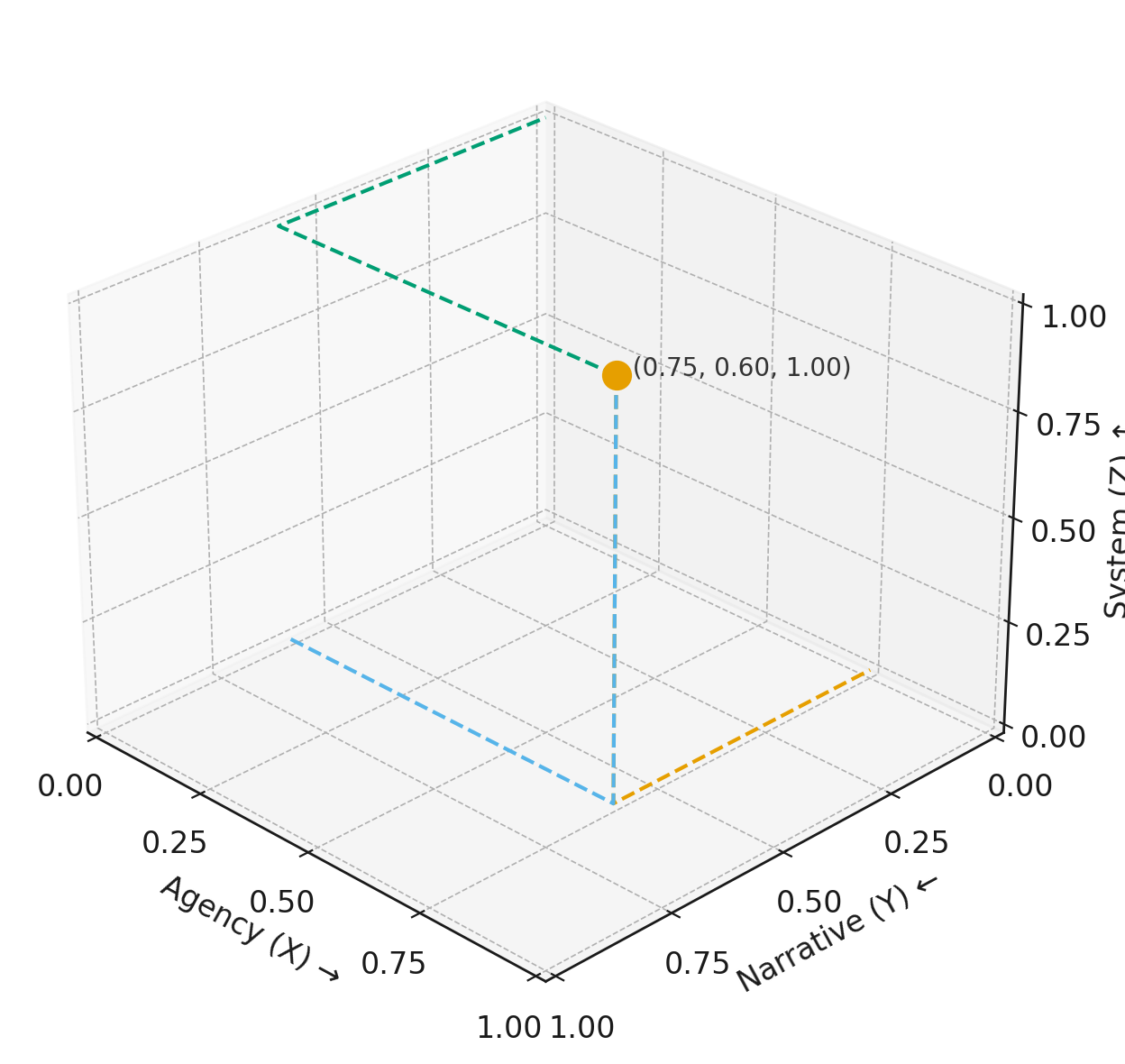
Justification:
- System = 1.0 – key activities (exploration, observation, following procedures, authoring) require being in the immersive VR environment; the certification phase similarly relies on presence in the physical environment with the real turbine.
- Narrative = 0.6 – there is a defined spatial and temporal structure (maintenance shop + turbine, stepwise procedures, visible state changes), but no developed storyline, characters, or emotional plot beyond “perform the procedures correctly”.
- Agency = 0.75 – learners and trainers have substantial operational agency in the environment (moving, manipulating components, selecting course structures), yet tactical and strategic agency are limited by predefined procedures and constrained interaction (only correct actions allowed).
7.2 Proximal uses
The Immersion Cube analysis (based on the coordinates above and the canonical use-theme coordinates) yields the following closest uses:
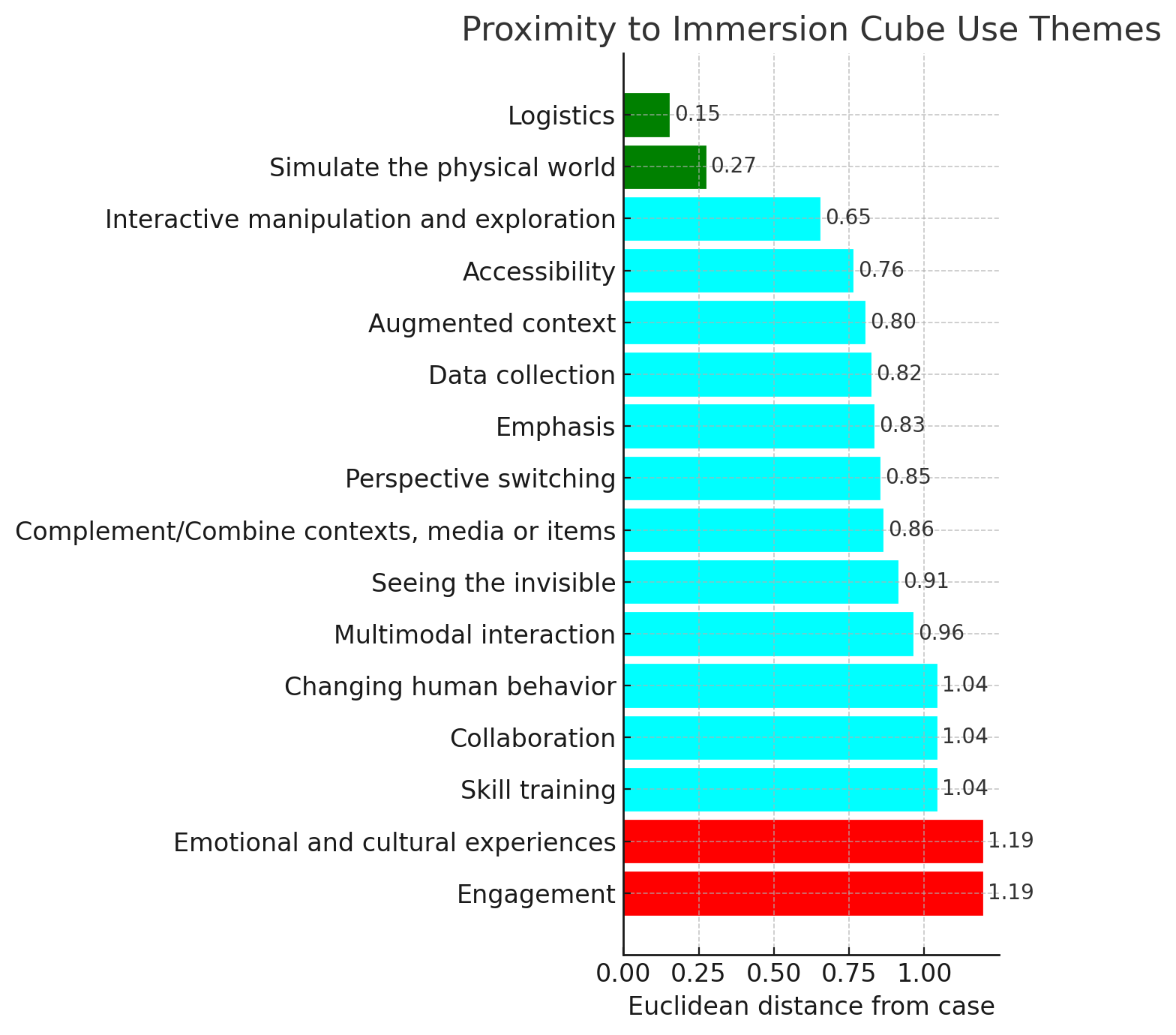
- Simulate the physical world – distance: 0.27; the VR environment closely mirrors the physical turbine and maintenance shop, using CAD-based models and real procedures to provide safe but faithful practice before work on real equipment.
- Logistics – distance: 0.15; geometrically very close in the cube because the scenario can, in principle, reduce costs, risks, and scheduling constraints, although logistics aspects (resource allocation, scheduling) are not explicitly enacted in the described learner activities.
8. Media and supporting resources
- Links to project websites:
– VRTrainingIndustry project page (INESC TEC).
– VESTAS corporate site (the industrial partner). - Screenshots and photos:

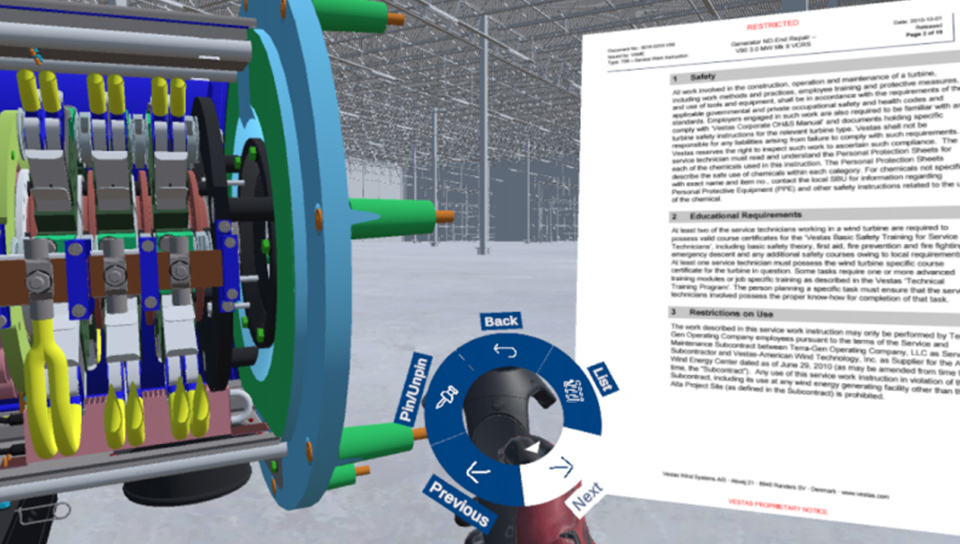
VR environment for authoring and training, with a wind turbine CAD model and technical instructions. 
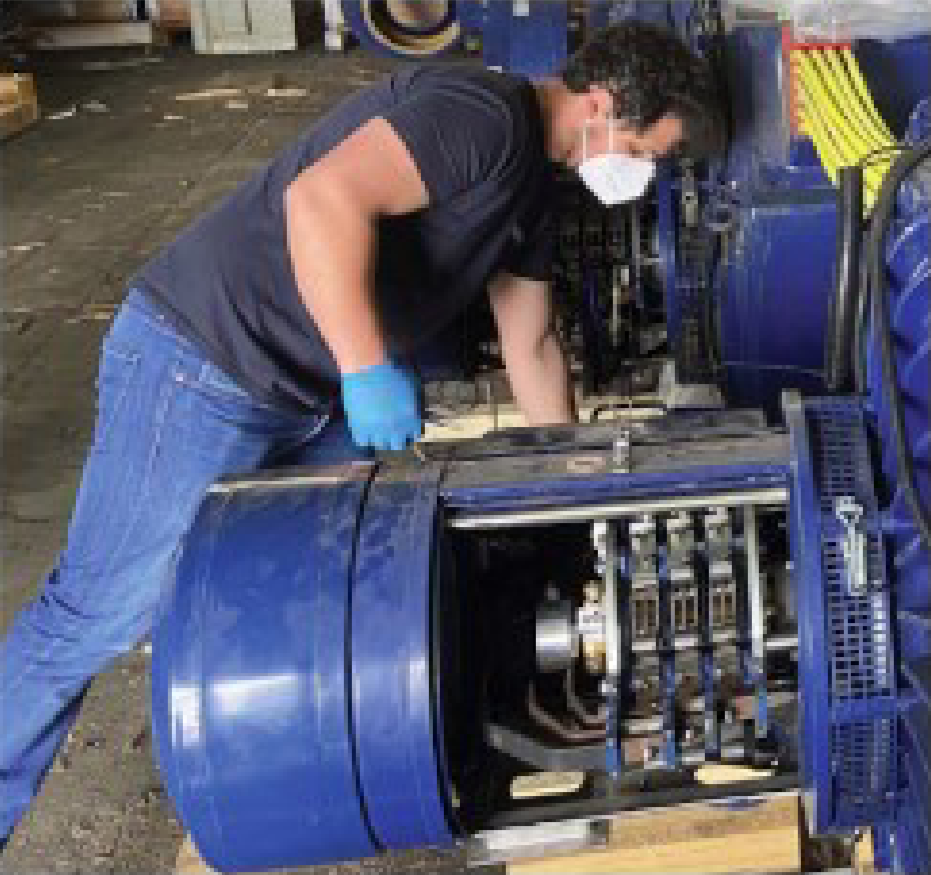
Technician during a certification test, executing the same procedure on a physical turbine. - Videos or demos:
9. Enrichment and innovation notes
Based on the ILCS analysis of this case:1
- Enrichment within existing clusters:
– One could add an after-action review step in VR, where trainees replay and reflect on their own recorded choreographies (not only expert ones), strengthening Active Context and Presence without changing the core flow.
– One could introduce light roleplay and narrative framing (e.g., “You are the technician called to repair a fault under time constraints”), modestly increasing narrative immersion. - Making latent logistics uses explicit:
– One could make the reduction of scheduling constraints and equipment scarcity visible in the design (e.g., explicit planning of who can train and when in VR vs on the physical turbine), so that Logistics becomes not only proximal in the cube but an explicit use. - Innovation via new clusters and distant uses:
– One could extend the design to multi-user VR sessions with differentiated roles (lead technician, safety officer), activating the Collaboration cluster.
– One could add simulated consequences for incorrect actions (e.g., near-miss accidents, downtime scenarios, or environmental impact narratives) to move towards the distant use of Emotional and cultural experiences. - Variations to explore:
– One could allow controlled “wrong” actions in VR, combined with feedback and after-action review, to increase agency and diagnostic power.
– One could explore lighter-weight AR or desktop variants that reduce System immersion but facilitate broader organisational deployment and blended learning setups.
10. Attribution for this case (to be edited by case authors)
This case sheet was prepared by:
Main sources: Cassola et al. (2022) – VR authoring and wind-turbine maintenance training case; Beck & Morgado (2025) – ILCS interpretation using the Immersion Cube and ILB.
Page adapted from the ILCS template on Nov 14, 2025 by Leonel Morgado, employing the Immersive Learning Case Sheet Assistant – ChatGPT 5.1 Thinking (supporting analysis & drafting)
References
-
Beck, D., & Morgado, L. (2025). Describing and Interpreting an Immersive Learning Case with the Immersion Cube and the Immersive Learning Brain. In J. M. Krüger et al. (Eds.), Immersive Learning Research Network. iLRN 2024 (CCIS, Vol. 2271). Springer, Cham, Switzerland. https://doi.org/10.1007/978-3-031-80475-5_8
-
Beck, D., Morgado, L., & O’Shea, P. (2024). Educational Practices and Strategies with Immersive Learning Environments: Mapping of Reviews for Using the Metaverse. IEEE Transactions on Learning Technologies, 17, 319–341. https://doi.org/10.1109/TLT.2023.3243946
-
Beck, D., Morgado, L., & O’Shea, P. (2020). Finding the Gaps about Uses of Immersive Learning Environments: A Survey of Surveys. Journal of Universal Computer Science, 26(8), 1043–1073. https://doi.org/10.3897/jucs.2020.055
-
Cassola, F., Mendes, D., Pinto, M., Morgado, L., Costa, S., Anjos, L., Marques, D., Rosa, F., Maia, A., Tavares, H., Coelho, A., & Paredes, H. (2022). Design and Evaluation of a Choreography-Based Virtual Reality Authoring Tool for Experiential Learning in Industrial Training. IEEE Transactions on Learning Technologies, 15(5), 526–539. https://doi.org/10.1109/TLT.2022.3157065
-
Kasapakis, V., & Morgado, L. (2025). Ancient Greek Technology: An Immersive Learning Use Case Described Using a Co-Intelligent Custom ChatGPT Assistant. arXiv preprint arXiv:2502.04110.
Case – Ancient Greek Technology with VRChat
(Kasapakis & Morgado)