
Case – VR Training for wind turbine maintenance
Case – VR Training for Wind Turbine Maintenance
This page documents an immersive learning case in the iLRN Immersive Learning Case Repository, described using the Immersive Learning Case Sheet (ILCS) method.1
1. Case identification
-
Case title:
VR Training for Wind Turbine Maintenance (VRTrainingIndustry / VESTAS) -
Contributors:
Leonel Morgado (Universidade Aberta; INESC TEC)
Dennis Beck (University of Arkansas)
Immersive Learning Case Sheet Assistant – ChatGPT 5.1 Thinking (supporting analysis & drafting) -
Original source(s):
Cassola, F., Mendes, D., Pinto, M., Morgado, L., Costa, S., Anjos, L., et al. (2022). Design and Evaluation of a Choreography-Based Virtual Reality Authoring Tool for Experiential Learning in Industrial Training. IEEE Transactions on Learning Technologies, 15(5), 526–539.
Beck, D., & Morgado, L. (2025). Describing and Interpreting an Immersive Learning Case with the Immersion Cube and the Immersive Learning Brain. In J. M. Krüger et al. (Eds.), Immersive Learning Research Network. iLRN 2024 (CCIS, Vol. 2271). Springer.
VRTrainingIndustry project page, INESC TEC: “Virtual EnvironmentS for optimization and training in InduStry 4.0”, https://vrtraining.inesctec.pt/. -
Time frame:
2019–2021: design, development, and evaluation during the VRTrainingIndustry project; usability and certification case study with wind-turbine maintenance professionals conducted within this period.
2. Short description (abstract)
3. Context and participants
-
Educational level and setting:
Corporate / industrial training in a wind-energy company (VESTAS); short course conducted in a dedicated VR lab and a physical maintenance workshop. -
Discipline / subject area:
Mechanical and industrial engineering; wind-turbine maintenance; safety and procedural competence. -
Number and profile of learners:
Small groups of adult professionals and trainees with prior experience in turbine maintenance or related technical work; in the reported usability and certification study, trainees were expert professionals with varying years of field experience. -
Other stakeholders:
Expert trainers from VESTAS; INESC TEC research and development team (VR authoring tool and study design); the wider industrial training and certification structure of the company. -
Constraints or special conditions:
Health and safety risks associated with in situ turbine maintenance; limited availability of real turbines and workshop time for training; need to reduce costs and downtime while still providing authentic, certifiable training.
4. Immersive environment and technologies
-
Type of environment:
Fully immersive virtual reality (VR) training and authoring environment, with a hybrid pipeline linking VR training to physical maintenance and certification. -
Main platforms and tools:
Custom VR authoring and training tool developed in Unity; head-mounted display (HMD)-based VR setup with motion/hand controllers; integration of CAD-based turbine models and industrial maintenance data. -
Physical and virtual spaces involved:
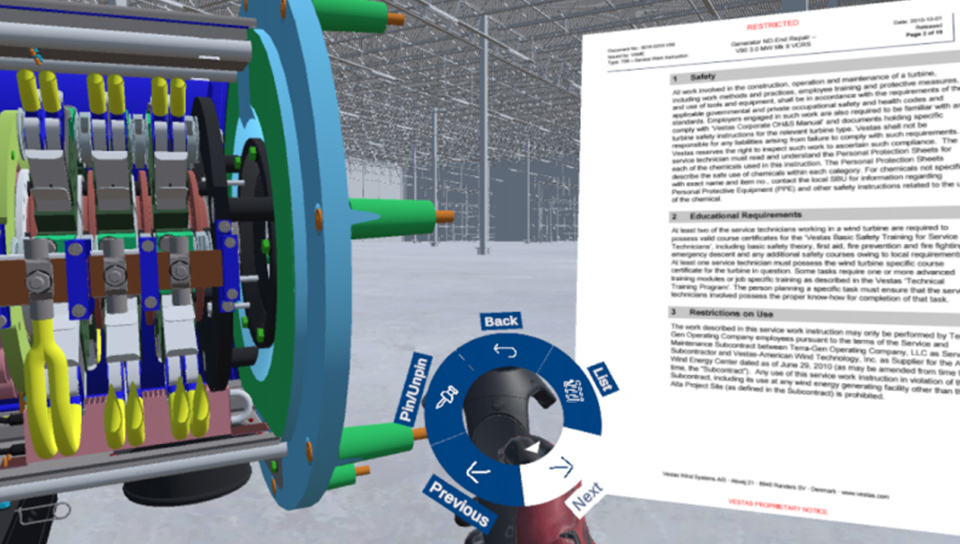
Learners are physically located in a VR lab for authoring and training sessions, and in a real maintenance warehouse/workshop for physical certification. Virtually, they experience a detailed 3D turbine model situated in a virtual maintenance shop, with panels, menus, and in-world documentation surrounding the work area. -
Key interaction modes:
Embodied manipulation (moving around the turbine, selecting and operating parts), controller-based interaction with components and menus, navigation in 3D space, and the ability to watch and mimic recorded expert actions (“virtual choreographies”). Text input and configuration are handled via in-world panels and a virtual keyboard.
5. Learning goals and assessment
-
Intended learning outcomes:
– Execute specific wind-turbine maintenance procedures safely and correctly, following the company’s technical manual.
– Recognise turbine components and their relationships in a complex generator assembly.
– Transfer procedural performance from immersive practice on a virtual turbine to physical execution on a real turbine during certification.
– Reduce dependence on scarce physical equipment and expert supervision while maintaining certification standards. -
Assessment approaches:
– During VR training, the system records trainees’ actions as virtual choreographies and checks them against trainer-specified choreographies (number of errors, execution time).
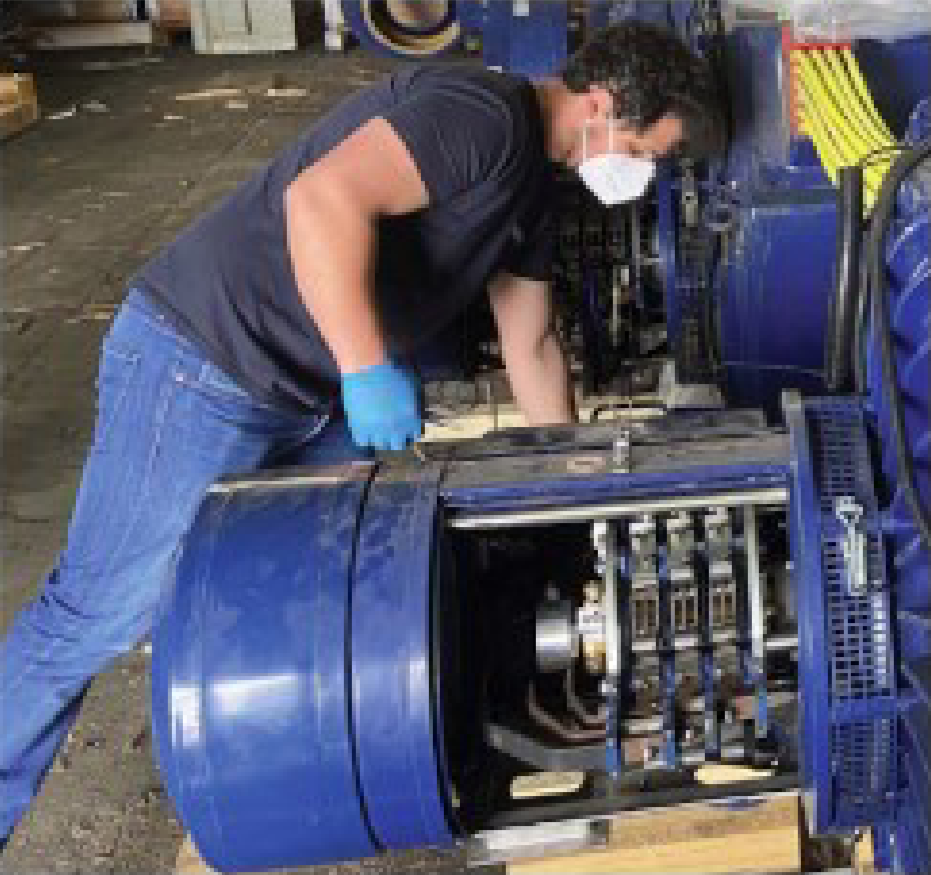
– In the certification phase, trainees perform the same maintenance task on a physical turbine, under supervision of an expert trainer, who checks successful completion, time, and errors.
– Questionnaires on usability, perceived fidelity, and satisfaction for both trainers (authoring) and trainees (learning experience). -
Main results (if available):
Trainers were able to author a full course in VR and judged the tool useful and the virtual turbine faithful to the physical one, though text input and scene switching needed improvement. Trainees reported high satisfaction and perceived fidelity, with relatively low error counts during VR training. In the physical certification test, both a VR-trained participant and a non-VR-trained participant completed the procedure successfully, but the VR-trained participant was faster (35 vs 42 minutes), suggesting promising transfer from immersive training to real-world performance.
6. ILB interpretation – practices and strategies
This section summarises how the case is interpreted using the Immersive Learning Brain (ILB) clusters.2
The focus is on clearly present practices and strategies, rather than listing every possible item.
- Main ILB clusters involved:
Active Context; Presence; Real and Virtual Multimedia Learning. (Engagement & Scaffolding, Collaboration, and Traditional practices are largely absent in the current design.)
6.1 Practices
The following ILB practices are clearly present in this case:
- Authentic practice and assessment (Active Context) – trainees rehearse genuine maintenance procedures on a realistic virtual turbine and then perform the same procedures on a physical turbine for certification.
- Exploration and experimentation of concepts/processes (Active Context) – VR sessions include a phase for free exploration of the turbine model and for trying out the procedure steps in a safe, resettable environment.
- Embodied interactions (Presence) – learners move around and act on the turbine using VR controllers and bodily movement, aligning perception and action in 3D space.
- Information visualization and inference (Real and Virtual Multimedia Learning) – the CAD-based turbine model and visible state changes during procedures make internal structure and process dynamics inspectable and interpretable.
- Learning design for multimodal information (Real and Virtual Multimedia Learning) – the course combines text (technical manuals), visual/3D representations, and recorded expert demonstrations into a single immersive learning flow.
(Additional practices such as explicit feedback, coaching, or collaboration are not yet implemented in this case.)
6.2 Strategies
The most relevant ILB strategies instantiated by these practices are:
- Active learning theories (Active Context) – learners engage in “learning by doing” via hands-on procedures in VR and the subsequent physical certification task.
- Authentic learning (Active Context) – the content and environment are tied to real turbine maintenance and company certification processes, not to a fictional task.
- Contextual theories (Active Context) – the virtual and physical environments mirror the contextual conditions of a real maintenance shop and workflow.
- Interactive visualization (Presence) – trainees interact with a manipulable, high-fidelity turbine model whose state responds dynamically to their actions.
- Presence (Presence) – the design relies on feeling “there” in both the virtual maintenance shop and the physical workshop as a condition for effective exploration, execution, and certification.
(Strategies from other clusters, such as collaborative learning or narrative/roleplay-based engagement, are candidates for future enrichment rather than being present in this baseline case.)
7. Immersion Cube interpretation – immersion and uses
This section describes how the case is positioned in the Immersion Cube and which generic uses of immersive learning environments it is closest to.3
7.1 Immersion coordinates
- System immersion (0–1): 1.0
- Narrative immersion (0–1): 0.6
- Agency immersion (0–1): 0.75
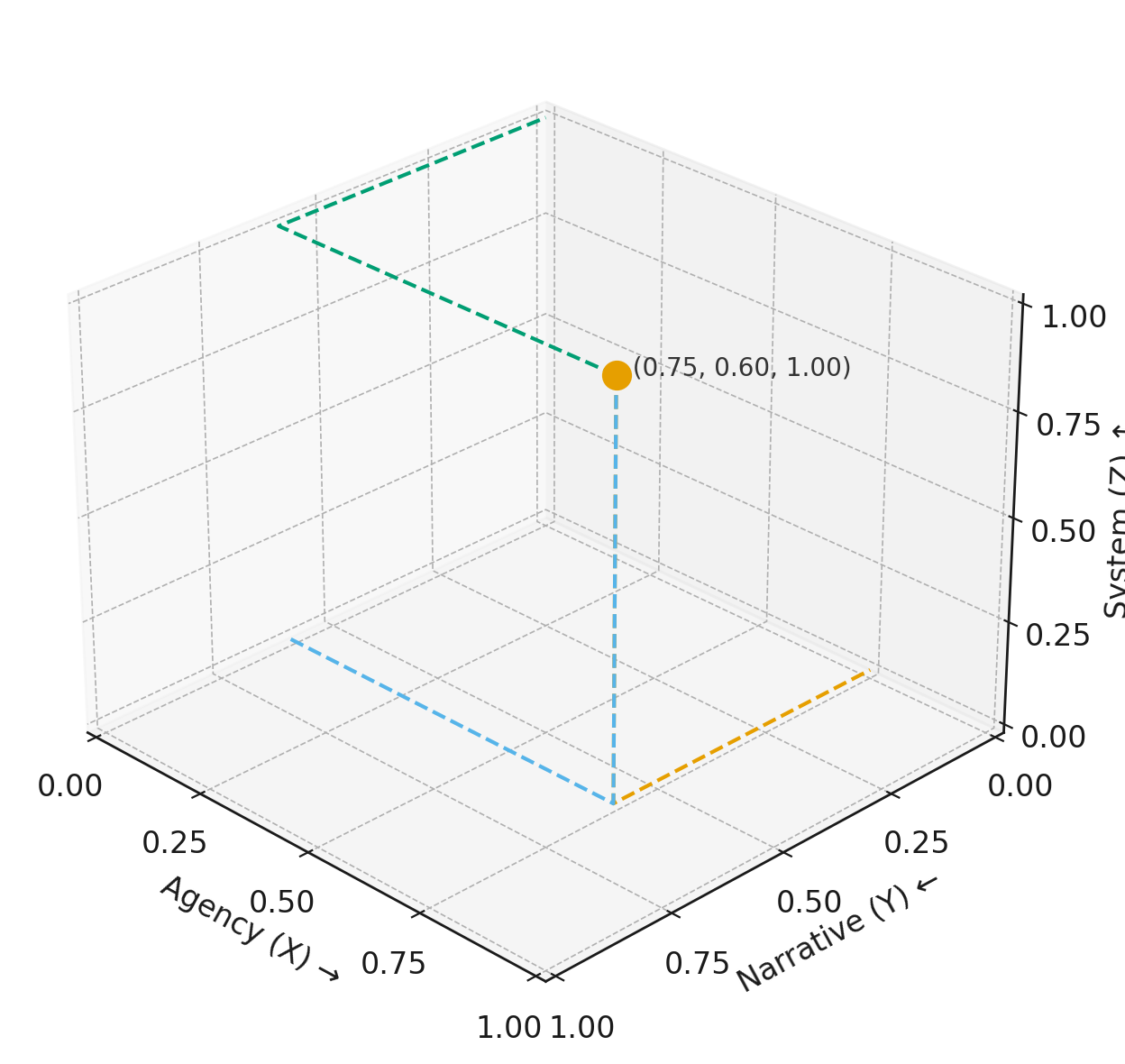
Justification:
- System = 1.0 – key activities (exploration, observation, following procedures, authoring) require being in the immersive VR environment; the certification phase similarly relies on presence in the physical environment with the real turbine.
- Narrative = 0.6 – there is a defined spatial and temporal structure (maintenance shop + turbine, stepwise procedures, visible state changes), but no developed storyline, characters, or emotional plot beyond “perform the procedures correctly”.
- Agency = 0.75 – learners and trainers have substantial operational agency in the environment (moving, manipulating components, selecting course structures), yet tactical and strategic agency are limited by predefined procedures and constrained interaction (only correct actions allowed).
7.2 Proximal uses
The Immersion Cube analysis (based on the coordinates above and the canonical use-theme coordinates) yields the following closest uses:
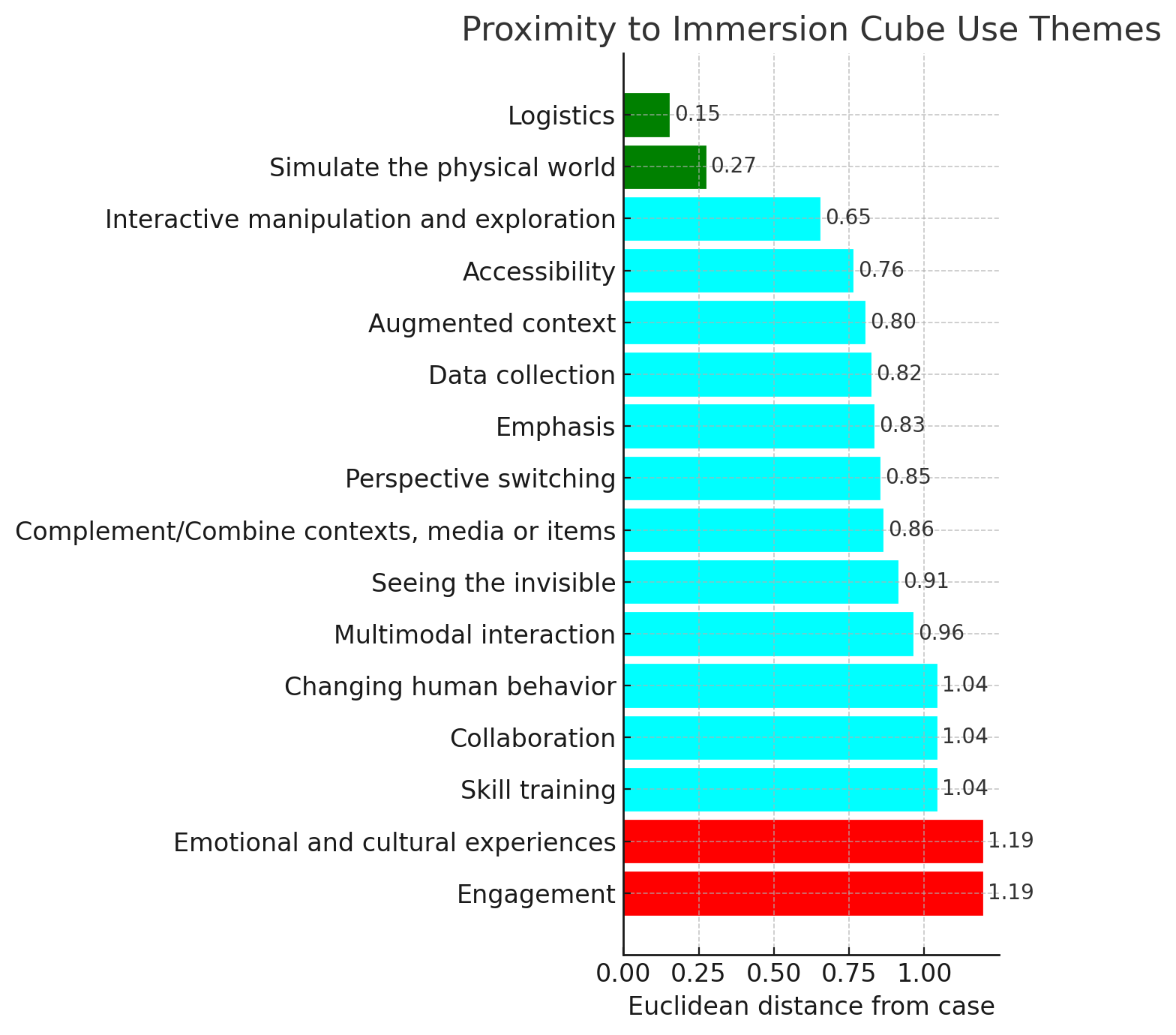
- Simulate the physical world – distance: 0.27; the VR environment closely mirrors the physical turbine and maintenance shop, using CAD-based models and real procedures to provide safe but faithful practice before work on real equipment.
- Logistics – distance: 0.15; geometrically very close in the cube because the scenario can, in principle, reduce costs, risks, and scheduling constraints, although logistics aspects (resource allocation, scheduling) are not explicitly enacted in the described learner activities.
8. Media and supporting resources
- Links to project websites:
– VRTrainingIndustry project page (INESC TEC).
– VESTAS corporate site (the industrial partner). - Screenshots and photos:
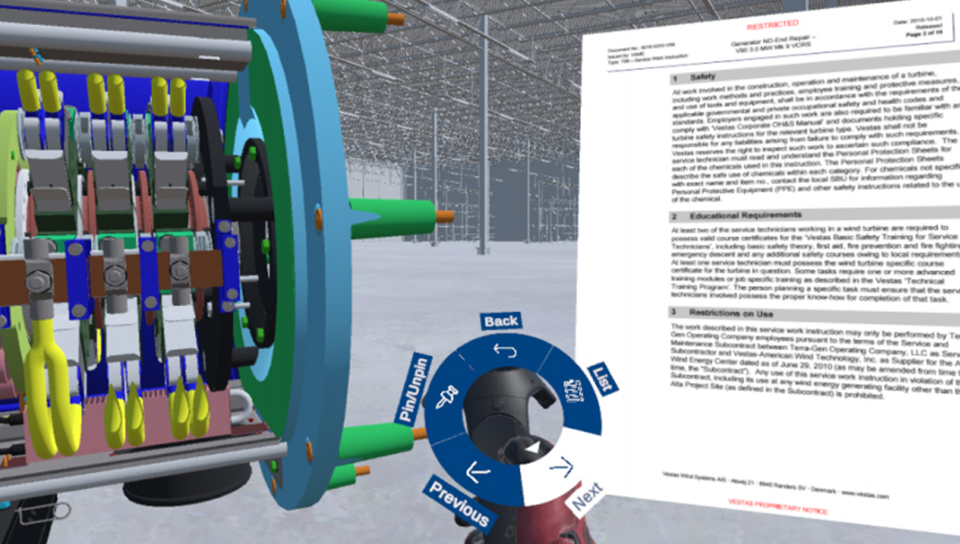
VR environment for authoring and training, with a wind turbine CAD model and technical instructions. 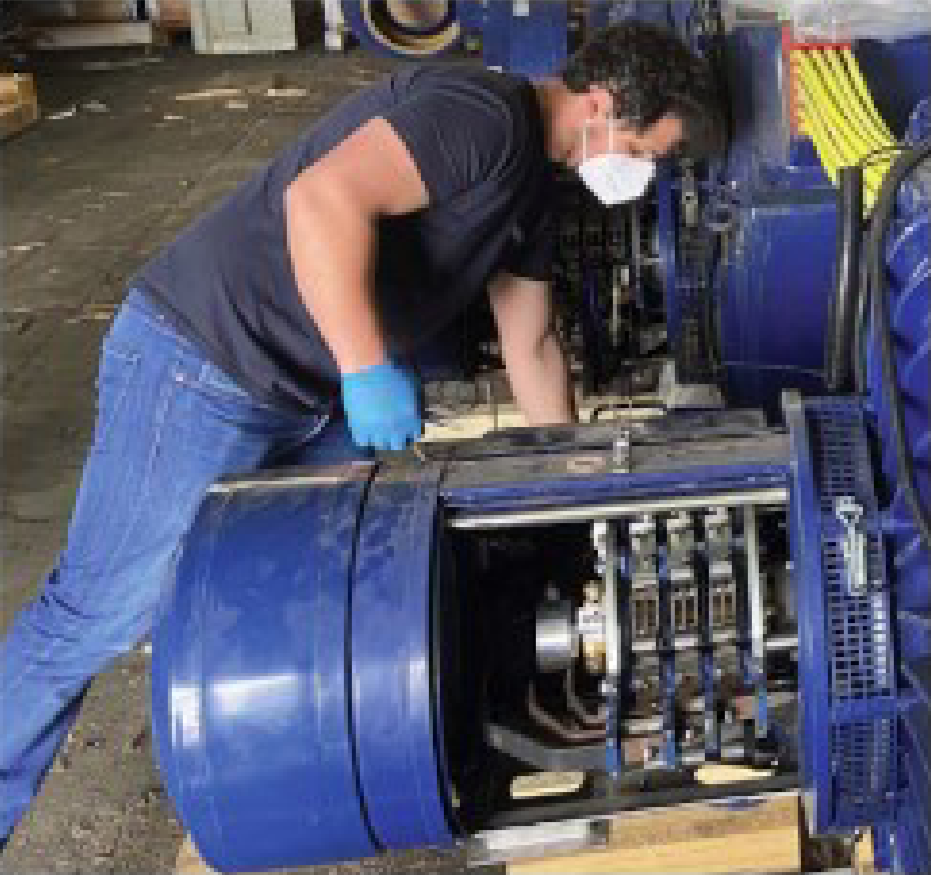
Technician during a certification test, executing the same procedure on a physical turbine. - Videos or demos:
9. Enrichment and innovation notes
Based on the ILCS analysis of this case:1
- Enrichment within existing clusters:
– One could add an after-action review step in VR, where trainees replay and reflect on their own recorded choreographies (not only expert ones), strengthening Active Context and Presence without changing the core flow.
– One could introduce light roleplay and narrative framing (e.g., “You are the technician called to repair a fault under time constraints”), modestly increasing narrative immersion. - Making latent logistics uses explicit:
– One could make the reduction of scheduling constraints and equipment scarcity visible in the design (e.g., explicit planning of who can train and when in VR vs on the physical turbine), so that Logistics becomes not only proximal in the cube but an explicit use. - Innovation via new clusters and distant uses:
– One could extend the design to multi-user VR sessions with differentiated roles (lead technician, safety officer), activating the Collaboration cluster.
– One could add simulated consequences for incorrect actions (e.g., near-miss accidents, downtime scenarios, or environmental impact narratives) to move towards the distant use of Emotional and cultural experiences. - Variations to explore:
– One could allow controlled “wrong” actions in VR, combined with feedback and after-action review, to increase agency and diagnostic power.
– One could explore lighter-weight AR or desktop variants that reduce System immersion but facilitate broader organisational deployment and blended learning setups.
10. Attribution for this case (to be edited by case authors)
This case sheet was prepared by:
Main sources: Cassola et al. (2022) – VR authoring and wind-turbine maintenance training case; Beck & Morgado (2025) – ILCS interpretation using the Immersion Cube and ILB.
Page adapted from the ILCS template on Nov 14, 2025 by Leonel Morgado, employing the Immersive Learning Case Sheet Assistant – ChatGPT 5.1 Thinking (supporting analysis & drafting)
References
-
Beck, D., & Morgado, L. (2025). Describing and Interpreting an Immersive Learning Case with the Immersion Cube and the Immersive Learning Brain. In J. M. Krüger et al. (Eds.), Immersive Learning Research Network. iLRN 2024 (CCIS, Vol. 2271). Springer, Cham, Switzerland. https://doi.org/10.1007/978-3-031-80475-5_8
-
Beck, D., Morgado, L., & O’Shea, P. (2024). Educational Practices and Strategies with Immersive Learning Environments: Mapping of Reviews for Using the Metaverse. IEEE Transactions on Learning Technologies, 17, 319–341. https://doi.org/10.1109/TLT.2023.3243946
-
Beck, D., Morgado, L., & O’Shea, P. (2020). Finding the Gaps about Uses of Immersive Learning Environments: A Survey of Surveys. Journal of Universal Computer Science, 26(8), 1043–1073. https://doi.org/10.3897/jucs.2020.055
-
Cassola, F., Mendes, D., Pinto, M., Morgado, L., Costa, S., Anjos, L., Marques, D., Rosa, F., Maia, A., Tavares, H., Coelho, A., & Paredes, H. (2022). Design and Evaluation of a Choreography-Based Virtual Reality Authoring Tool for Experiential Learning in Industrial Training. IEEE Transactions on Learning Technologies, 15(5), 526–539. https://doi.org/10.1109/TLT.2022.3157065
-
Kasapakis, V., & Morgado, L. (2025). Ancient Greek Technology: An Immersive Learning Use Case Described Using a Co-Intelligent Custom ChatGPT Assistant. arXiv preprint arXiv:2502.04110.
No comments to display
No comments to display