
Designing Immersive Convenings at iLRN
Exploratory, Participatory, and Place-Aware Conferences and Events
This page articulates iLRN’s shared framework for designing conferences and network events as immersive learning experiences—integrating a T-shaped immersive model, a seasonal engagement rhythm, and a commitment to intentional, participatory experience design.
Purpose and Scope
This page serves as a design charter for how the Immersive Learning Research Network (iLRN) conceives, plans, and evaluates its conferences and other convenings.
Rather than treating events as isolated moments of presentation or dissemination, iLRN understands conferences, meetups, and network activities as immersive learning experiences: exploratory, participatory, and situated in local and cultural context. These experiences are designed intentionally over time, across modalities, and with explicit attention to authors, planners, and designers needs for creating quality participant experience and impact.
This page establishes the shared logic and commitments that guide those designs. Detailed operational models are documented in linked Codex pages.
Core Commitment
iLRN commits to designing its conferences and events as immersive experiences, not merely as schedules of talks.
This means:
-
experiences are exploratory, not only consumptive;
-
participation is active and dialogic, not passive;
-
local context, culture, and place matter;
-
and impact is something to be co-created and reflected upon, not assumed.
The iLRN T-Shaped Model for Maximizing Immersive Learning Capabilities
iLRN uses a T-shaped immersive model to guide the design of conferences and events.
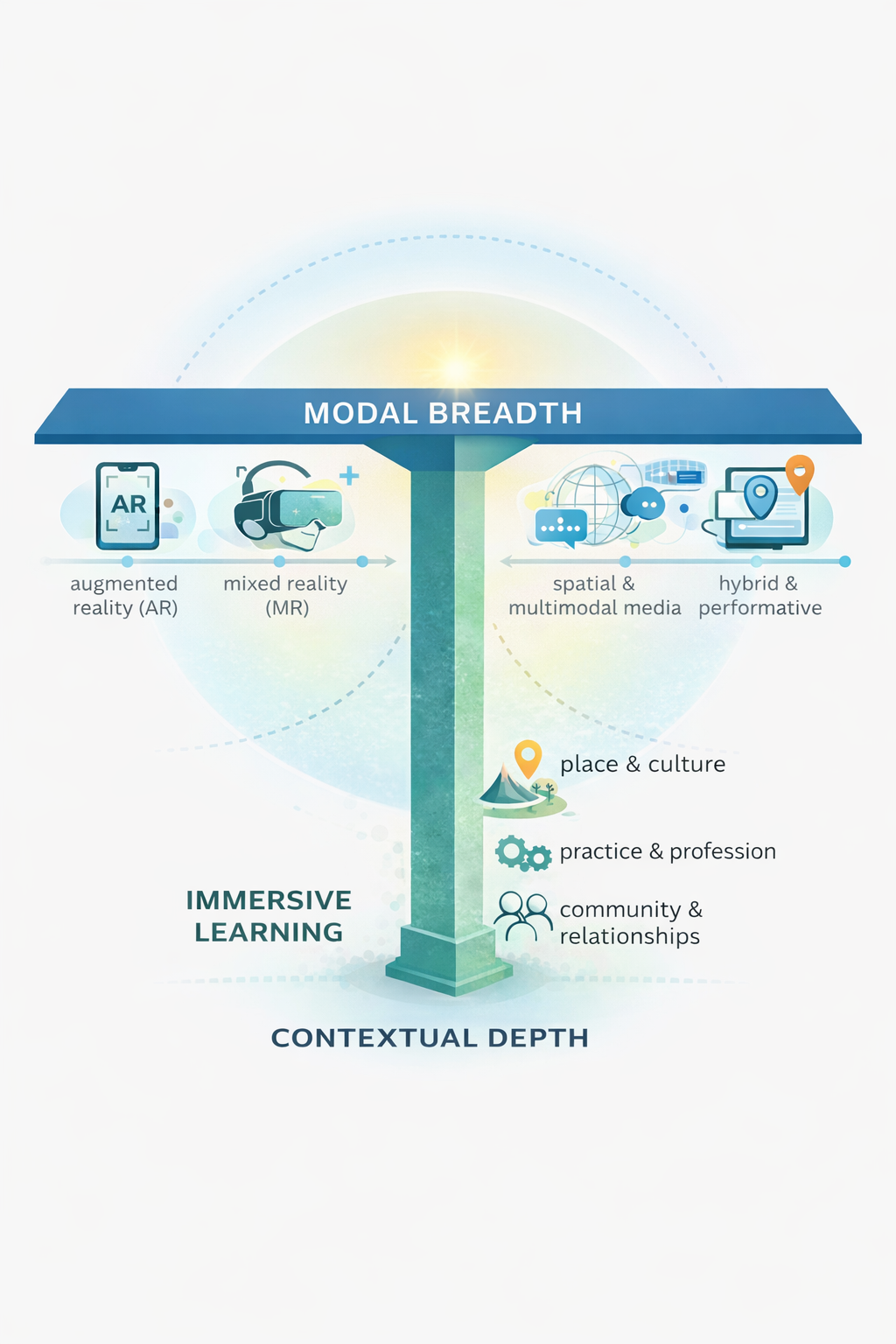
Legend: Interpreting iLRN's T-Shaped Immersion Model
(1) Horizontal (Modal Breadth).
iLRN conferences intentionally span Milgram’s Reality–Virtuality Continuum, integrating a range of hardware- and software-mediated experiences—from augmented and mixed reality to fully virtual environments and even non-digital forms of immersion. This breadth allows participants to explore the diverse immersive learning possibilities enabled by computer science, interaction design, and related technical domains. In order to create healthy community dialogue, iLRN seeks to provide participants with the wide range of designed immersive experiences currently employed for learning and training, worldwide.
Across iLRN convenings, participants encounter a broad spectrum of immersive modalities, including (but not limited to):
-
augmented, mixed, and virtual reality
-
spatial and multimodal media
-
hybrid physical–digital formats
-
embodied, dialogic, and performative practices
This horizontal dimension ensures accessibility, inclusivity, and exposure to the diversity of immersive learning approaches in the field. This happens best by planning and co-design.
(2) Vertical (Contextual Depth).
At the same time, iLRN convenings are designed to deepen engagement with the local host context. Events draw upon the place, people, cultures, practices, and relationships of the host community, ensuring that immersion is not only technological, but also social, cultural, and situational.
The vertical dimension represents deep immersion in local context, including:
-
place, culture, and environment (including local game studios, cultural landmarks, food, music, arcades and attractions)
-
disciplinary and professional practice
-
community relationships and histories
At conferences, this depth is expressed through local partnerships, place-based programming, and intentional engagement with the host context.
Together, these dimensions support immersive learning experiences that are both technically expansive and meaningfully grounded. Together, the horizontal and vertical dimensions ensure that iLRN convenings are both broadly exploratory and deeply grounded.
[A dedicated Codex page elaborates this model in detail.]
The Seasonal Timeline of iLRN Convenings
iLRN designs its conferences and events within a seasonal rhythm, recognizing that immersion unfolds over and across time rather than at a single moment. Immersion, as a function of attention, is best built over time and orchestrated with "seasons" allowing competing kinds of attention and perspectives to be woven together.
The iLRN Year
iLRN’s official annual cycle begins on September 1. The rhythm of convening, however, includes a pre-season buildup, the conference peak, and post-event synthesis. Conference hosts do work up to THREE YEARS in advance of planning and collaboration with iLRN's Steering Committee and Executive Team - announcing their intent to host usually in the Springtime during the Year BEFORE the calendar year of their conference. This allows conference attendees to discuss, plan and collaborate on future conferences while attending the present one.
Seasonal Engagement Logic
Across the year, different audiences engage with iLRN at different moments, including:
-
prospective academic authors and reviewers
-
practitioners and designers
-
futures and innovation communities
-
industry and institutional partners
-
local and regional chapters
Each season emphasizes different forms of participation—calls, preparation, dialogue, experimentation, convening, reflection, and publication—while remaining connected to the same overarching design intent.
Committee-Governed Timelines
Each conference or major event operates with its own committee-governed timeline nested within the broader seasonal rhythm. These timelines align:
-
scholarly review and publication cycles,
-
program development and curation,
-
community engagement and outreach,
-
and post-event synthesis and dissemination.
This layered approach allows iLRN to remain both globally coherent and locally adaptive.
[A dedicated Codex page documents the seasonal model and its typical phases.]
Conferences and Events as Immersive Experiences
iLRN explicitly treats conferences and events as designed immersive experiences, with participant experience considered a core deliverable.
Intentional Experience Design
Organizing Committees are expected to approach convenings with the same care given to immersive learning design, including:
-
clear experiential goals,
-
intentional flows across sessions and spaces,
-
attention to transitions, pacing, and social dynamics,
-
and coherence across physical, virtual, and hybrid environments.
UX-Informed Budgeting (with Boundaries)
Experience design is reflected in budgeting decisions, within responsible and transparent constraints. Investments are considered not only in terms of cost efficiency, but in terms of:
-
participant engagement and accessibility,
-
quality of interaction and dialogue,
-
technical reliability and inclusivity,
-
and the overall integrity of the immersive experience.
This does not imply extravagance. It implies intentionality.
Co-Creating and Measuring Impact
iLRN convenings are designed to co-create impact with participants rather than merely deliver content. Organizing Committees are encouraged to:
-
articulate intended forms of impact,
-
design mechanisms for participation and contribution,
-
and reflect on outcomes through synthesis, documentation, and shared learning.
Impact may be scholarly, professional, community-based, or field-shaping—and is understood as something that emerges through collective engagement.
[A dedicated Codex page elaborates this commitment and provides guidance for Organizing Committees.]
How These Elements Work Together
The T-shaped model, seasonal timeline, and immersive experience commitment are complementary lenses, not separate initiatives:
-
the T-shaped model guides what kinds of immersion are designed,
-
the seasonal timeline guides when and how engagement unfolds,
-
and the immersive experience commitment guides how events are shaped, resourced, and evaluated.
Together, they form a coherent framework for iLRN convenings as learning ecosystems in motion.
Status and Evolution
This framework is a living design charter. As iLRN’s practices, technologies, and communities evolve, these models may be refined. Changes will be documented through the Codex as part of iLRN’s ongoing design-based organizational learning.
Linked Codex Pages
-
The iLRN Seasonal Timeline for Conferences and Programs
-
Designing Conferences and Events as Immersive Experiences
Suggested Citation
Immersive Learning Research Network. Designing Immersive Convenings at iLRN: Exploratory, Participatory, and Place-Aware Conferences and Events. iLRN Codex. Public edition.
Codex Colophon
This page is part of the iLRN Codex, a living knowledge base supporting shared understanding, quality assurance, and continuity across the Immersive Learning Research Network. Codex entries reflect evolving practice and are intended to support transparent, reflective, and ethical field development.