
Part I. Introduction to the Immersive Futures Guild
1.1 What the Immersive Futures Guild Is
The Immersive Futures Guild is iLRN's dedicated foresight community — the organizational structure within which horizon scanning, expert deliberation, scenario development, and long-range knowledge synthesis take place. The Guild operates as a standing working group within iLRN, coordinated by the Circle of Scholars and open to wider community participation through structured contribution mechanisms.
The Guild's primary intellectual output is the Vision 2035 series: a rolling program of foresight cards, scenario narratives, and research strand analyses that collectively constitute a living picture of the societal, technological, and educational conditions that will shape immersive learning over a ten-to-twenty year horizon. These outputs are organized and maintained within the Immersive Futures Guild Codex.
The Guild operates on an annual cycle with two distinct phases. In H1 (January through June), the Circle of Scholars conducts facilitated workshops that produce time-stamped foresight syntheses — the foundational scholarly record for each card. In H2 (July through December), those syntheses are opened to the broader iLRN community for evidence contribution, methodological challenge, cultural perspective, and dialogue. This cycle repeats, with each January Circle of Scholars session reviewing and potentially versioning the outputs of the prior year's community evidence track.
1.2 What the Immersive Futures Guild Codex Is
The Immersive Futures Guild Codex is a purpose-specific deployment of iLRN's BookStack-based Codex infrastructure. While the broader iLRN Codex serves multiple organizational functions — including Knowledge Tree evidence synthesis, conference logistics documentation, and operational procedures — the Immersive Futures Guild Codex is dedicated exclusively to the Guild's foresight work.
The Immersive Futures Guild has, for now, chosen to structure every page in their Guild Codex so it follows a consistent two-section architecture: a fixed foresight documentation block anchored to Circle of Scholars expert workshop output (Part I of each page), followed by a living community evidence and dialogue page section that accumulates contributions from network members throughout H2 (Part II of each page). No page in the Guild Codex is a single-section document. The two-section structure is not optional — it is the defining design principle of every artifact the Guild produces.
The Living Architecture is thus:
-
Expert Circle Snapshot
-
Community disagreement, discussion, and ongoing dialogue
1.3 Relationship to the Broader iLRN Codex
The Immersive Futures Guild Codex is one of several functional deployments of the iLRN Codex infrastructure at codex.immersivelrn.org Other deployments serve the Knowledge Tree (evidence synthesis), Circle of Scholars governance (advisory records), and iLRN operations (conference documentation, community management). The Codex is deployed as a “Single Source Document” across the network. These deployments share the same BookStack platform and the same underlying naming and linking conventions described in Part VIII of this handbook.
Pages in the Guild Codex are cross-linked to pages in other Codex deployments — particularly Research Strand pages (which connect foresight work to the Knowledge Tree evidence base) and Scenario pages (which draw on Societal Challenge and Future Technology cards). These cross-links are intended to be maintained bidirectionally and essential to the function of the Codex as a network rather than a collection of isolated documents.
We should have the platform that allows us to carry out this Open Science collection of shared, public evidence that aims to serve people with immersive learning needs, everywhere.
1.4 The Circle of Scholars Foresight Cycle
The Circle of Scholars is iLRN's top-tier advisory body composed of distinguished researchers, practitioners, and community leaders in immersive learning. Within the Immersive Futures Guild, the Circle's function is specifically foresight production: Participating Circle of Scholar members contribute to discussions and shared activities for the facilitated synthesis of expert perspective into publication of time-stamped cards and narratives. The environmental scanning + structured publication can stand on its own as imaginative & current syntheses of RIGHT NOW in AI+XR… and documenting these bounded activities constitutes the Guild Codex's primary scholarly record. We will practice forecasting out loud, creating & sharing scenarios that can be anchored in critical intelligence and imagination for better human learning.
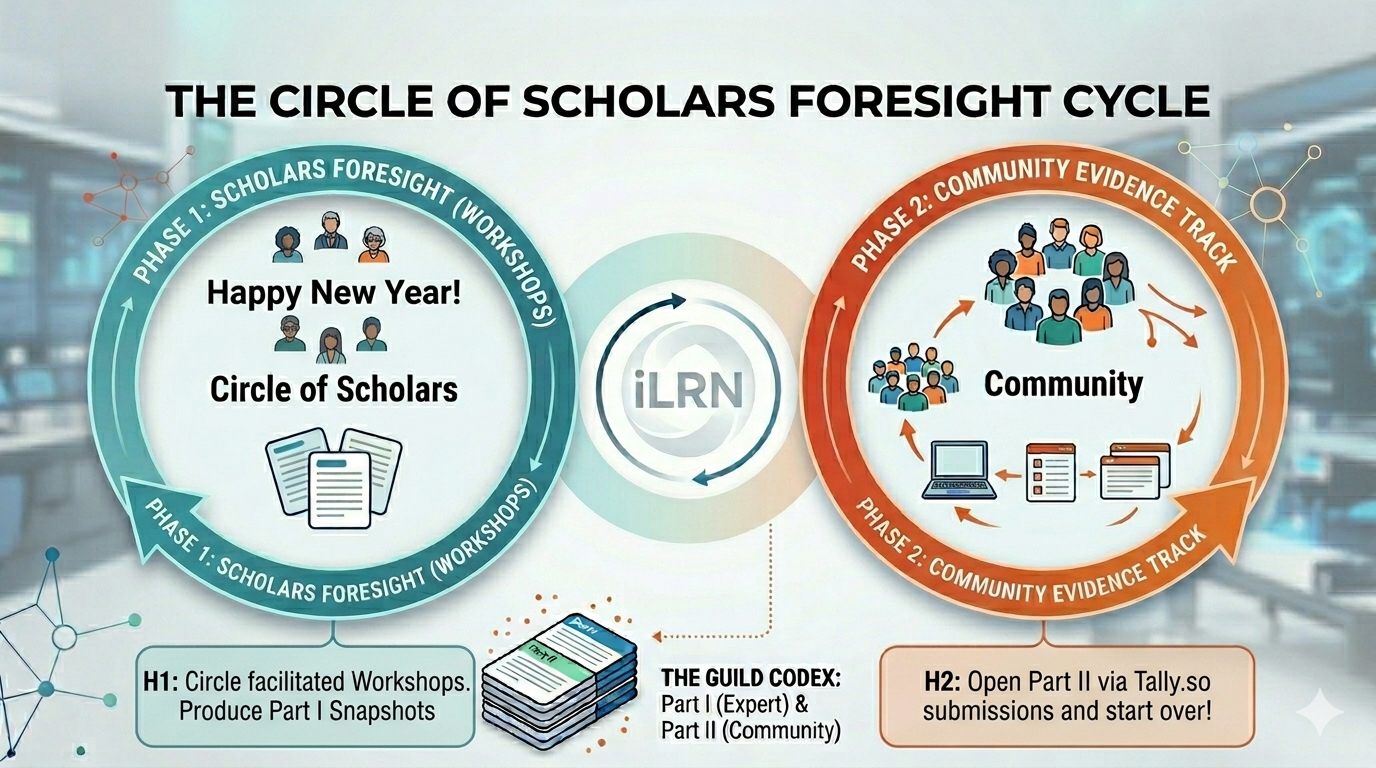
Circle workshops are conducted using Design-Based Research (DBR) participatory synthesis methods. Facilitation is provided by designated Circle members with foresight methodology and scenario or trend relevant expertise. Workshop outputs are documented as the fixed Part I of each Codex page — they represent the best available expert synthesis at a given moment in time, and they anchor the community evidence track that follows.
|
H1 Activity |
Circle of Scholars facilitated workshops — produce time-stamped Part I foresight snapshots for new and reviewed cards |
|
H2 Activity |
Community evidence track — Part II of each card opens for broader iLRN contribution via Tally.so forms |
|
Annual Handoff |
January Circle of Scholars session reviews prior year's community evidence; decides on Part I versioning; opens new card cycle |
|
Tally.so Role |
Each card carries a unique Tally.so form URL; submissions are reviewed and incorporated into Part II on a rolling basis |
|
Facilitation |
Designated Circle of Scholars members; foresight methodology expertise required |
|
Documentation |
All workshop outputs are time-stamped and attributed; no revision without formal versioning decision |
1.5 Two-Section Structure reflecting Expert Perspective & Community Calibration
The two-section architecture of every Guild Codex page embodies a specific epistemological commitment: that foresight knowledge can be best built in sequence: of two distinct but equally necessary dimensions. The first is scholarly anchoring — the rigorous, facilitated, time-stamped synthesis of expert perspective that gives a card its initial authority and stability. The second is community calibration — the ongoing testing, challenging, extending, and contextualizing of that synthesis by a broader and more diverse community of knowers.
Neither dimension is sufficient alone. A card with only Part I is a snapshot that will age without stewardship. A card with only Part II is an unanchored discussion without scholarly grounding. The two-section structure ensures that Guild Codex pages maintain both epistemic authority and epistemic responsiveness over time.
The Tally.so community contribution form attached to every card's Part II is not an optional feedback mechanism — it is structural infrastructure. It ensures that the pathway from community knowledge to Codex record is always specific, traceable, and open. Each form is unique to its card, allowing contributions to be organized and synthesized by card rather than accumulated in a single undifferentiated inbox.
1.6 Living Knowledge Infrastructure for Foresight Work
Foresight is particularly vulnerable to synthesis decay — the process by which authoritative-seeming documents become outdated without mechanisms for update and maintenance. A scenario written in one year may be significantly miscalibrated by the next, as technologies develop faster or slower than anticipated, as social conditions shift, and as weak signals mature into prominent trends.
The Guild Codex addresses this through several design features: the H1/H2 annual cycle that ensures every card is revisited at least once per year; the community evidence track that creates continuous incoming signal; the versioning protocol that documents when and why the Part I synthesis is updated; and the Ways of Knowing framework (Tree, Garden, Lantern) that makes explicit which dimension of knowledge each contribution addresses.
1.7 Ways of Knowing in the Guild Codex
Every Guild Codex page is situated within iLRN's Ways of Knowing framework. This framework distinguishes three dimensions of knowledge production that are all present in immersive learning, all necessary for rigorous foresight, and all welcome as contribution modes in the community evidence track.
|
Symbol |
Way of Knowing |
What It Addresses |
Contribution Type in Part II |
|---|---|---|---|
|
🌳 Tree |
Knowledge / Evidence |
What research shows; what systematic evidence supports; what the literature documents |
Literature citations, empirical findings, systematic review summaries |
|
🌼 Garden |
Practice / Design |
What works in practice; what practitioners observe; what design produces |
Case examples, practitioner accounts, design pattern documentation |
|
🏮 Lantern |
Futures / Anticipation |
What signals suggest; what scenarios illuminate; what long-range thinking reveals |
Horizon signals, scenario challenges, future-oriented evidence claims |
1.8 Codex Governance Philosophy
The Guild Codex operates under a governance philosophy that prioritizes epistemic honesty over apparent consensus, documentation over resolution, and community breadth over institutional convenience. The following principles are operational requirements, not aspirational values — they are embedded in the design of every template, every workflow, and every review protocol in this handbook.
|
Guild Codex Governance Principles |
|
Provenance First — Every claim carries attribution: who produced it, when, through what process, on what basis. |
|
Disagreement is Expected — The Part II evidence track is not for endorsement; it is for substantive engagement including dissent. |
|
Documentation over Resolution — Unresolved tensions are documented, not resolved artificially. Open questions are named and maintained. |
|
Fidelity to Workshop Output — Part I content is fixed at the point of workshop synthesis. It is not edited in response to criticism; it is versioned. |
|
Community Breadth — Part II actively seeks contributions from under-represented contexts: Global South, Indigenous, practitioner, non-English-language. |
|
Transparency of Revision — Every change to Part I requires a formal versioning decision documented in the page's revision log. |
|
Tally.so as Infrastructure — Community contribution forms are permanent features of every card, not temporary consultation mechanisms. |
|
Ways of Knowing Pluralism — Evidence from Tree, Garden, and Lantern modes is equally valid and welcomed in Part II. |
No comments to display
No comments to display