
Care, Culture, and Community
Workshop Synthesis
Circle of Scholars Activity
Facilitated by Fridolin Wild
January 14, 2026
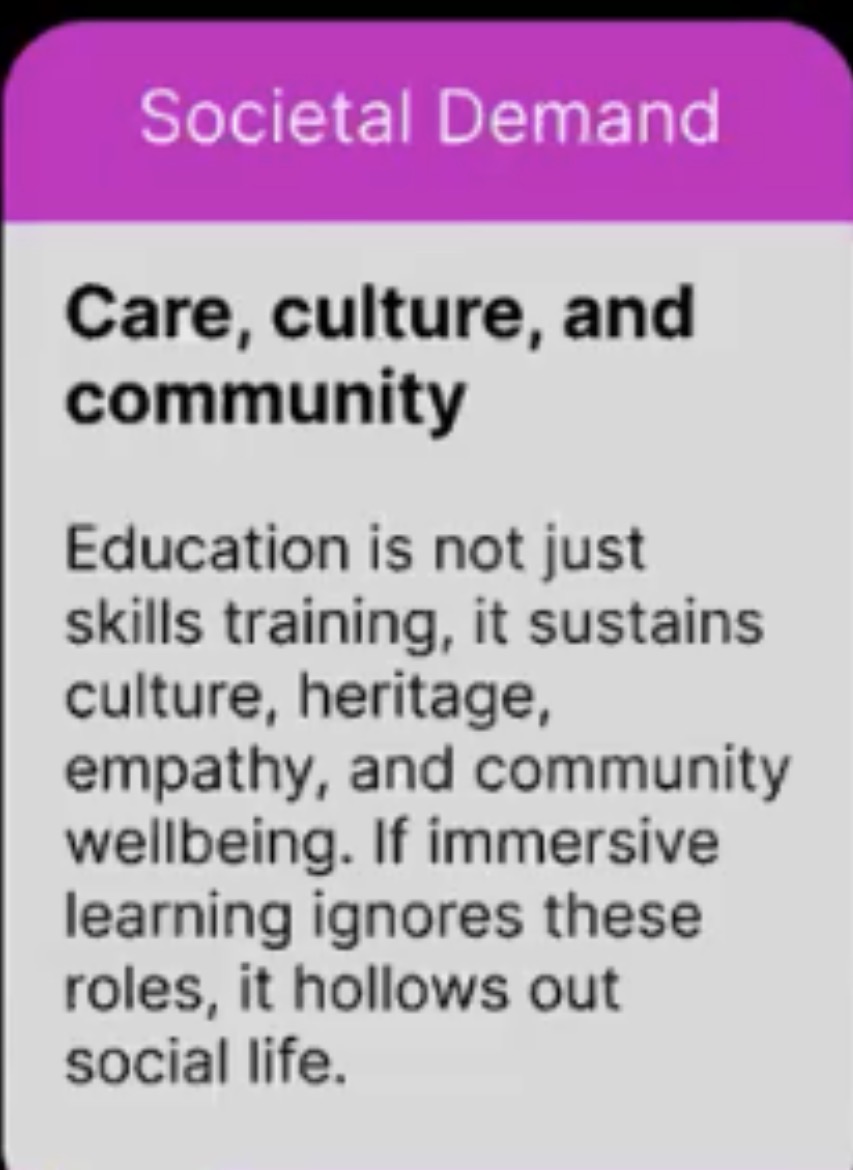
Societal Demand — Circle of Scholars
- Immersive Learning Research Network (iLRN)
- - Immersive Futures Guild
Care, Culture, and Community
One Sentence Abstract:
This Codex entry documents a shared articulation and ongoing tensions emerging from an iLRN Circle of Scholars workshop addressing care, cultural grounding, and community stewardship as first-order societal demands in immersive learning.
Suggested Citation:
Immersive Learning Research Network (iLRN). (2026). Care, culture, and community: Societal demand—Circle of Scholars workshop synthesis. Immersive Futures Guild, iLRN Codex. https://codex.immersivelrn.org/link/458
Part I — Shared Articulation (Workshop Synthesis)
Context
This card emerged from the Circle of Scholars 2026 workshop as a response to a growing societal demand: immersive learning systems must move beyond efficiency, novelty, or scale alone, and instead account for care, cultural grounding, and community continuity as first-order design considerations.
Participants noted that immersive technologies increasingly shape how people attend to one another, how cultures are represented or transformed, and how communities are formed, sustained, or fragmented over time.
Core Claim
Immersive learning environments should be designed and evaluated not only for what they teach, but for how they care for people, cultures, and communities.
This includes care for:
-
Learners and participants
-
Cultural knowledge and epistemic traditions
-
Communities of practice and belonging
-
Futures shaped by immersive systems
Key Dimensions Identified
The workshop surfaced three interrelated dimensions:
1. Care
-
Care as attentional responsibility, not sentiment
-
Recognition of cognitive, emotional, and social load
-
Design choices that acknowledge vulnerability, fatigue, and power asymmetries
-
Ethical responsibility for how immersion shapes experience and behavior
2. Culture
-
Culture as living, situated, and dynamic—not static content
-
Respect for cultural protocols, authorship, and sovereignty
-
Avoidance of extraction, flattening, or aestheticization
-
Recognition that immersive media can amplify harm as easily as understanding
3. Community
-
Communities as ongoing sociotechnical systems, not audiences
-
Importance of trust, continuity, and shared meaning
-
Need for stewardship models beyond single experiences or deployments
-
Recognition that immersive learning often succeeds or fails at the community level, not the individual level
Why This Matters for Immersive Learning
Participants emphasized that immersive learning systems:
-
Shape patterns of attention toward people, places, and narratives
-
Influence who feels welcome, represented, or excluded
-
Can strengthen or erode communal ties depending on design and governance
As immersive learning scales globally, care, culture, and community become structural concerns, not optional values.
Part II — Tensions, Open Questions, and Ongoing Dialogue
(This section remains intentionally open and revisitable.)
Unresolved Tensions Identified
The workshop did not converge on a single resolution. Instead, several productive tensions surfaced:
-
Care vs. scalability
How can immersive systems scale without eroding relational or cultural care? -
Cultural specificity vs. generalizability
When does adaptation become dilution or misrepresentation? -
Community stewardship vs. institutional ownership
Who governs immersive learning spaces once they persist over time? -
Design intention vs. emergent use
How should responsibility be understood when communities appropriate or transform immersive environments?
Points of Debate
Participants raised questions that warrant continued discussion:
-
Can care be meaningfully designed, or does it only emerge through practice?
-
What constitutes evidence of care or harm in immersive learning systems?
-
How should immersive learning account for historical and ongoing inequities?
-
When does “community engagement” become performative rather than substantive?
Relationship to the iLRN Ways of Knowing Map
This card intersects directly with all three iLRN Ways of Knowing:
-
Tree (Knowledge / Evidence):
Ethics of care, cultural theory, community learning research -
Garden (Practice):
Culturally grounded design, community-led XR projects, participatory methods -
Lantern (Futures):
Governance of immersive worlds, attention ethics, long-term community impact
The card therefore functions as a cross-cutting societal demand, not a single application area.
Invitation for Continued Contribution
Members of iLRN are invited to:
- Contribute case examples that illustrate care or harm in immersive learning
- Surface cultural or community perspectives not represented in the workshop
- Challenge the framing where it fails to account for lived experience
- Propose methods for evaluating care, culture, and community impact
To contest, contribute, or otherwise add to this discussion,
please complete this contribution form for Societal Demand for Vision 2035: Care, Culture, & Community
Disagreement is expected. Documentation is encouraged.
Examples, perspectives, challenges, and methods related to this card to appear here with iLRN member use of the above linked feedback form.
Working Status
This card reflects the current synthesis of the Circle of Scholars workshop.
It is a living artifact and may evolve as further dialogue, evidence, and practice emerge.
Codex Colophon
This page is part of the iLRN Codex, a living knowledge base supporting scholarly dialogue, practice-based inquiry, and futures-oriented exploration in immersive learning.
-
Guild: Immersive Futures
-
Activity: Circle of Scholars
-
Artifact Type: Societal Demand Card
-
Methodological Context: Design-Based Research (DBR)
-
Ways of Knowing: Tree · Garden · Lantern
This artifact records a time-stamped synthesis, not a final position.
Disagreement is expected. Documentation is encouraged.
Contributions, dissents, case examples, and methodological proposals related to this card are collected via the linked Societal Demand contribution form and may be incorporated into future revisions.
Versioning & Status
-
Initial synthesis: January 2026
-
Status: Living document
-
Revision policy: Updated through documented community contributions and facilitated dialogue
Permanent link:
https://codex.immersivelrn.org/link/458
No comments to display
No comments to display