
Flow Machines: Adaptive XR via Biometrics
Flow Machines: Adaptive XR via Biometrics
Workshop Synthesis
Circle of Scholars Activity
Facilitated by Fridolin Wild
January 14, 2026
Technology Possibility — Circle of Scholars
-
Immersive Learning Research Network (iLRN)
-
Immersive Futures Guild
-
Flow Machines: Adaptive XR via Biometrics
One Sentence Abstract
This Codex entry documents a shared articulation and ongoing tensions emerging from an iLRN Circle of Scholars workshop exploring biometric sensing and adaptive XR as a technological possibility for maintaining learner flow through closed-loop, real-time pedagogical control systems.
Suggested Citation
Immersive Learning Research Network (iLRN). (2026). Flow machines: Adaptive XR via biometrics—Technology possibility—Circle of Scholars workshop synthesis. Immersive Futures Guild, iLRN Codex. https://codex.immersivelrn.org/link/459
Part I — Shared Articulation (Workshop Synthesis)
Context
This card emerged from the Circle of Scholars 2026 workshop as an exploration of a specific technology possibility: the use of real-time biometric sensing (e.g., heart rate variability, galvanic skin response, eye tracking, EEG proxies) to dynamically adapt immersive learning environments.
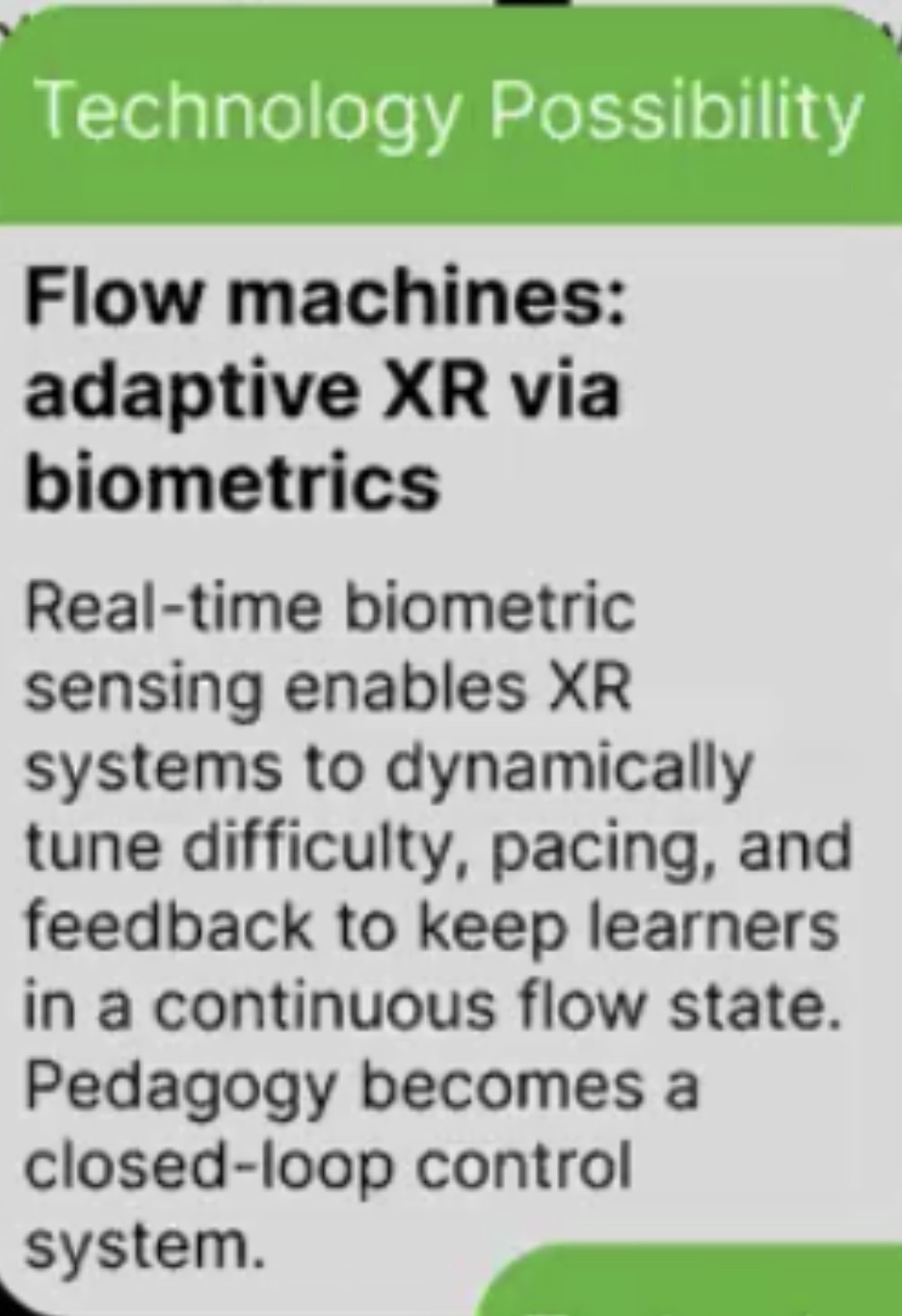
Participants examined the idea that XR systems could sense learner state continuously and adjust difficulty, pacing, modality, and feedback to sustain engagement—framing pedagogy as a closed-loop control system rather than a fixed instructional sequence.
The discussion treated this not as an inevitability, but as a design frontier with profound implications for agency, ethics, evidence, and governance.
Core Claim
Biometric-adaptive XR systems make it technically feasible for pedagogy to operate as a real-time feedback loop—continuously sensing learner state and tuning experience parameters to maintain flow—but this capability fundamentally reshapes assumptions about agency, consent, and instructional responsibility.
Key Dimensions Identified
The workshop surfaced four interrelated dimensions of this technology possibility:
1. Flow as a Controllable Variable
Flow was discussed not as a mystical state, but as a measurable proxy constructed from physiological and behavioral signals.
Key considerations included:
-
Operationalizing “flow” through indirect indicators rather than self-report alone
-
The risk of collapsing complex cognitive-emotional states into optimization targets
-
Whether maintaining flow should always be the goal, versus productive struggle or discomfort
2. Pedagogy as Closed-Loop Control
Participants explored the shift from open-loop instructional design to adaptive systems that respond continuously to learner state.
This reframing raised questions about:
-
Who defines the target state of the learner
-
How control parameters are set, tuned, and validated
-
The difference between responsiveness and manipulation
-
Transparency of adaptation logic to learners and educators
3. Biometric Data as Pedagogical Substrate
Biometric signals were treated not merely as analytics, but as instructional inputs.
Discussion emphasized:
-
Data quality, noise, and contextual ambiguity
-
The danger of over-interpreting physiological signals
-
Issues of data ownership, storage, and secondary use
-
Cultural and individual variability in biometric expression
4. Automation, Agency, and Trust
Adaptive XR systems introduce new asymmetries between system intelligence and learner awareness.
Key concerns included:
-
Learner consent in continuously adaptive environments
-
The erosion or augmentation of learner self-regulation
-
Educator trust in algorithmic pedagogical decisions
-
Long-term dependence on optimization systems
Why This Matters for Immersive Learning
Participants emphasized that biometric-adaptive XR systems:
-
Shift instructional authority from static design to dynamic systems
-
Blur boundaries between assessment, feedback, and intervention
-
Introduce ethical stakes at the level of moment-to-moment experience
-
Demand new validation methods beyond learning outcomes alone
As immersive learning systems become more responsive and autonomous, the locus of pedagogical responsibility moves from content to control logic.
Part II — Tensions, Open Questions, and Ongoing Dialogue
(This section remains intentionally open and revisitable.)
Unresolved Tensions Identified
The workshop did not resolve several core tensions:
Flow optimization vs. learner autonomy
When does adaptive support become behavioral steering?
Responsiveness vs. opacity
How much should learners know about how systems are adapting them?
Personalization vs. normalization
Do adaptive systems privilege certain physiological norms over others?
Efficiency vs. educational friction
What kinds of struggle or discomfort are pedagogically necessary—and should not be optimized away?
Points of Debate
Participants raised questions requiring further inquiry:
-
Can flow be a legitimate instructional objective across all learning domains?
-
What constitutes evidence that biometric adaptation improves learning rather than engagement alone?
-
How should disagreement between learner self-perception and system inference be handled?
-
Who is accountable when adaptive systems fail or cause harm?
Relationship to the iLRN Ways of Knowing Map
This card intersects with all three iLRN Ways of Knowing:
Tree (Knowledge / Evidence):
Learning sciences, control theory, affective computing, human-AI interaction, psychophysiology
Garden (Practice):
Adaptive XR design, biometric sensing pipelines, instructor dashboards, ethical design patterns
Lantern (Futures):
Automated pedagogy, attention economies, governance of adaptive learning systems
The card functions as a technology possibility, not a recommended practice or settled theory.
Invitation for Continued Contribution
Members of iLRN are invited to:
-
Contribute empirical studies or prototypes involving biometric-adaptive XR
-
Surface ethical failures or unintended consequences
-
Propose alternative metaphors to “closed-loop control”
-
Develop evaluation methods that move beyond engagement metrics
To contest, contribute, or extend this discussion,
please complete the Technology Possibility contribution form for Vision 2035: Flow Machines — Adaptive XR via Biometrics.
Disagreement is expected. Documentation is encouraged.
Examples, critiques, implementations, and methodological proposals related to this card may be added here through documented community contribution.
Working Status
This card reflects the current synthesis of the Circle of Scholars workshop.
It is a living artifact and may evolve as further dialogue, evidence, and practice emerge.
Codex Colophon
This page is part of the iLRN Codex, a living knowledge base supporting scholarly dialogue, practice-based inquiry, and futures-oriented exploration in immersive learning.
Guild: Immersive Futures
Activity: Circle of Scholars
Artifact Type: Technology Possibility Card
Methodological Context: Design-Based Research (DBR)
Ways of Knowing: Tree · Garden · Lantern
This artifact records a time-stamped synthesis, not a final position.
Disagreement is expected. Documentation is encouraged.
Versioning & Status
-
Initial synthesis: January 2026
-
Status: Living document
-
Revision policy: Updated through documented community contributions and facilitated dialogue
Permanent link:
https://codex.immersivelrn.org/link/459