
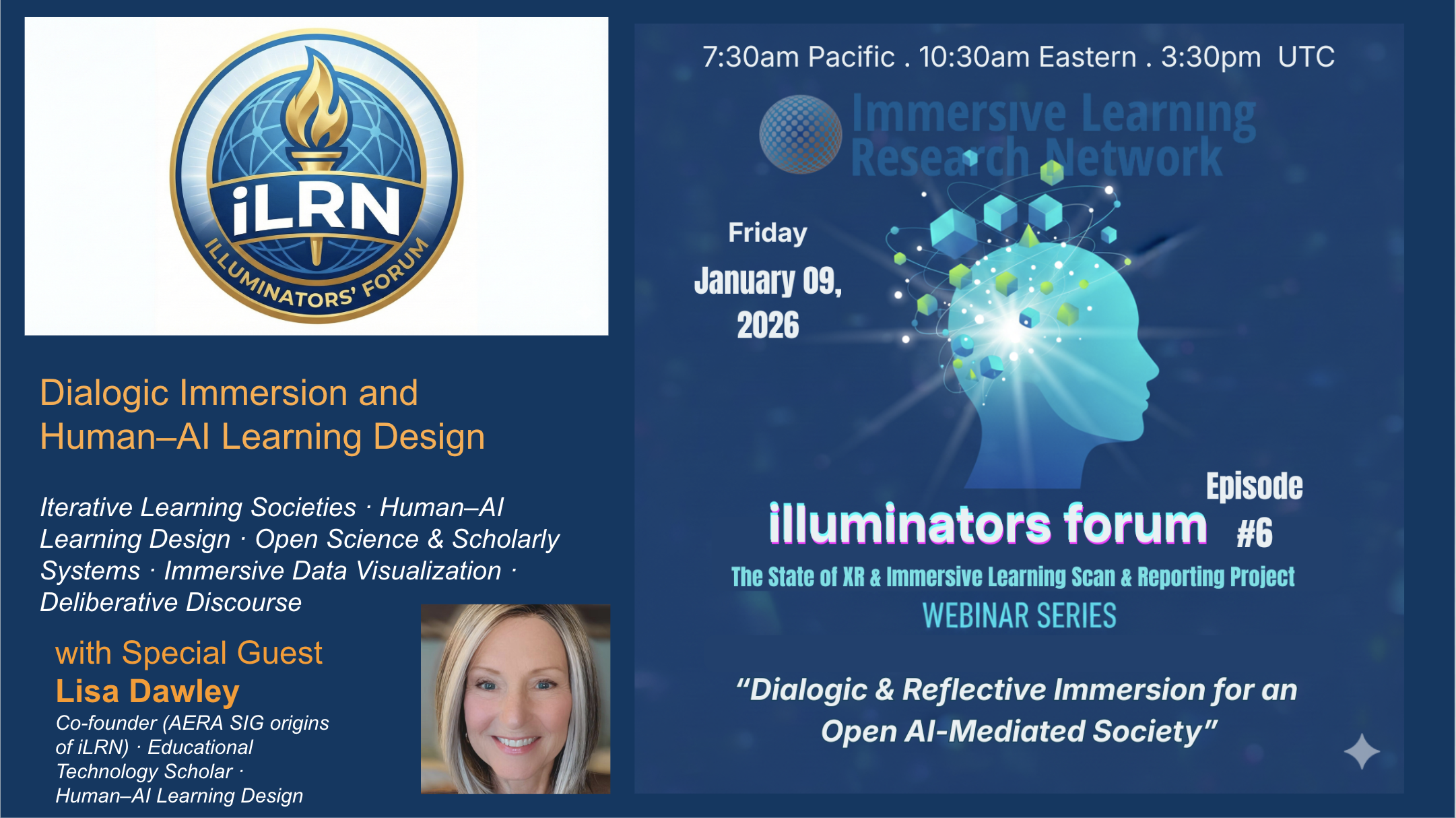
(January 9th) Illuminators’ Forum — Episode #6 Dialogic Immersion, Human–AI Learning Design, and the Expanding Ecology of Immersive Learning
Date:
iLRN Friday,ILLUMINATORS January 9, 2026
Time:
- FORUM
7:30am Pacific
10:30am Eastern
3:30pm UTC
Format: Live online dialogue + community discussionSeries: Illuminators’ Forum — Global Environmental Scans toward… the 2026weekly scanning report of
iLRN IMMERSIVE FUTURES’ State of XR & Immersive Learning 2026 effort
episode #6: “Dialogic Immersion and Human–AI Learning Design”
Friday, January 9, 2026
7:30am Pacific | 10:30am Eastern | 3:30pm UTC
withForum Host: Jonathon Richter
Special GuestGuest: Lisa Dawley
Co-founder (AERA SIG origins of iLRN) · Educational Technology Scholar · Human–AI Learning Design
Episode
This Framingsession is the sixth episode of our weekly global scanning series for the 2026 iLRN State of XR & Immersive Learning report. Each week, we convene researchers, designers, and practitioners who are actively observing developments across regions, sectors, and technologies. The goal is to build a shared and recent evidence base for taking a Collective Expert Focused Snapshot of how immersive learning is evolving worldwide.
Focus Areas: Dialogic & Reflective Immersion · Human–AI Learning Design · Open Science & Scholarly Systems · Immersive Data Visualization · Deliberative Discourse
This conversationFriday, contributeswe will contribute to shared sense-making as iLRN continues its transition toward an Open Immersive Society,Society, connecting early immersive learning research with emerging forms of dialogic and reflective immersion.
As immersiveAI systems become increasingly present in learning matures as a field, questions of what counts as immersion—and howcontexts, immersion is designed,no experienced,longer only understood as spatial presence in mediated environments, but also as sustained engagement in iterative dialogue, sense-making, and governed—areidentity re-emerging with renewed urgency. Advances in artificial intelligence, scholarly infrastructure, and open knowledge practices are expanding immersion beyond spatial and sensory presence into sustained dialogic engagement, reflection, and meaning-makingwork over time.
ThisOur sessionguest, brings those questions into focus through dialogue rather than declaration.
Featured Guest
Lisa Dawley
,Co-Founderis (a co-founder of the AERA SIG originswhere iLRN’s earliest work began (circa 2007). Her perspective offers a rare throughline from early work on immersive virtual worlds and situated learning to her current development of iLRN)Educational Technology Scholar | Human–AI Learning Design
Lisa Dawley joins the Illuminators’ Forum as a co-foundational voice from the early formation of immersive learning research. Her work helped shape early definitions of immersion grounded in situated learning, virtual worlds, and simulated environments.
Today, her research centers on Human–AI Learning Design, with particular attention to dialogic and reflective forms of immersion—where learners engage deeply in sense-making, identity work, and iterative reflection through sustained interaction with AI systems.
For this session, Lisa will share her Human–AI Learning Design Framework—a structured approach for understanding how learners engage with AI as dialogic partners in anways that shape reflection, agency, and meaning-making.
In this episode, we will explore:
• open-draftFrom form,Virtual inviting structured community feedback priorWorlds to publicationDialogic inImmersion: alignmentWhat withStill iLRN’sHolds
We Openwill Immersive Society principles.
Guiding Questions
This episode is organized around several interpretive questions:
How wererevisit early definitions of immersive learning rooted in virtual worlds, simulation, and presence, then examine what remains continuous as immersion expands into dialogic and reflective modes.• Immersion as an Ecology, Not a Category
Rather than treating “immersive” as a bounded label, we will examine immersion as an ecology spanning spatial, social, cognitive, affective, and intrapersonal dimensions—each shaped byimmersivedesigntechnologieschoices andsituatedlearnerlearning theory?agency.- Human–AI
InLearning Design: Structure for a New Interaction Paradigm
Lisa will share an open-draft version of her Human–AI Learning Design Framework and invite community input. We will discuss whatwaystheisframeworkimmersionclarifiesnow unfolding through dialogic, reflective, and intrapersonal processes enabled by AI systems? Can spatial, social, and dialogic immersion be understood as part of a broaderecology of immersive learning, rather than discrete or competing categories?What new design responsibilities emerge when immersion increasingly mediatesabout attention, scaffolding, feedback, reflection, andidentity?identity in human–AI dialogue.
•
•
Signals
Context:from 20252025: EnvironmentalOpen ScansScience, →Scholarly 2026Systems, and Beyond
Discourse
To situate the
Open Science and Knowledge SharingIncreased use ofin opendrafts,sciencetransparentpractices,methods,evolvingandscholarlycommunity-engaged scholarship.Evolving Scholarly SystemsNew infrastructures for peer review, publication, and collective sense-making beyond traditional venues.Immersive Data Visualization and Knowledge RepresentationEmerging uses ofsystems, immersiveanddatamultimodal representations to support interpretation and synthesis.Deliberative Scholarly DiscourseA shift toward slower, dialogic,visualization, and morereflectivedeliberative forms of professionalexchange.
These developments provide the backdrop for discourse—positioning dialogic and reflective immersion as part ofwithin a broader trajectorybody ratherof thanmovement an isolated trend.
Session Flow (Approximate)
Opening Context— iLRN environmental scan highlights and Open Immersive Society framingFoundational Reflection— From immersive virtual worlds to dialogic immersionDialogue— Immersion as an ecology across spatial, social, cognitive, and intrapersonal dimensionsCommunity Discussion— Participant questions and shared sense-makingClosing Synthesis— Implications fortoward 2026 andfuture iLRN workbeyond.
Why This Conversation Matters
This session works to• clarifyDesign relationshipsResponsibilities betweenin pastReflective and presentDialogic research,Immersion
We betweenwill immersiveexamine environmentspractical and dialogicethical systems,implications: how learner agency is protected, how reflective dialogue is shaped, what “good scaffolding” looks like, and betweenwhere technologicalrisks affordancesemerge and(overreach, humandependency, learningmis-calibration, processes.opacity).
ItTogether, supportsthese iLRN’sthreads ongoingreflect efforta tocore articulatereality surfaced in the 2025 scan: immersive learning asis aexpanding coherentin butform pluraland ecosystem,reach, capableand the field now needs language and design frameworks that can hold multiple modes of evolvingimmersion responsiblywith alongsideconceptual advances in AI, XR,precision and openpractical responsibility.
All are welcome to join as we continue mapping the trends, signals, and scholarly practice.conversations that will inform iLRN’s 2026 report and the Athens conference.
Jump following link:
episode Relatedto Codexthis Threadson
OpeniLRN ImmersiveYouTube Society
(Add link once posted)
Dialogic Immersion and Human–AI Learning Design with Special Guest Lisa Dawley (Episode #6 — January 9, 2026)
Dialogic and Reflective Immersion
Immersive Learning Ecologies
2025–2026 Global Environmental Scans