
Case – VR Training for wind turbine maintenance
Case – VR Training for wind turbine maintenance
(Cassola et al.)
This case describes a wind-turbine generator maintenance training program developed with an immersive authoring tool that allows expert trainers to design the VR training from inside the virtual environment itself.1,4 The ILCSImmersive Learning Case Sheet (ILCS) method is used here to organise the description and interpretation.1
(UNDER CONSTRUCTION)
1. Case identification
- Case title:
VRTrainingtraining for wind turbine generator maintenance - Contributors:
Case descriptionadaptedprepared by Dennis Beck and LeonelMorgadoMorgado,frombased on the work of Fernando Cassola and colleagues at INESC TEC and Vestas Wind Systems.1,4 - Original source(s):
CassolaCassola, F., et al.,“(2022). Design and Evaluation of a Choreography-Based Virtual Reality Authoring Tool for Experiential Learning in IndustrialTraining”Training (IEEETLT)Transactions on Learning Technologies).4
Case interpretation using ILCS: Beck & Morgado (2025).1
Supplementary materials and media: https://vrtraining.inesctec.pt/.5 - Time frame:
StudyToolconducteddevelopment and study in collaboration withprofessionals froman international wind-energycompanycompany,betweenwith2018experimentsandreported2021in(publication 2022).2022.4
2. Short description (abstract)
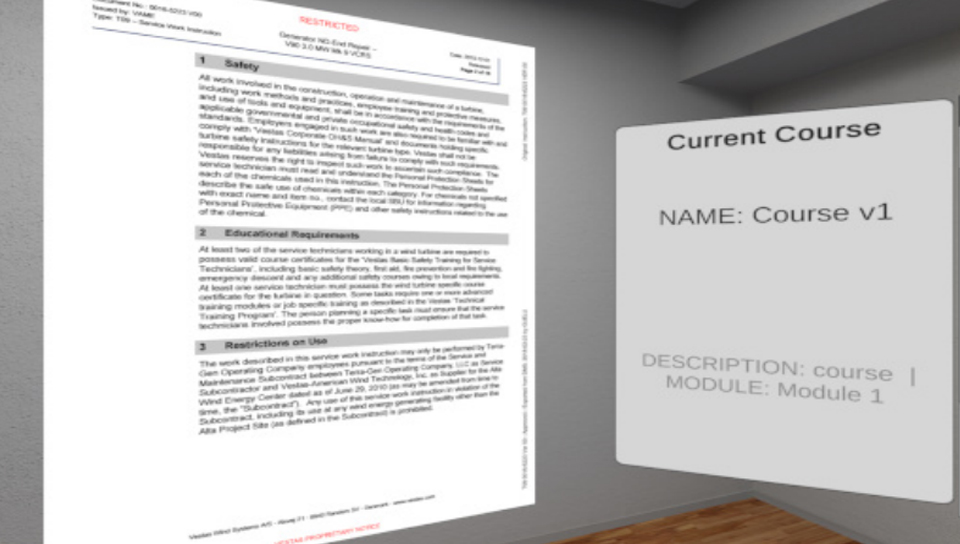
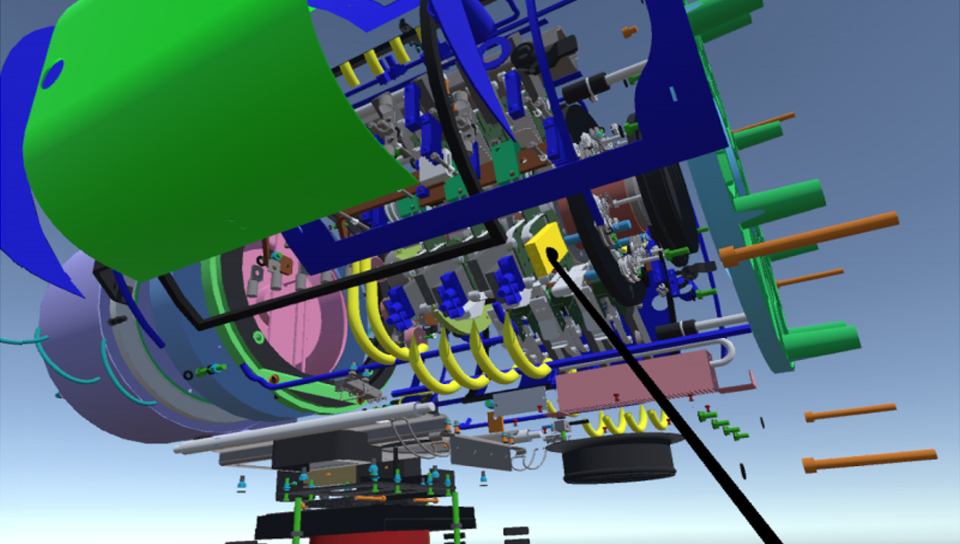
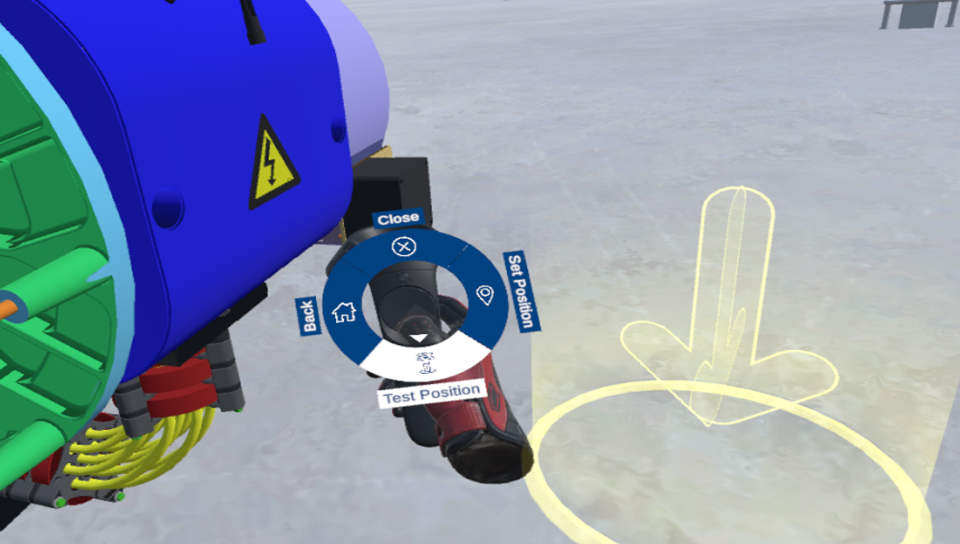
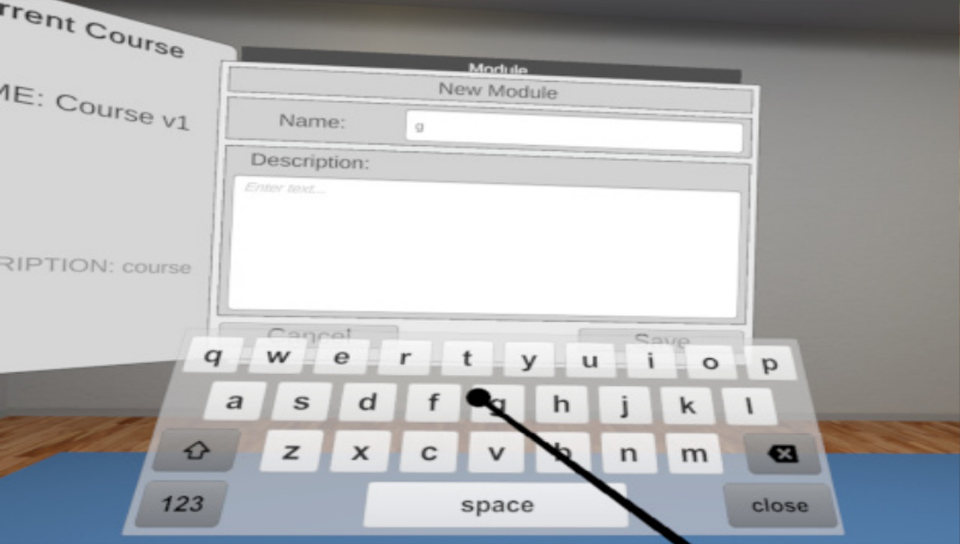
Expert trainers from a wind-energy company use an immersive authoring tool to design a multi-step VR course on generator disassembly and maintenance, based directly on existing technical documentation and CAD models of a real turbine.4,5 Their own performance is recorded as “virtual choreographies”, which become the reference procedures for the course. Trainees then practise thethese procedures on a virtual generator, withwhile accessconsulting todigital documentsmanuals and replays ofreplaying expert demonstrations; their actions are recordeddemonstrations as “virtualneeded. choreographies”The system checks each step for correctness, logs errors, and checkedproduces againstanalytics theon experttask specification.completion. After training in VR,Finally, technicians perform the same procedure on a physical generator in a warehouse setting for certification, using the tool-generated analytics to compare virtual and real performance.certification. The case focuses on howusing immersion supportsto support authentic, repeatable, and risk-free rehearsal of complex maintenance procedures.procedures and to bridge VR training with real-world performance.1,4
3. Context and participants
Educational level and setting:Workplace training in industrial maintenance. Sessions were conducted in a controlled laboratory with VR equipment, followed by certification in a warehouse using a physical generator model.4Discipline / subject area:Mechanical and electrical engineering; wind-turbine generator maintenance; industrial safety.Number and profile of learners:Nine male participants in total: two expert trainers for course authoring, six professionals for trainee experience, and two technicians for certification (one overlapping between phases). Ages ranged roughly from early 20s to mid-40s, with field experience from 2 to 10+ years and qualifications from secondary school to master’s degree.4Other stakeholders:Vestas Wind Systems (industrial partner), INESC TEC (R&D), Universidade Aberta, and the broader immersive learning research community through iLRN.1,4Constraints or special conditions:Training must mirror real generator components and procedures closely, using CAD-based models for high visual fidelity.4,5Risky or time-consuming operations are rehearsed virtually to avoid damage and reduce downtime.Small group