
Volunteer Workplan
edited 11/15/2026
At a glance
The Fall 2025 draft is a solid skeleton, but it cannot go out as written: it is aimed at a funder iLRN is unlikely to reach, asks for almost five times iLRN’s annual revenue, and rests on numbers nobody has sourced yet. This pipeline gets the organization grant-ready first, finds funders that fit, then retools the draft for each one.
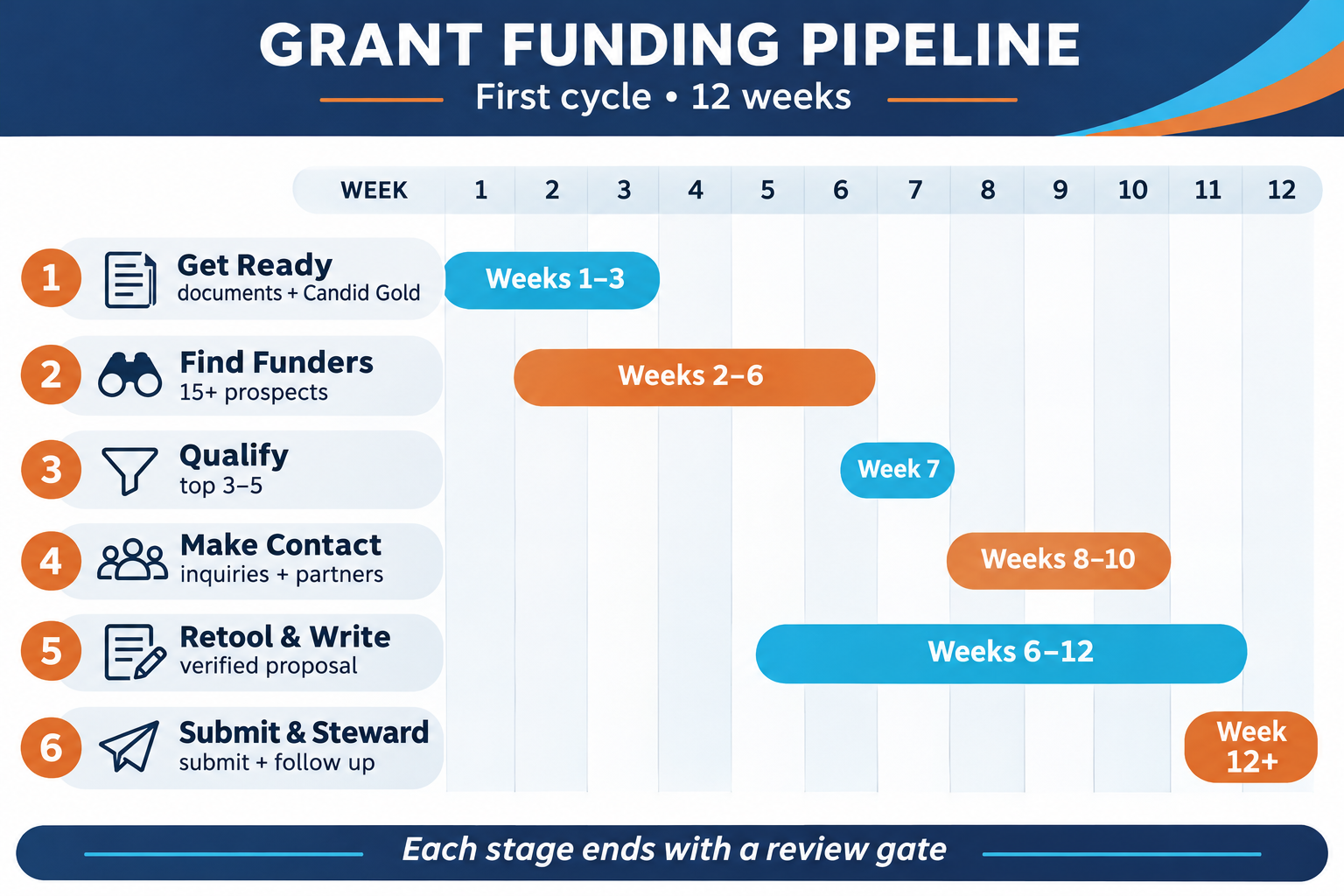
The work runs in six stages over roughly 12 weeks for the first cycle. Volunteers can start Stage 1 and Stage 2 tasks this week without waiting on anyone.
Three decisions shape everything else, and they belong to leadership:
1. Who can commit iLRN to an application. Name the authorized signer and confirm whether the board needs to vote before a letter of inquiry goes out.
2. Apply alone or with a lead partner. Several best-fit funders fund only universities or accredited institutions. A university partner or IBSTPI as lead applicant opens those doors.
3. How big the first ask is. A planning or convening grant in the $25,000 to $75,000 range matches iLRN’s size. The full $250,000 project becomes phase two.
Where iLRN stands today
A program officer who looks iLRN up will see a small organization with a thin public record, and some of it conflicts with the draft. Fixing the public record is the cheapest work in this pipeline and it comes first.
What the public filings show (ProPublica Nonprofit Explorer, EIN 30-1218072, Missoula, MT, all Form 990-EZ):
|
Fiscal year |
Revenue |
Expenses |
Net assets |
|
2024 |
$52,662 |
$53,766 |
$11,093 |
|
2023 |
$47,846 |
$53,031 |
$12,197 |
|
2022 |
$61,727 |
$135,935 |
$17,382 |
|
2021 |
$126,643 |
$143,711 |
$91,590 |
|
2020 |
$143,078 |
$53,180 |
$108,658 |
Four things in that record need attention before any funder sees an application:
• The name is misspelled. The listing reads “Immersive Learining Research Network.” Check the IRS Tax Exempt Organization Search to see whether the error is in the IRS record itself, and correct it on the next filing if so.
• The founding date does not match. The draft says founded in 2014. The public record shows tax-exempt status from June 2020 and a first filing for 2019. The proposal needs one sentence that explains the gap.
• The category is off. iLRN is classified under community improvement and capacity building, not education or research. Funders who filter by category will not find it.
• Only one officer is listed. The draft describes a 12-member board. The Candid profile is the place to show the full board.
Candid profile. Claiming the profile is free and takes three steps: create an account, request access to the organization by name or EIN, then fill in the profile (Candid). The 2026 Seals guide sets the levels:
|
Seal |
What it takes |
Why it matters here |
|
Bronze |
Mission, contact details, leader, address, website |
Minimum for looking legitimate |
|
Silver |
At least one program with description, area and population served |
Lets funders see what iLRN does |
|
Gold |
A 2024 or 2025 Form 990, 990-EZ or 990-N (an audit is not required), plus leader and board demographics, where “decline to state” is accepted |
Candid advertises free Candid Premium access for small nonprofits at Gold, which is the prospect research tool volunteers need |
|
Platinum |
Goals, strategy, and at least one metric from 2025 |
Worth doing once the verified numbers exist |
Gold is reachable now with the 2024 Form 990-EZ. Confirm the Candid Premium offer terms on Candid’s site before counting on it.
Pipeline stages
Each stage ends at a gate. Nothing moves past a gate until its output exists in the shared folder. Weeks are counted from the start of the first cycle, proposed as the week of November 16, 2026.
|
Stage |
Weeks |
What happens |
Gate to pass |
|
1. Get ready |
1 to 3 |
Org documents gathered, Candid profile claimed and brought to Gold, signer confirmed |
Document folder complete, Candid Gold published |
|
2. Find funders |
2 to 6 |
Volunteers research prospects in assigned lanes and write a one-page record for each |
At least 15 prospect records filed |
|
3. Qualify |
7 |
Score every prospect on the fit rubric, pick the top three to five (see RUBRIC PAGE) |
Go or no-go decision recorded for each prospect, signed off by leadership |
|
4. Make contact |
8 to 10 |
Short inquiry or letter of inquiry to each chosen funder, partner conversations with IBSTPI and a university |
Inquiry sent, partner commitments in writing |
|
5. Retool and write |
6 to 12 |
Core proposal rebuilt from verified facts, then tailored per funder |
Draft passes the review checklist and a cold read by someone who did not write it |
|
6. Submit and steward |
12 onward |
Submission, confirmation saved, follow-up calendar, lessons logged |
Tracker updated, next deadline scheduled |
Stages 2 and 5 overlap on purpose. The funder-neutral core of the proposal (need, track record, project design) can be rebuilt while prospect research is still running.
Fit rubric for Stage 3. Score each item 0 to 2, and drop any prospect that scores 0 on the first item. (see RUBRIC PAGE)
1. Eligibility: iLRN, or a named partner, is an eligible applicant type.
2. Mission fit: the funder’s stated priorities match standards, credentialing, open knowledge, or learning technology.
3. Size fit: the typical grant is no more than about half of iLRN’s annual revenue, unless a partner leads.
4. Access: the funder takes unsolicited inquiries or has an open call.
5. Timing: a deadline or review window falls inside the next six months.
Volunteer roles
Seven roles cover the work. One person can hold two, and the hours are estimates for the first cycle.
|
Role |
What they own |
Hours per week |
Good fit for |
|
Pipeline lead |
Tracker, weekly check-in, gate decisions, link to leadership |
2 to 3 |
Someone already coordinating volunteers |
|
Records keeper |
Org document folder, Candid profile, registrations |
2 for three weeks, then 30 minutes |
Detail-minded, comfortable asking the Treasurer for files |
|
Prospect researchers (2 to 4) |
One research lane each, one-page prospect records |
2 to 3 |
Librarians and information professionals, for example the Codex Librarian group |
|
Evidence checker |
Sources every number and claim in the draft, runs the member survey if one is needed |
2 to 3 |
Research methods background |
|
Writer and editor |
Funder-neutral core proposal, then tailored versions |
3 to 4 during Stage 5 |
Strong plain-language writer |
|
Budget builder |
Budget by project component, in-kind volunteer value, budget narrative |
2 during Stage 5 |
Works with the Treasurer |
|
Partner liaison |
IBSTPI, IEEE, and university conversations, letters of support |
1 to 2 |
Board member or someone with existing relationships |
A cold reader is not a standing role. For each submission, pick one volunteer who has not seen the draft and give them the funder’s guidelines and 45 minutes.
Work to do
Thirty-one tasks, grouped by stage. Each has a role and a plain test for when it is done. Tasks in Stage 1 and Stage 2 can be handed out now.
Stage 1: Get ready
|
Task |
Role |
Done when |
|
Confirm the authorized signer and whether inquiries need a board vote |
Pipeline lead |
Answer is written in the tracker |
|
Create a shared grants folder with subfolders for org documents, prospects, drafts, and submissions |
Pipeline lead |
Folder link is posted to volunteers |
|
Collect the IRS determination letter, EIN, and a signed W-9 |
Records keeper |
Files are in the folder |
|
Collect Form 990-EZ filings for 2022, 2023, 2024, and 2025 if filed |
Records keeper |
PDFs are in the folder |
|
Collect the current board list with titles and affiliations, bylaws, and conflict of interest policy |
Records keeper |
Files are in the folder, board list dated |
|
Get the current-year operating budget and latest financial statement from the Treasurer |
Records keeper |
Files are in the folder |
|
Check the IRS Tax Exempt Organization Search for the name spelling and category |
Records keeper |
Screenshot saved, correction path noted |
|
Create a Candid account and claim the iLRN profile by EIN |
Records keeper |
Access approved |
|
Complete Bronze and Silver: mission, contacts, leader, programs |
Records keeper |
Seal published |
|
Complete Gold: upload the 2024 Form 990-EZ, enter leader and board demographics |
Records keeper |
Gold Seal published, Candid Premium access checked |
|
Export volunteer hours from the time sheet and total them by year |
Budget builder |
One-page summary with totals and method |
|
Start SAM.gov registration only if a federal route is chosen in Stage 3 |
Records keeper |
Unique Entity ID issued |
Stage 2: Find funders
|
Task |
Role |
Done when |
|
Assign research lanes: national foundations, Montana and Pacific Northwest, federal and partner-led, XR industry, Korea and international |
Pipeline lead |
Each researcher has one lane |
|
Adopt the one-page prospect record: funder, program, eligibility, grant range, how to apply, deadline, three recent grants, fit score, source links |
Pipeline lead |
Template is in the folder |
|
Verify and extend the starting list in the next section |
Prospect researchers |
Each entry confirmed on the funder’s own site |
|
Look up who funds peer organizations (AECT, ISTE, EDUCAUSE, 1EdTech, Credential Engine, Digital Promise) through their annual reports and funders’ Form 990-PF grant lists |
Prospect researchers |
At least 10 funder names with grant amounts |
|
Search Candid Premium once Gold access is live for standards, credentialing, and immersive learning |
Prospect researchers |
Saved search exported |
|
Set up alerts on Grants.gov and funder newsletters for the chosen lanes |
Prospect researchers |
Alerts confirmed |
|
File prospect records and flag any deadline inside 60 days |
Prospect researchers |
15 or more records filed |
Stage 3: Qualify
|
Task |
Role |
Done when |
|
Score all prospects on the fit rubric |
Prospect researchers |
Scores in the tracker |
|
Hold a go or no-go meeting and pick three to five targets |
Pipeline lead |
Decisions and reasons recorded |
|
Decide the size and scope of the first ask |
Pipeline lead with leadership |
One-paragraph scope statement approved |
Stage 4: Make contact
|
Task |
Role |
Done when |
|
Get IBSTPI’s role confirmed in writing |
Partner liaison |
Letter or email on file |
|
Approach one or two universities about leading or co-applying |
Partner liaison |
Named contact and a yes, no, or maybe |
|
Request letters of support from IEEE collaborators and two member institutions |
Partner liaison |
Signed letters in the folder |
|
Write a one-page inquiry for each target funder |
Writer and editor |
Sent by the authorized signer, date logged |
Stage 5: Retool and write
|
Task |
Role |
Done when |
|
Source or remove every statistic in the draft, using the audit below |
Evidence checker |
Evidence log has a source for each claim that stays |
|
Run a short member survey if no usable survey data exists |
Evidence checker |
Results summarized with response count and dates |
|
Rewrite the funder-neutral core: need, track record, project design, evaluation |
Writer and editor |
Core draft uses only verified facts |
|
Rebuild the budget by project component with a narrative and in-kind volunteer value |
Budget builder |
Budget totals match the narrative |
|
Tailor the core for each target and run the cold read |
Writer and editor |
Reviewer checklist signed |
Stage 6: Submit and steward
Submission, confirmation, and follow-up belong to the pipeline lead. Log every outcome, including declines and any feedback, so the second cycle starts from what was learned.
Funder prospects researched so far
No open call found so far is a clean fit for iLRN applying alone at $250,000. Realistic openings include a rolling letter of inquiry to Sloan, a regional capacity grant, and a partner-led route for federal or credential-focused money. This is a starting list checked on November 15, 2026. Researchers should confirm every entry on the funder’s own site.
|
Funder and program |
How to get in |
Fit for iLRN |
Verdict |
|
2026 call closed February 17, 2026. Limited to accredited four-year degree-granting institutions, $250,000 to $500,000 |
iLRN is not an eligible applicant type |
Drop |
|
|
Staff review inquiries and invite proposals. Most grants come by invitation |
Public Knowledge is the closest program, and only if the project is framed around the Codex as open scholarly record |
Low. Inquiry only, after the Codex gaps are fixed |
|
|
Rolling letter of inquiry, two pages maximum, by email. A university listing reports most projects fall between $50,000 and $600,000 |
Program supports how scientific knowledge is produced and shared. Standards for a research field fit that language |
Best near-term target. Confirm details on sloan.org |
|
|
Letter of inquiry through the grants portal. Needs three full years of history. Requests under $50,000 are discouraged. Staff and program grants step down over three years |
iLRN is a Montana 501(c)(3), which the Trust prioritizes. The Trust also favors diversified funding and regional impact, and iLRN’s reach is global |
Medium. Take the eligibility check, and build a Montana angle before asking |
|
|
Rolling letter of inquiry online. The process takes several months |
Focus is undergraduate persistence and completion. Credential training not tied to accredited academic programs is generally not funded |
Low alone. Possible with a university partner |
|
|
Lumina Foundation |
Mostly invitation, per secondary sources. Lumina funded the Higher Learning Commission’s endorsement process for short-term credential providers |
Shows funder interest in credential quality. Also a comparable effort the proposal should acknowledge |
Relationship route. Not yet verified on lumina.org |
|
Small and Large research grants are paused January through June 2027, with a new approach due in June 2027. The Conference Grants program was discontinued in January 2023 |
Education research funder. A standards validation study could fit the refreshed programs |
Revisit in June 2027 |
|
|
The directorate was reorganized in 2026. RITEL, which covers immersive technologies for learning at up to $900,000 over three years, last listed a November 4, 2025 deadline |
Strong topic fit, but competitive only with a university principal investigator and iLRN as a partner |
Partner route. Watch for the next solicitation |
|
|
Cancelled for fiscal year 2026 |
None while cancelled |
Drop |
|
|
Invitation-based. Grants in learning, work, and infrastructure |
Topic overlap on learning infrastructure |
Relationship route, long term |
Partners, not funders. IEEE’s Learning Technology Standards Committee runs an active working group on ethically aligned educational metadata for XR, and IBSTPI is named in the draft. Both strengthen an application through letters and shared authorship. Neither pays for the work.
Leads nobody has checked yet. Walton Family Foundation, Hewlett Foundation (open education), Schmidt Sciences, XR industry programs (Meta, Unity, Epic), Montana Community Foundation, Humanities Montana, and Korean funders connected to iLRN2027 in Daegu.
Draft audit: what must change before reuse
The structure of the Fall 2025 draft can stay. Thirteen specific things cannot, and the first four are priority adjustments, as they are ill-suited to a successful application.
|
Where |
Problem |
Fix |
|
Request amount |
$250,000 is about 4.7 times 2024 revenue of $52,662, with net assets of $11,093. Reviewers will ask how an all-volunteer organization manages it |
Lead with a planning or convening phase sized to iLRN, or name a partner as fiscal lead |
|
Statement of Need |
“A 2024 survey of 340 institutions found 78%, 82%, 91%” has no citation |
Find the source or cut it. Replace with published literature the evidence checker can link |
|
Community Demand |
“85% interest” from member surveys and “60 to 80 participants” at pilot webinars have no source |
Pull the actual survey and attendance records, or run a new survey |
|
IBSTPI |
Described as a partnership with co-branded credentials. The Codex competencies book lists an IBSTPI contributor but has no pages yet |
Get the commitment in writing and describe only what IBSTPI has agreed to |
|
Budget |
60% ($150,000) goes to a Virtual Accessibility Lab, which is not one of the four project components. Nothing is budgeted for IBSTPI, a badge platform, or working group time |
Rebuild the budget line by line against the four components |
|
Budget narrative |
Says no funds support administration, yet $75,000 pays for coordination and facilitation. It does not say who is paid |
Add a personnel plan: roles, hours, rates, and who supervises |
|
Dates |
Timeline runs January 2026 to December 2027. Goals are dated August and December 2026. Conference tracks cite iLRN 2026 |
Use relative months, and set iLRN2027 in Daegu as the first public milestone |
|
Scope |
Title and components are about standards and credentialing. The conclusion describes an accessibility hub |
Pick standards as the spine and make accessibility one pillar of the standards |
|
Workshops |
“12 virtual workshops (2/month)” across months 4 to 18. Two a month for 15 months is 30 |
Choose one number and make the schedule match |
|
Repository |
Evaluation counts “20+ repository resources.” The dissemination section promises “80+ documented resources” |
Reconcile to one target |
|
Organization facts |
“Hundreds” of members in one place and “500+” in another. A “three-person executive team” with two people named. Founded 2014 against a 2020 exemption date |
Verify each figure and state it once |
|
Track record |
The draft never mentions iLRN’s own standards work |
Add the FAIDS working group recommendations from the 2022 annual meeting and the Codex Professional Standards and Measures shelf |
|
Funder language |
Mellon priorities, Mellon comparison grantees, and the course header are built into the text |
Move all funder-specific language into a swappable alignment section. Remove the course header |
Still missing from the draft. A logic model, a timeline chart, named key personnel with short bios, letters of support, a risk section, and an evaluator. Most funders ask for some of these, and the working group roster is the easiest to start now.
Open questions for leadership
Eight answers unblock the volunteers. None needs a meeting if they can be answered in writing.
• Who signs applications, and does a letter of inquiry need a board vote?
• Is the IBSTPI relationship formal, and who is the contact?
• Where did the 340-institution survey figures come from?
• Does member survey data exist, and what are the current membership and conference attendance counts?
• What was iLRN’s legal structure between 2014 and the 2020 exemption?
• Has the 2025 Form 990-EZ been filed?
• What produced the 2020 and 2021 revenue of roughly $143,000 and $127,000? Past grants or sponsorships are track record worth citing.
• Is there a university willing to lead or co-apply, and who on the board can make that introduction?
Sources
Pages consulted on November 15, 2026, some through search result extracts only. The Sloan and Lumina entries rest on secondary listings and are marked for confirmation in the prospect table.
• ProPublica Nonprofit Explorer: iLRN filings
• Candid: claim your nonprofit profile
• Candid: 2026 Seals of Transparency guide
• Mellon Foundation: 2026 Higher Learning Open Call for Concepts
• Mellon Foundation: Humanities in Place
• University of Washington CSDE: Sloan Foundation Technology Program listing
• M.J. Murdock Charitable Trust: eligibility guidelines
• Higher Learning Commission: endorsement process announcement
• Spencer Foundation: strategic refresh FAQs
• Spencer Foundation: Conference Grants
• NSF: STEM Education programs
• NEH: Digital Humanities Advancement Grants
• Siegel Family Endowment: what we fund
• IEEE Learning Technology Standards Committee: working groups
• iLRN Codex: Immersive Learning Professional Competencies
• iLRN: FAIDS design standards recommendations
• Draft reviewed: “Building the Future of Immersive Learning,” C. Hardin, Fall 2025 - Originally drafted as a grant writing exercise for SJSU coursework - needs substantial rewrite to align with available grants
No comments to display
No comments to display